

Offshore Bookkeeping Services vs In-House Bookkeeping: Which One Is Right for Your Business?

Table Of Contents
Toggle



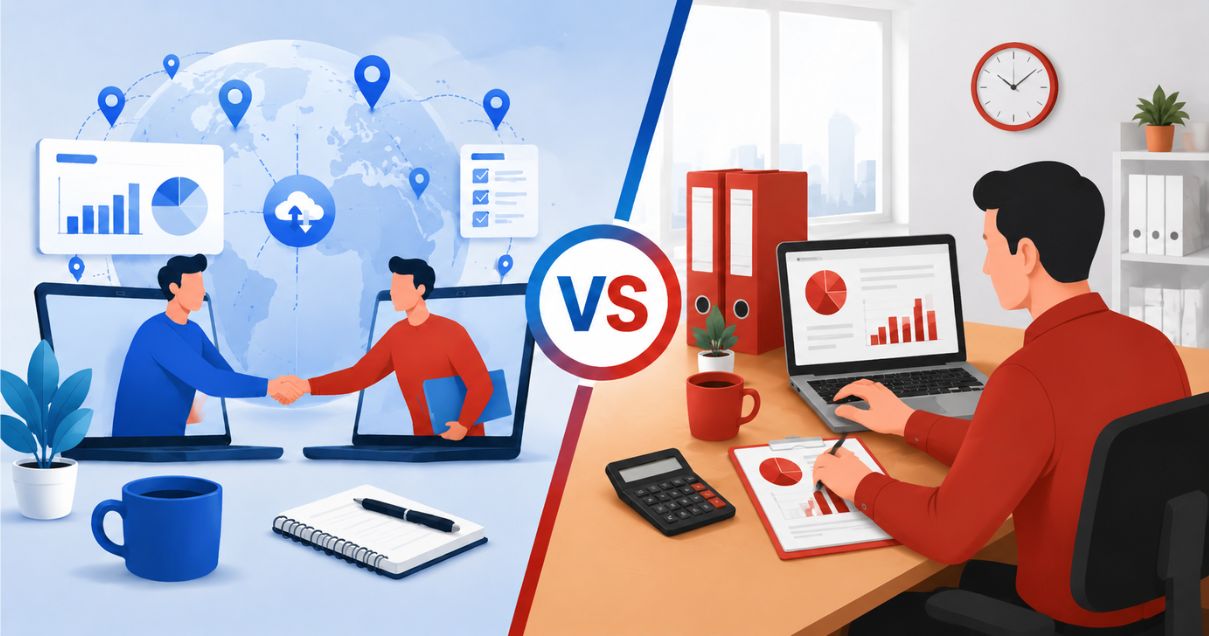
Most businesses don’t get tripped up by their products or their people. They get tripped up by the back office. The payroll that ran late. The reconciliation that nobody touched for three months. The accountant who quit and took six months of context with them. These aren’t rare horror stories. They’re common enough to make any business owner seriously rethink how they’re managing their books.
If you’re weighing offshore bookkeeping services vs in-house bookkeeping, you’re probably past the point of wondering if a change is needed. You’re asking which direction makes more sense for where your business is right now, and where you’re trying to take it. That’s a fair question, and one worth answering properly.
This isn’t going to be a generic comparison that tells you both options have pros and cons. You already know that. What you need is a clear-eyed breakdown of what each model actually costs, what it risks, and what it enables.
Offshore bookkeeping services are exactly what they sound like: a dedicated team, usually based in a country with lower labor costs, that handles your bookkeeping work remotely. But calling it just “remote bookkeeping” undersells how structured these engagements actually are.
A proper offshore provider doesn’t hand you a freelancer on a part-time arrangement. You get a team with defined processes, set turnaround time expectations, and access to qualified accountants who work within your preferred accounting software, whether that’s Xero, QuickBooks, MYOB, or something else entirely.
For businesses in New Zealand, Australia, the UK, and the US, outsourcing bookkeeping services offshore has become a real operational strategy, not just a cost-cutting move. The scale of the accounting firms and bookkeeping firms doing this today is a good indicator of how mainstream it’s become.
What gets handled? The scope usually includes accounts payable and receivable, bank reconciliations, payroll processing, GST and VAT filing support, monthly management reports, and financial reporting for compliance and decision-making. Some providers also cover budgeting support and CFO-level advisory, depending on the engagement.
Having an internal bookkeeper involves hiring someone to come on as an employee, whether part-time or full-time, who does your accounting from within your own organization. He or she works right in your office, at least exclusively for you. This person knows your system inside out because he or she works within it everyday.
This approach may be very normal for most companies, especially when they reach a particular level of success. You need someone who will be responsible for your records; someone who can attend your team meetings.
The appeal is real. An in-house bookkeeper builds institutional knowledge. They know your vendors, your recurring invoices, your quirky payroll arrangements. They can walk down the hall and ask the operations manager about a purchase order.
The cost, though, is significant. And the risk is concentrated. When your one in-house bookkeeper takes leave, or leaves entirely, the continuity problem can get expensive fast.
| Factor | Offshore Bookkeeping Services | In-House Bookkeeping |
|---|---|---|
| Staffing Model | A dedicated team with built-in redundancy. No single point of failure. | One or two people. If they're out, the work stops. |
| Cost Structure | Subscription or project-based. Scales with your actual workload. | Fixed cost regardless of volume. Salary, benefits, workspace, software, training. |
| Expertise Depth | A pool of specialists who handle complex work, like multi-currency reconciliation or GST issues, daily across multiple clients. | Limited to what one person knows. Gaps in expertise mean gaps in your books. |
| Accounting Software | Adapts to your existing stack. Xero, QuickBooks, MYOB, Sage, no platform switch required. | Works within whatever system they were trained on, which may or may not match your needs. |
| Availability | Flexible hours or overlapping time zones. Work is often ready when you start your day. | Bound by local working hours and leave calendars. |
| Data Security | Formal protocols: role-based access, encrypted transfers, audit logs, compliance frameworks. | Often informal. Shared logins, unaudited drives, laptops going home nightly. |
| Scalability | Scales up or down with a conversation. No hiring lag, no onboarding delay. | Scaling means recruiting, interviewing, onboarding, and managing more headcount. |
| Continuity Risk | Distributed across a team. One person leaving doesn't disrupt delivery. | High. If your bookkeeper leaves, so does months of institutional knowledge. |
Let’s be direct. Cost savings are the most immediate reason businesses look at offshore options, and those savings are substantial.
A mid-level bookkeeper in New Zealand, Australia, or the UK earns anywhere from $50,000 to $75,000 per year in base salary. Add employer contributions, leave entitlements, workspace, equipment, and the occasional training course, and the real cost of that hire is closer to $80,000 to $90,000 annually in some markets.
Offshore bookkeeping services priced for comparable work typically run at a fraction of that. Businesses routinely report saving 50 to 70 percent versus equivalent in-house arrangements. That’s not because quality drops. It’s because the labor cost differential between high-cost English-speaking markets and offshore locations is significant, and professional providers pass that difference on to clients.
For a small business watching every line item in their budget, those savings are meaningful. But for larger businesses too, redirecting $40,000 to $60,000 per year from bookkeeping wages toward growth activities changes what’s possible.
There are also softer cost savings. Recruitment time. Onboarding time. The productivity gap when someone leaves. Offshore arrangements eliminate almost all of that by design.
Saving money is one thing. Improving how the business actually manages its finances is another thing entirely, and honestly the more important one.
When offshore bookkeeping services are set up well, the quality of financial management inside the business goes up. Here’s why.
Offshore providers are process-driven by necessity. They operate across multiple clients and time zones, which means they can’t afford to be informal about how work flows. That discipline tends to produce cleaner books, more consistent reconciliations, and more reliable financial data than many in-house arrangements where shortcuts accumulate over years.
Better financial data means better decisions. If you’re a business owner looking at a monthly P&L you can actually trust, your ability to make forward-looking calls about investment, hiring, or pricing improves significantly.
Offshore teams also tend to be current on accounting software updates and best practices. Your Xero setup might get refined in ways your in-house person never got around to because they were too busy processing transactions to step back and look at the workflow.
Financial reporting quality often improves too. Structured reports on schedule, rather than whenever the bookkeeper gets around to it, give management teams a cadence they can plan around.
This is the objection that comes up most often, and it’s a fair one. When financial data sits outside your building and outside your direct control, security matters a lot.
The honest answer is that security in offshore bookkeeping is well-addressed by any professional provider worth working with, and in many cases more rigorously managed than typical in-house arrangements.
Consider what most in-house setups actually look like. A single login to the accounting software. A shared drive that nobody audits. A laptop that goes home every night. That’s not an accusation. It’s just reality for a lot of small and mid-sized businesses.
A professional offshore bookkeeping services provider operates under formal data security protocols. Role-based access so no one team member sees more than they need to. Encrypted data transfer. Audit logs that track every change. Some providers also comply with ISO 27001 or similar frameworks, and many have signed data processing agreements that align with GDPR or Australian Privacy Act requirements.
Data security isn’t a reason to avoid offshore arrangements. It’s a criterion for choosing the right partner. Ask for their security policy. Ask how access is managed. Ask what happens in the event of a breach. A good provider has practiced answers to all of these.
Reliability is the other side of this. Offshore firms are businesses with reputation at stake across many client relationships. A single bad outcome gets felt across the whole book of business. That’s a strong incentive to maintain standards. An in-house bookkeeper, by contrast, has only one client relationship to maintain, with varying levels of accountability depending on how closely they’re managed.
There’s a version of this benefit that sounds cliched because it gets said so often: “outsourcing lets you focus on what you do best.” It’s become a platitude. But the underlying truth is worth unpacking properly.
Every hour a business owner or senior manager spends reviewing bank statements, chasing missing receipts, or figuring out why a reconciliation doesn’t balance is an hour not spent on sales, product development, client relationships, or strategy. For most businesses, that trade-off is genuinely painful.
Outsourcing bookkeeping services offshore removes the operational weight of financial admin from the internal team entirely. The house team doesn’t have to manage a bookkeeper, cover for them when they’re out, or deal with the monthly scramble to get books ready for the accountant.
The core business gets more attention. The finance function runs in the background, reliably, without internal resources carrying it. For founder-led businesses especially, this shift in attention can have real revenue impact.
There’s also something to be said for the way offshore arrangements professionalize the finance function. When a dedicated team owns your bookkeeping, it stops being a task and starts being a managed service with accountability baked in.
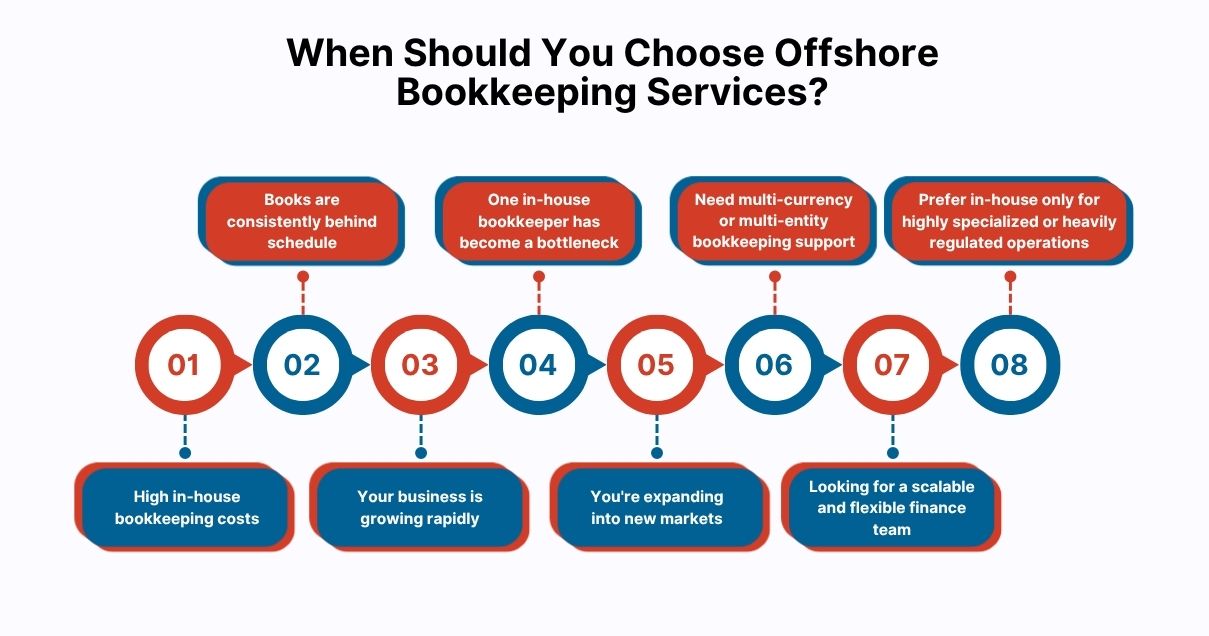
Your current bookkeeping costs are high relative to the complexity of the work. If you’re paying full-time wages for work that a structured offshore team could handle at a fraction of the cost and equal quality, the math is simple.
Your books are consistently behind. If month-end close is always late, if reconciliations drag into the next month, if management accounts aren’t available when they’re needed, that’s a process and capacity problem. Offshore solves both.
You’re scaling. Growth creates transaction volume. More invoices, more payroll complexity, more bank accounts, more entities sometimes. Scaling an in-house full time bookkeeping function means hiring, onboarding, and managing more people. Scaling an offshore arrangement means a conversation with your provider.
Your in-house bookkeeper is becoming a bottleneck. When one person owns the entire financial admin function and other parts of the business depend on outputs from that function, the concentration of work in one role creates fragility. Offshore teams distribute that risk.
You’re entering new markets. If you’re a New Zealand or Australian firm expanding into the UK or US, or vice versa, offshore providers with cross-jurisdiction experience can handle multi-currency bookkeeping and multi-entity reporting without missing a beat.
In-house still makes sense when your business has highly specialized, complex transactions that require deep institutional knowledge and constant internal collaboration. Or when regulatory requirements in your industry create constraints that are difficult to manage remotely. These are real situations, just not the majority.
Indian Muneem Chartered Accountant (IMCA) works with accounting firms and businesses across New Zealand, Australia, the UK, and the US. The model isn’t built around providing cheap labor. It’s built around delivering qualified, structured accounting services that give client firms a genuine operational advantage.
The team at IMCA works across the major accounting software platforms used in
English-speaking markets: Xero, QuickBooks, MYOB, Sage, and others. Clients don’t have to adjust their tech stack. IMCA adapts.
Engagements are managed with defined turnaround time expectations so clients always know when work will be ready. Financial reporting is delivered on schedule, not whenever capacity allows. That reliability matters, especially for accounting firms that have their own clients to serve.
Data security is treated seriously. Client data is handled under strict access protocols, with confidentiality agreements in place and secure data transfer methods used throughout.
IMCA also brings something that’s harder to quantify but genuinely valuable for firms offering offshore bookkeeping services to their own clients: the capacity to scale. When a firm grows its client base, IMCA grows with it. There’s no hiring freeze, no recruitment lag, no six-week wait to onboard a new staff member.
The goal at IMCA is to function as a seamless extension of the firms and businesses it works with, not as a vendor at arm’s length. That distinction shows up in how work is communicated, how issues are handled, and how the relationship develops over time.
The offshore bookkeeping services vs in-house bookkeeping question doesn’t have a universal answer, but for most businesses operating in today’s cost environment, the case for offshore is compelling. Significant cost savings, higher-quality financial management, stronger data security protocols, and the freedom to let the core business run without the drag of internal financial admin: those are real advantages, not theoretical ones.
In-house bookkeeping makes sense in specific situations. For most small and mid-sized businesses, and for accounting firms looking to scale their service capacity without scaling their headcount, offshore is worth a serious look.
If you’re ready to have that conversation with a team that understands the New Zealand, Australian, UK, and US markets, Indian Muneem Chartered Accountant is worth talking to.