
Offshore Bookkeeping Services vs In-House Bookkeeping: Which One Is Right for Your Business?

Table Of Contents
Toggle




Let’s be direct. Most growing businesses in the US, UK, Australia, and New Zealand are not losing money because of bad products or poor customer service. They are losing money, time, and leadership bandwidth because their bookkeeping setup was never built to scale.
You hired a bookkeeper when you had ten clients. Now you have a hundred. Your transactions have tripled. Your compliance needs have grown. And that same bookkeeper, or that same in-house setup, is now a bottleneck. Costs keep rising, errors creep in, and your accountant is spending more time fixing records than advising you on strategy.
This is the reality for thousands of small and mid-sized businesses right now. And the answer most of them land on, once they actually look at the numbers, is offshore bookkeeping services.
Not because it’s trendy. Because it works. And it works well, especially when the provider knows your country’s compliance standards and does this at scale.
That’s exactly what Indian Muneem Chartered Accountant does. We specialize in delivering offshore bookkeeping services to businesses across the US, UK, Australia, and New Zealand. In this blog, we’re going to break down every real, tangible benefit, not marketing fluff, but specifics you can take back to your next business meeting.
For those who have not used offshore bookkeeping providers, here is a brief description.
The term ‘offshore bookkeeping services’ indicates that the duties of keeping business records have been outsourced to another country, where an experienced team will handle the work. They do all the work that an internal accountant would do, from recording the transactions to making reports.
The model has matured significantly over the last decade. It’s no longer about just handing files to someone overseas and hoping for the best. Today’s offshore bookkeeping setups run on shared cloud platforms like Xero, QuickBooks Online, MYOB, and FreshBooks. Communication happens in real time. Deliverables come with deadlines. And the quality, when you’re working with a CA-led firm, tends to be higher than what most businesses get in-house.
The biggest misconception is that offshore means offshore-quality. It doesn’t. With the right provider, you get accountant-reviewed bookkeeping at bookkeeper pricing. That’s the actual value proposition.
There are a few forces driving this shift, and they’re not going away.
The first reason for offshore outsourcing is that the cost of professional labor has risen significantly in the United States, the United Kingdom, and Australia over the past three years. The cost of hiring a full-time bookkeeper in the United States alone ranges between $50,000 and $75,000 per year, excluding health insurance, vacation pay, and software subscriptions.
The second reason is that there is a scarcity of talent. It is more difficult to find a bookkeeper with extensive knowledge of GST compliance, VAT calculations, and US GAAP principles.
These three factors together have created the perfect environment for offshore bookkeeping services to grow. Businesses that once hesitated are now making the switch because the risk has dropped and the quality has gone up.
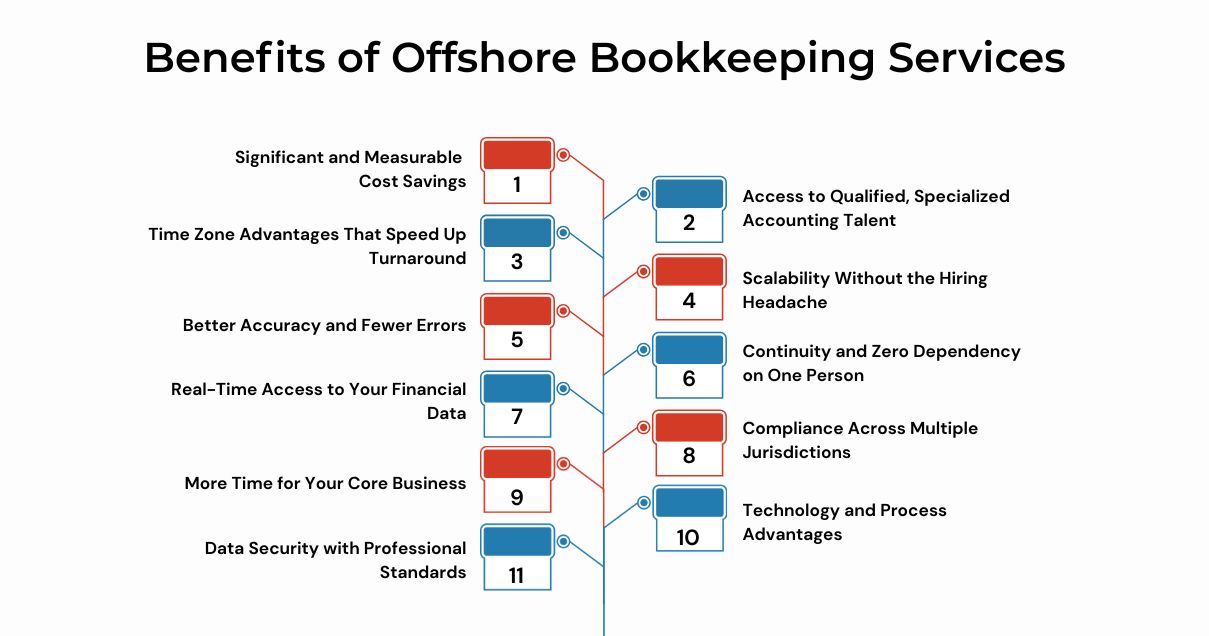
This is the one everyone talks about, and it’s legitimate. Most businesses switching to offshore bookkeeping services reduce their bookkeeping costs by 50 to 70 percent compared to maintaining in-house staff.
That’s not a vague estimate. With a bookkeeping salary and expenses totaling $60,000, the annual cost of outsourcing this role to an offshore provider could range anywhere from $12,000 to $20,000 based on the amount of work required.
The reason for such savings is due to lower personnel costs at the provider’s end, absence of any overhead expenses associated with office space and office furniture, no need to pay for insurance or other benefits, paid leaves, or training.
Most offshore bookkeeping firms worth working with are not staffed by generalist clerks. At Indian Muneem Chartered Accountant, the team includes Chartered Accountants and trained bookkeeping professionals who specialize in specific regional compliance needs.
That means you’re getting someone who understands BAS lodgment for Australian clients, Making Tax Digital (MTD) requirements for UK businesses, 1099 filing and state tax compliance for US clients, and GST returns for New Zealand businesses. This level of specialization is rare in a single local hire.
Working with a team in India when your business is in the US, UK, or Australia means you often send files at the end of your business day and find them processed by the time you start the next morning.
This is a genuine operational advantage. Your financial close process speeds up. Monthly reports are ready faster. Queries get resolved faster. For fast-growing businesses, this kind of turnaround time is hard to put a value on, but it’s very real.
Growth is exciting until it hits your back office. When your transaction volumes double, you can’t immediately hire and train a new bookkeeper. There’s a lag, and during that lag, errors pile up.
With offshore bookkeeping, scaling is straightforward. You communicate the increased volume with your provider, and the resources are allocated. No job postings, no interviews, no three-month onboarding. For businesses going through seasonal peaks, this is particularly valuable.
This might seem counterintuitive, but offshore CA-led firms often produce more accurate bookkeeping than solo in-house hires. The reason is the process and review structure.
At a dedicated offshore bookkeeping firm, your accounts don’t go through one person. There are maker-checker processes, internal reviews, and quality checks before anything is delivered. That layered approach catches errors that a single in-house bookkeeper, however capable, can miss when they’re stretched thin.
One of the most underrated risks in small business finance is key-person dependency. If your bookkeeper gets sick, leaves, or goes on extended leave, you’re exposed. Your records fall behind, your reporting gets delayed, and you scramble.
Offshore teams eliminate this risk. The provider maintains your account knowledge within a team, not with one individual. If one person is unavailable, your work continues without interruption. This continuity is a major operational benefit that doesn’t show up on a cost comparison sheet but matters enormously in practice.
Modern offshore bookkeeping works through platforms like Xero, QuickBooks Online, and MYOB. You retain full access to your data at all times. Your accountant can log in and review records. You can generate reports whenever you need them.
There’s no black box. No waiting for a monthly package from someone down the hall. Your real-time financial visibility actually improves with a well-structured offshore arrangement because the process is more systematic than most in-house setups.
For businesses operating across states, or even across countries, compliance is increasingly complex. Keeping up with changes to GST in Australia, VAT in the UK, sales tax in the US, and GST in New Zealand requires dedicated attention.
A specialized offshore provider tracks these changes and ensures your books stay compliant. You don’t have to manage training or updates internally. The burden shifts to the provider, and that’s exactly where it should be.
Every hour you spend reviewing messy bookkeeping is an hour you’re not spending on sales, product, customers, or strategy. This is a simple trade-off, but businesses tend to underestimate how much time finance admin actually consumes at the owner or CFO level.
Offshore bookkeeping lets you delegate that entirely. You review reports, you make decisions, and you move on. The operational heavy lifting is handled by a team that does it all day, every day.
Good offshore bookkeeping providers invest in technology and process infrastructure that most small businesses wouldn’t build internally. That means structured month-end close checklists, automated bank feeds, accounts receivable aging reports, and regular cash flow statements as standard deliverables.
This is a common concern and a fair one. Sharing financial data with an offshore team feels risky until you understand what serious providers actually do to protect it.
Indian Muneem Chartered Accountant operates under ISO-aligned data security practices, with NDAs and data processing agreements signed with every client. Access is role-based, data is encrypted in transit and at rest, and nothing is stored outside secured systems. The level of security is, in most cases, higher than what a solo in-house hire maintains.
If you run a CPA firm, accounting practice, or bookkeeping business, offshore bookkeeping services work differently for you. It’s not about replacing your team. It’s about expanding your capacity without adding to your payroll.
Many accounting firms use white-label offshore bookkeeping to handle the compliance work while their senior staff focus on advisory, tax planning, and client relationships. This capacity on demand model is particularly effective for firms that experience seasonal peaks around tax filing periods.
The offshore team operates as an extension of your practice. They follow your workflows, your templates, and your quality standards. Clients see seamless delivery. Your firm takes on more revenue without the overhead of proportional headcount growth.
Small businesses often feel like offshore bookkeeping isn’t for them. They assume it’s for larger companies with complex operations. That assumption costs them money.
In reality, small businesses benefit the most from offshore bookkeeping because they tend to have the most constrained resources. A startup or small business in Auckland, Melbourne, London, or Chicago can get fully managed bookkeeping for a fraction of what a full-time local hire would cost.
That means clean books from day one, proper accounts receivable tracking, timely bank reconciliations, and monthly financial statements, all without the overhead of employment. For a growing small business, getting that financial foundation right early makes a significant difference when you go to raise capital, apply for a loan, or bring on a CFO.
Let’s address a few things that hold businesses back from making this move.
Myth 1: The communication process will cause issues. In modern offshore collaborations, the use of Slack, email, and video conferencing makes for efficient communication. Communication with an offshore team proves to be much more efficient compared to that with their former in-house employees.
Myth 2: They won’t understand our local tax rules. Specialized firms like Indian Muneem CA invest heavily in understanding Australian tax law, HMRC requirements, IRS compliance, and Inland Revenue NZ rules. This is their core offering.
Myth 4: My financial data won’t be safe. With proper agreements, encrypted platforms, and access controls, offshore bookkeeping is as secure as any cloud-based service you already use.
Indian Muneem Chartered Accountant was built specifically for this. We don’t do offshore bookkeeping as a side service. It’s the core of what we do, and our team is structured entirely around delivering it to businesses in the US, UK, Australia, and New Zealand.
Here’s what sets us apart:
We also operate as a white-label partner for accounting firms, delivering bookkeeping under your firm’s brand, on your templates, to your standards.
Not all offshore providers are equal, and choosing the wrong one creates more problems than it solves. Here’s what actually matters when evaluating a provider.
Taking the time to evaluate these criteria will save you a lot of pain down the road. A good offshore bookkeeping partner should feel like an extension of your team, not a distant vendor you hope gets it right.
For business owners or managers in accounting firms based in the United States, Great Britain, Australia, or New Zealand who are unhappy with their current bookkeeping arrangements due to high costs, unreliability, or limited capacity, offshore bookkeeping deserves serious consideration.
At Indian Muneem Chartered Accountant, we give you a free consultation on the subject and provide an illustration of how a managed offshore bookkeeping engagement might look for your organization.

We use cookies and similar technologies to improve your experience, personalise content, and analyse traffic. Some are essential for access to our products and informational resources. Certain services or pages may also be governed by additional Terms of Use. Manage your preferences at any time.