
Bookkeeping for Real Estate Investors: 9 Essential Practices for Better Financial Control
Table Of Contents
Toggle
Most SMEs don’t realize they need a CFO until they’re already in trouble. A cash flow crisis hits, a funding round stalls, or the business is expanding into a second market and nobody has a clear picture of what it actually costs. By that point, getting financial oversight in place feels reactive.
Virtual CFO services change that. They’re not a new concept, but European SMEs are only recently warming up to what they actually offer: senior financial leadership without the six-figure salary commitment.
Here’s what that looks like in practice, and when it makes sense for your business.
A Virtual CFO is a senior finance professional who works with your business remotely, usually part-time or on a flexible retainer. They do what an in-house CFO does: financial planning, forecasting, cash flow management, investor reporting, strategic advice. The difference is engagement structure and cost.
The “virtual” part has nothing to do with automation. It means the work is delivered remotely and scoped around what your business actually needs, not around a full-time presence.
For many SMEs, this is the first time they’ve had access to strategic financial leadership. Most have a bookkeeper and an accountant. That covers compliance. It doesn’t cover the kind of forward-looking financial thinking that actually shapes how a business grows.
Your accountant is backward-looking by design. They close the books, file the returns, keep you compliant. That work matters. But it tells you what already happened.
A Virtual CFO works the other direction. They are focusing on the future direction of the business, the messages conveyed by the figures, and the current decisions that must be made. They develop financial models, conduct scenarios analyses, develop financial presentations for investors, and join the discussions where financial judgment really counts.
The two roles aren’t in competition. Most Virtual CFO engagements layer on top of the existing accounting function. The accountant keeps the numbers accurate; the CFO tells you what those numbers mean.
Some of these will be obvious. Others less so.
You’re making growth decisions without proper financial modeling. You’re regularly surprised by your cash position. You’re heading into a fundraising conversation without a credible financial story. You’re expanding into a new country and nobody has mapped out the financial and regulatory implications. Your finance function flags problems after they’ve already happened.
Any one of these is a real warning sign. Two or three of them together and you’ve probably needed Virtual CFO services for a while.
European SMEs deal with a specific mix of problems that single-market businesses often don’t face in the same way.
Cross-border VAT is one of the first things that catches growing businesses off guard. The rules on One Stop Shop registration, distance selling thresholds, and local fiscal requirements shift between EU member states, and they change. Without proper oversight, surprise VAT liabilities are common.
Currency exposure is another. A business invoicing in euros, paying suppliers in pounds, and reporting in dollars is running FX risk without necessarily knowing it. For SMEs without a hedging strategy, this erodes margin quietly.
Payment terms vary a lot across Europe too. French and Italian customers often pay in 60 to 90 days. If you’re paying your own suppliers in 30, you’re financing that gap out of your own pocket. The working capital cycle matters more than most owners realize until cash gets tight.
Then there’s the complexity of operating across multiple jurisdictions. Payroll compliance, entity structure, transfer pricing considerations, all of it adds up. These are solvable problems, but only if someone with the right expertise is actually looking at them.
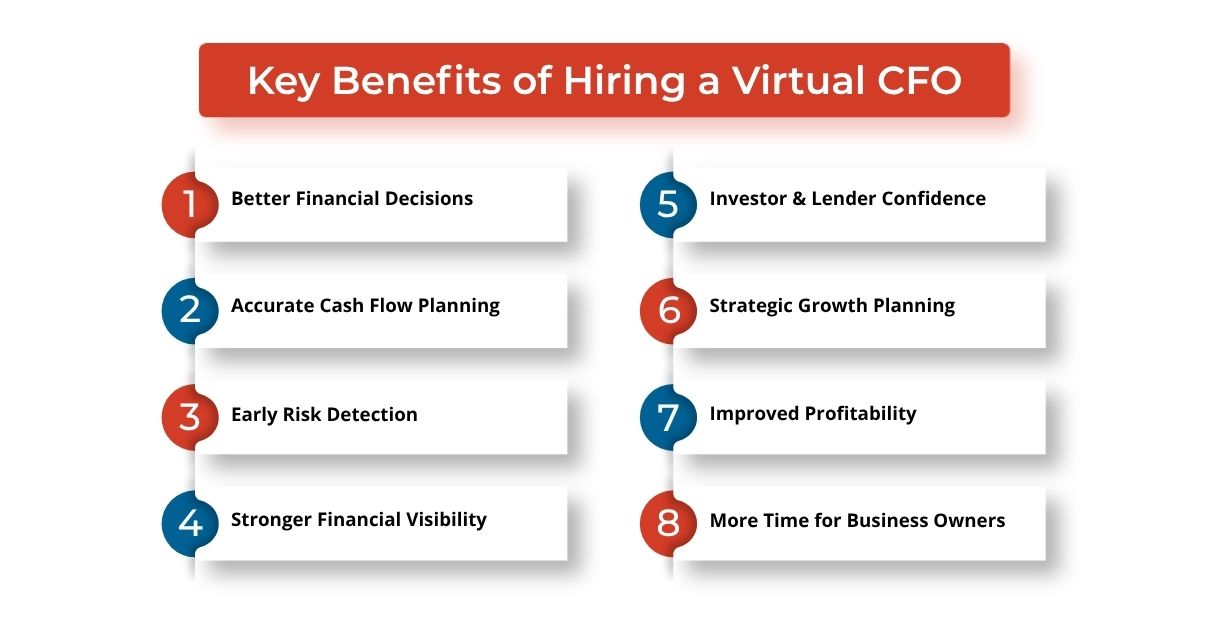
The practical value breaks down into a few clear areas.
Better decisions. When someone can build a three-way financial model (P&L, cash flow, balance sheet) quickly and test your assumptions against it, you stop making expensive guesses. Pricing changes, hiring decisions, expansion timing, all of these get better when they’re grounded in real numbers.
Early problem detection. A Virtual CFO running regular reviews will flag issues before they become urgent. A customer concentration that’s getting risky. A payroll line growing faster than revenue. A working capital gap that’s four weeks from surfacing. Prevention is almost always cheaper than the response.
Credibility with investors and lenders. Having a qualified finance professional behind your numbers changes how those conversations go. Investors pick up quickly on whether a business is being run with financial discipline.
Bandwidth back to the founder. Finance is one of those areas where founders without a financial background spend a lot of time without getting it fully right. Getting the right person on it returns hours to the parts of the business where the founder actually belongs.
A working financial model is probably the most important deliverable a Virtual CFO produces. Not a one-off spreadsheet built for a bank application, but a live model that the business uses to run itself.
Good financial forecasting means 12-month and 3-year projections built around your actual revenue model, cost structure, and hiring plan. It means running scenarios. What does the cash position look like if your biggest customer churns? What’s the minimum revenue needed to stay solvent through a slow quarter? What happens to margin if you add a sales hire six months earlier than planned?
These aren’t theoretical. Founders who go through this process regularly make better calls. They know their numbers. They’re not caught off guard.
Profitable businesses go under because of cash flow problems. It happens more than people talk about.
A Virtual CFO puts infrastructure around this. The standard tool is a 13-week rolling cash flow forecast: a short-term, week-by-week view of what’s coming in and going out. It’s not sophisticated. It’s just the thing that tells you four weeks in advance that you’re going to have a problem, which is enough time to act.
Beyond forecasting, they look at the structural drivers. Are your customer payment terms longer than your supplier terms? Are you invoicing promptly? Is there a credit control process that actually runs, or does chasing receivables fall through the cracks? Are you using tools like invoice discounting that could improve liquidity without adding to long-term debt?
A budget that gets updated once a year and lives in a spreadsheet nobody opens is not a management tool. Businesses that use budgeting well treat it as something the team actually works against month to month.
A Virtual CFO builds a budget tied to the business’s real strategy, with financial KPIs that reflect the actual drivers: gross margin by product line, revenue per head, customer acquisition cost, churn, EBITDA margin. The right metrics depend on the model. Getting them wrong just creates noise.
Monthly management accounts that compare actuals to budget, with commentary on variances, are the output that ties this together. That’s the mechanism for catching things early and having informed conversations about performance.
A full-time CFO makes sense when the complexity genuinely demands daily attention: revenue above £20m to £30m, multiple entities, active M&A, a finance team that needs senior leadership. At that stage, you probably already know you need a permanent hire.
For most European SMEs, that’s not the situation. They need CFO-level thinking without the full-time commitment. A senior CFO in the UK runs £120,000 to £200,000 in base salary, before employer contributions, benefits, and recruitment. A Virtual CFO engagement typically costs £2,000 to £8,000 per month depending on scope.
Start with a Virtual CFO. Revisit when the complexity genuinely outgrows what a part-time engagement can handle.
Outsourced Virtual CFO services have improved a lot. Ten years ago this was mostly a cost conversation. Now it’s a value conversation, because the quality of outsourced finance professionals at the CFO level has caught up.
Working with a provider based in India, for example, you’re typically engaging with professionals qualified to international standards (ICAI, ACCA, CIMA) who have real experience with UK and European clients. The work involved in a Virtual CFO engagement, modeling, forecasting, management accounts, board packs, is all deliverable remotely. Physical presence isn’t required.
For a European SME, this can mean a cost reduction of 40% to 60% compared to a UK or EU-based engagement. That’s often the factor that makes the arrangement financially sensible at a stage where revenue doesn’t yet support a premium local hire.
The shift toward outsourced finance functions isn’t just about cutting costs. It’s about getting access to a broader range of capability than a single hire provides.
A structured outsourced arrangement brings together bookkeeping, management accounting, tax compliance, and strategic CFO oversight in one coordinated setup. As the business grows, capacity scales. More transactions means more bookkeeping support. A fundraising round means deeper CFO involvement. When it’s done, it scales back. That kind of flexibility is hard to replicate with headcount.
There’s also the management burden to consider. Hiring finance staff means recruiting, covering for turnover, managing performance. Outsourcing moves that problem to the provider.
Indian Muneem Chartered Accountant works with SMEs across the UK and Europe, providing Virtual CFO services structured around what businesses at the growth stage actually need.
Engagements start with understanding the business: revenue model, existing finance setup, the decisions being made and the gaps in financial visibility. Scope is built from that, not from a generic package.
The typical deliverables include monthly management accounting reports with analysis, rolling cash flow forecasts, annual budgeting, KPI tracking, and investor or board reports. Where an organization faces international complexities, the IMCA team will deal with multi-entity consolidation along with local experts from various jurisdictions.
The team is composed of qualified chartered accountants with international experience. Engagements sit alongside your existing accountant or bookkeeper rather than replacing them. IMCA adds the strategic layer that most growing businesses are missing.
If your business is past the point where your current finance setup is keeping up, and you’re not yet at the size where a full-time hire is the right answer, it’s worth a conversation.

We use cookies and similar technologies to improve your experience, personalise content, analyse website traffic, and understand how visitors interact with our website. Some technologies may help us identify businesses visiting our website and improve our marketing and services. Some cookies are essential for website functionality.