October 15 Tax Deadline: How CPA Firms Can Manage Tax Season Workloads Without the Last-Minute Rush
Table Of Contents
Toggle

Most farm operators are exceptional at growing things. But managing the books? That is a different story. Between seasonal income swings, multiple enterprises, government payments, and tax obligations that look nothing like a regular small business, farming creates a financial picture that standard accounting tools were simply not built to handle. Farm accounting software fixes that problem, and if you have not yet made the switch from spreadsheets or generic bookkeeping tools, this guide will show you exactly why that decision is costing you more than you realize.
This is not a beginner’s intro to accounting. If you are running a real farming operation in New Zealand, Australia, the US, or the UK and you want to know which tools are actually worth your time and money, keep reading.
A lot of farm operators try to make QuickBooks or Xero work for them and then wonder why their books feel like a constant workaround. General accounting software is designed around a simple business model: you sell something, you get paid, you track expenses. Farming does not work like that.
You have multiple profit centers running at once. Your beef cattle operation, your wheat paddocks, and your contract spraying work all sit under the same ABN or NZBN, but they have completely separate cost structures, revenue timelines, and risk profiles. You need to see each one clearly, not just a blended farm P&L that tells you very little about what is actually working.
Then there is the tax side. In New Zealand, primary producers have specific GST concessions and livestock valuation methods (national standard cost, herd scheme, or cost price) that need to be handled correctly. In Australia, there are primary production tax concessions and income averaging provisions that affect how you report. In the US, Schedule F is its own world entirely. Generic software does not know any of this exists.
The right agricultural accounting software does not just store your numbers. It presents them in a way that matches how your business actually runs, makes tax time straightforward, and gives your bank manager or farm consultant something they can actually read and trust.
Agricultural Accounting Software is a tailor-made finance and accounting application designed specifically for agricultural operations. As opposed to generic accounting software, it takes into consideration the true nature of the business: enterprise accounting of crops/livestock, cash flow calculations according to seasons, expense accounting, depreciation of farm equipment, as well as tax forms unique to agriculture.
The core job is the same as any accounting system. Record income. Record expenses. Reconcile your bank. Produce reports. But everything about how it categorizes, structures, and reports that information is built for farming, not for a café or a plumbing business.
Good accounting software for farmers also handles things like livestock trading accounts (which reconcile openings, purchases, births, deaths, and sales into a single account), on-farm inventory valuation, government subsidy or grant income, and agri-specific payroll for seasonal and casual workers whose hours and tax codes are anything but straightforward.
When you are comparing platforms, these are the features that separate genuinely useful farm tools from ones that will frustrate you within a season:
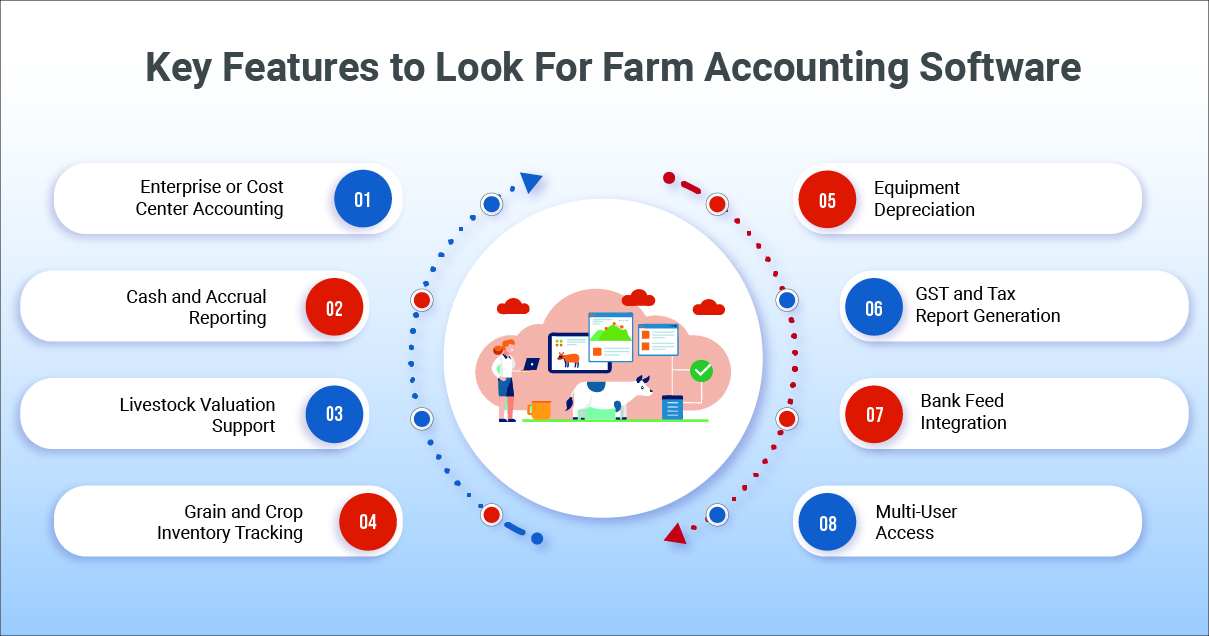
This is non-negotiable.. You need to separate your financials by enterprise, whether that is by crop type, block, herd, or product line. If you cannot see your sheep operation independently from your cropping income, your financial reports are decorative.
Many farmers file taxes on a cash basis but want to manage the business on an accrual. The best platforms support both without requiring separate books.
For New Zealand and Australian operators, especially, your software needs to handle the valuation method you use correctly. Whether you are on the herd scheme or the national standard cost, errors here flow straight through to your tax return.
On-farm commodity storage creates an inventory asset that needs to be reflected in your balance sheet. Most general software has no framework for this.
Tractors, planters, center pivots, post drivers. Your farm machinery depreciation schedule needs to be maintained accurately for tax purposes. Look for software that handles both diminishing value and straight-line methods.
In New Zealand, this means clean GST returns that correctly classify farm income and expenses, including the treatment of private use portions on vehicles and fuel. In Australia, it is BAS preparation. In the US, it is Schedule F. Make sure the software you choose actually produces these reports in the right format.
Automatic reconciliation is not a luxury. It is the difference between books that stay current and books that become a project every quarter.
If your farm accountant or bookkeeper needs to access your records, cloud-based platforms with proper user permissions make this seamless.
Created specifically for agriculture. Some examples include FarmBooks, PCMars, and Ultra Farm. Their level of features for agriculture-related needs cannot be equaled; however, there are some programs in this group that come with outdated-looking interfaces.
Xero and QuickBooks with farm-specific chart of accounts templates or third-party integrations. More modern interfaces, broader support networks, but shallower farm functionality unless paired with a specialist add-on.
These go beyond accounting into field records, agronomic history, equipment tracking, and sometimes precision agriculture data. Platforms like Figured (when connected to Xero) and AgriWebb sit in this space. These are particularly strong in the New Zealand and Australian market.
Cloud tools give your accountant live access, work across multiple devices, and do not require backups. Desktop tools like PCMars are preferred by operators with limited rural connectivity or those who want full control over their data locally. Both have legitimate use cases depending on your situation.
Figured (New Zealand and Australia): If you are farming in New Zealand, Figured deserves serious attention. It connects directly to Xero and is built around the way New Zealand and Australian farm accountants actually work. It handles livestock trading accounts, GST for primary producers, whole-farm budgeting, and produces reports that banks and rural consultants recognise immediately. It is widely used by sheep, beef, and dairy operations across both countries, and the NZ-specific tax handling is genuinely strong.
AgriMaster (Australia): AgriMaster is well-established in Australian agriculture. It handles whole farm budgeting, BAS and GST reporting for primary producers, and livestock trading accounts. It is used by a large number of Australian farm accountants, which means if you switch to it, your adviser is likely already familiar with how it works.
FarmBooks (US): FarmBooks accounting software is a straightforward, affordable desktop application for US farm operators. It handles Schedule F reporting, enterprise accounting, and farm loan tracking competently. It is not the most visually modern tool, but it is reliable, purpose-built, and priced accessibly for small to medium operations.
PCMars (US): PCMars farm accounting software has been used by US grain and livestock operators for decades. It is particularly strong on cash flow projection, handles multiple enterprises cleanly, and has a loyal user base in the Midwest. The interface is dated, but the functionality is deep. For operators who want serious farm-specific capability at a low cost, it holds up well.
Ultra Farm (US): Ultra Farm accounting software goes further than pure bookkeeping. It combines financial accounts with land records, crop history, and equipment maintenance tracking in one platform. It suits operations that want a single system for both financial and operational records rather than maintaining separate tools.
QuickBooks or Xero with Farm Chart of Accounts (NZ, AU, US, UK): For operators who want a modern interface and broad accountant support, pairing a mainstream tool with a well-structured farm chart of accounts and a specialist add-on can work. The trade-off is that the farm-specific reporting requires more manual configuration and may not handle livestock valuations or country-specific tax concessions as cleanly as a dedicated tool.
Be honest about four things before you decide: your country’s tax requirements, your operation’s complexity, your technical comfort level, and whether your accountant can work with the platform.
The country question comes first because it eliminates a lot of options immediately. A US-built tool will not be set up for New Zealand GST or the herd scheme. An Australian tool will not produce Schedule F. Start with what is built for your jurisdiction.
Then look at complexity. A single-enterprise sheep farm with one bank account and straightforward GST has different needs from a diversified operation running beef cattle, dairy grazing, and a cropping block with multiple bank accounts and seasonal employees.
Ask your accountant or farm consultant what they use and prefer before you commit. If they work in Figured every day, and you set yourself up in AgriMaster, someone is doing double handling. Their familiarity with the platform has real value for you at year end.
Finally, use the trial period. Every platform worth considering offers one. Load your actual data, run through your most recent quarter, and see how it feels. A tool that looks great in a demo can feel clunky in daily use with real farm transactions.
Choosing based on price alone: The cheapest option often costs more over time through hours lost to workarounds, reporting gaps, and accountant fees for manual adjustments.
Not checking tax compliance upfront: Some software handles bookkeeping fine, but produces reports that do not match what your accountant needs. Confirm the specific reports it generates before you buy.
Skipping the trial: There is no substitute for running your own data through the system before committing.
Ignoring data migration: Switching systems mid-season or without a clear plan to bring historical data across is a real risk. Losing prior-year comparatives is more disruptive than most people expect.
Picking a tool your accountant cannot support: This one creates friction every single year at tax time.
The practical case is straightforward. When your books are structured correctly throughout the year, tax preparation becomes a reporting job rather than a reconstruction exercise. That alone saves most operators significant accounting fees.
Beyond tax, the visibility you get into enterprise profitability changes how you make decisions. When you can see that your dairy grazing enterprise is consistently outperforming your cropping block on a per-hectare return, that is a strategic insight, not just a number.
Clean, detailed financials also strengthen your position with lenders. Rural finance providers in New Zealand, Australia, and the US all want to see well-maintained farm accounts. A clear set of books produced through recognized software carries more weight than a summary spreadsheet.
Farm cash flow management is another area where the right tool earns its cost. Income arrives in seasonal lumps. Expenses run all year. Seeing that clearly, with projections, lets you plan debt servicing, input purchasing, and capital expenditure with confidence rather than guesswork.
Sheep and Beef Operations (NZ, AU, UK): You need strong livestock trading account support and a correct livestock valuation method handling. Figured and AgriMaster are built for exactly this. In the UK, a Xero setup with a specialist farm chart of accounts.
Dairy Farms: Dairy has unique revenue structures, regular milk solids payments, and significant scale. Figured is particularly well-suited to New Zealand dairy, and its integration with Xero gives you flexibility as the operation grows.
Grain and Arable Farms: Strong commodity inventory tracking and enterprise accounting by paddock or crop matter most here. PCMars and FarmBooks are respected in the US for arable operations. In NZ and AU, AgriMaster handles this well.
Mixed or Diversified Farms: Multi-enterprise support with clean reporting by profit center is the priority. Both Figured and Ultra Farm handle this, though for different markets.
Small or Hobby Farms: Cost and simplicity matter most. FarmBooks and the entry-level PCMars tier are more than adequate. For NZ small operators, a basic Xero subscription with a farm template is a reasonable starting point.
Pricing varies widely across the market.
At the lower end, PCMars and FarmBooks are available for under $500 NZD or USD annually, making them accessible for smaller operations. Mid-range tools like AgriMaster and standard Figured subscriptions run from roughly $600 to $1,500 NZD per year, depending on the plan and number of enterprises. Integrated or enterprise-level platforms can run significantly higher, particularly when you add seats for staff and accountants.
In nearly every case, the software cost is small relative to the accountant fees it saves, the errors it prevents, and the decisions it informs. When you use professional farm accounting services, the value increases significantly. Treat it as an operational input, not an overhead to minimize.
The right farm accounting software is not the most expensive option or the most popular one. It is the one that fits your operation type, your country’s tax rules, and how you and your accountant actually work. For New Zealand operators, Figured is hard to look past. For Australian farms, AgriMaster has deep market penetration and strong accounting familiarity. For US operators, PCMars and FarmBooks have earned their reputations over decades of real-world farm use.
Whatever you choose, the key is that your books stay current, your reports mean something, and your tax obligations are handled correctly from day one. That is what the right tool makes possible.
It depends on your location and operation type. For New Zealand and Australian farmers, Figured and AgriMaster are the most widely used and respected options. For US operations, PCMars and FarmBooks are strong choices. The best software is the one that handles your country's specific tax reporting and fits how your accountant works.
There are limited free options. Wave Accounting is a free general bookkeeping tool that some small farms use, but it has no farm-specific functionality. Most dedicated farm platforms require a paid subscription. For operations with meaningful revenue, the cost of a proper tool is almost always justified.
Wave Accounting is the most capable free option, though it is not purpose-built for farming. If your operation is simple enough that general bookkeeping covers your needs, it can serve as a starting point. Once you have enterprises, livestock, or complex tax obligations, you will outgrow a free general tool quickly.
FarmBooks is generally considered one of the more accessible dedicated farm tools. For those already comfortable with mainstream software, a Xero setup with a farm chart of accounts template is another manageable starting point. Figured also has a relatively gentle learning curve for NZ and Australian farmers, especially when set up with accountant support.
For small farm operations, FarmBooks and PCMars offer the best combination of farm-specific functionality and affordability in the US. In New Zealand and Australia, an entry-level Figured subscription or a basic Xero plan with a farm template works well for smaller operations. The key is ensuring the tool handles your country's tax requirements correctly, even at the small end.
PCMars is a long-established US desktop accounting program built specifically for farm operators. It is well-regarded for its cash flow projection tools, multi-enterprise support, and affordability. It has been used by Corn Belt and Midwest grain and livestock operators for decades, and while the interface is dated, the functional depth for farm-specific accounting is strong.
FarmBooks is a US-based, dedicated farm accounting program designed to be usable by farm operators without a professional accounting background. It handles Schedule F tax preparation, enterprise tracking, and basic asset management. It is a reliable, cost-effective choice for small to medium-sized US farm operations that want purpose-built software without a steep learning curve.
Ultra Farm accounting software is a more comprehensive platform that combines financial accounts with operational records management. It tracks land records, crop history, and equipment maintenance tracking alongside standard accounting functions. It suits operations that want a single platform for both financial and operational farm data rather than running separate systems.
The most important features are enterprise or profit-center accounting, correct tax report generation for your country (GST for NZ and AU, Schedule F for the US), support for both cash and accrual basis, livestock valuation handling, on-farm inventory management, equipment depreciation tracking, bank feed integration, and payroll support for seasonal workers. Cloud access and multi-user permissions matter if your accountant needs live access to your books.
Indeed, and this is one of the major reasons why you should use accounting software designed specifically for the farming industry instead of a generic program. Such software provides you with the required reports for your accountants, such as accurately formatted GST for agricultural business in New Zealand and Australia, cattle accounts, US Schedule F, and correctly categorized income and expenses during the year. Keeping good records throughout the year will ensure that your tax preparation goes quickly and without any mistakes or omissions on your part.
We use cookies and similar technologies to improve your experience, personalise content, analyse website traffic, and understand how visitors interact with our website. Some technologies may help us identify businesses visiting our website and improve our marketing and services. Some cookies are essential for website functionality.