
Bookkeeping for Real Estate Investors: 9 Essential Practices for Better Financial Control
Table Of Contents
Toggle
Audit workloads are up. Qualified staff are harder to find. Regulatory expectations keep climbing. And your senior people are still spending hours on working paper prep that a well-trained outsourced team could handle at a fraction of the cost.
That is the reality most accounting firms in the US, UK, Australia, and New Zealand are dealing with right now. It is exactly why professional audit support services have become a core part of how smart practices operate.
Professional audit support services cover the behind-the-scenes work that keeps an audit moving: documentation, working papers, reconciliations, lead schedules, and disclosure checklists. The work is technical and time-consuming, but it does not always require a senior CPA in your office.
Professional Audit Support Services are the technical support functions that take an audit engagement from start to finish, covering everything before and after the senior auditor applies professional judgment.
This encompasses preparing working papers, compiling financial statements, documenting audit plans, preparing lead schedules, conducting analytical tests, substantiating testing, using disclosure checklists, and SMSF audit assistance for Australia-based firms.
The aim is to have clean, properly organized audit files that will reduce review time and satisfy your regulator’s documentation requirements.
There is a version of this conversation that firms have been having for years, and there is the version that is happening in 2025 and 2026. The difference is urgency.
The audit profession across the US, UK, Australia, and New Zealand is dealing with a staffing problem that is not going away on its own. Accounting graduates are choosing advisory, consulting, and finance roles at higher rates than they were a decade ago. The firms that used to rely on a steady stream of junior hires to build out their audit capacity are finding that pipeline thinner and more competitive than it has ever been.
At the same time, regulatory expectations are moving in the opposite direction. The PCAOB in the US, the FRC in the UK, ASIC in Australia, and the XRB in New Zealand have all pushed for higher documentation standards, more rigorous quality evidence, and tighter controls around audit file management. Each round of updated standards adds more required steps, more required documentation, and more required review evidence per engagement. The workload per file is going up, not down.
So the firms that are managing this well are not the ones waiting for the staffing market to improve or for standards to ease up. They are the ones that have built a support structure around their senior team that allows them to handle more volume without asking those senior people to absorb more hours. Professional audit support services are the most direct way to build that structure.
Beyond the capacity argument, the cost case is strong and getting stronger. A full-time audit support hire in Chicago, London, Sydney, or Auckland runs well over six figures when you factor in base salary, payroll taxes, benefits, recruitment costs, and the time spent onboarding. And that person has a fixed cost whether your workload is at peak or not.
Outsourced professional audit support services flip that model. The cost per hour is significantly lower, typically 40 to 60 percent less than equivalent in-house staffing. The capacity scales up when you need more and back down when you do not. And the work is done by qualified accountants who have been trained specifically for this kind of engagement support, not by whoever happened to be available.
For Australian firms, SMSF audit support is in a category of its own. With many practices handling dozens or hundreds of self-managed super fund audits per year, a structured outsourced workflow for file preparation is one of the highest-return uses of audit support available.
Not every outsourced provider offering audit support is actually set up to do it properly. The difference between a provider that understands audit work and one that is just processing documents shows up quickly in the quality of what comes back. Here is what separates the real options from the noise.
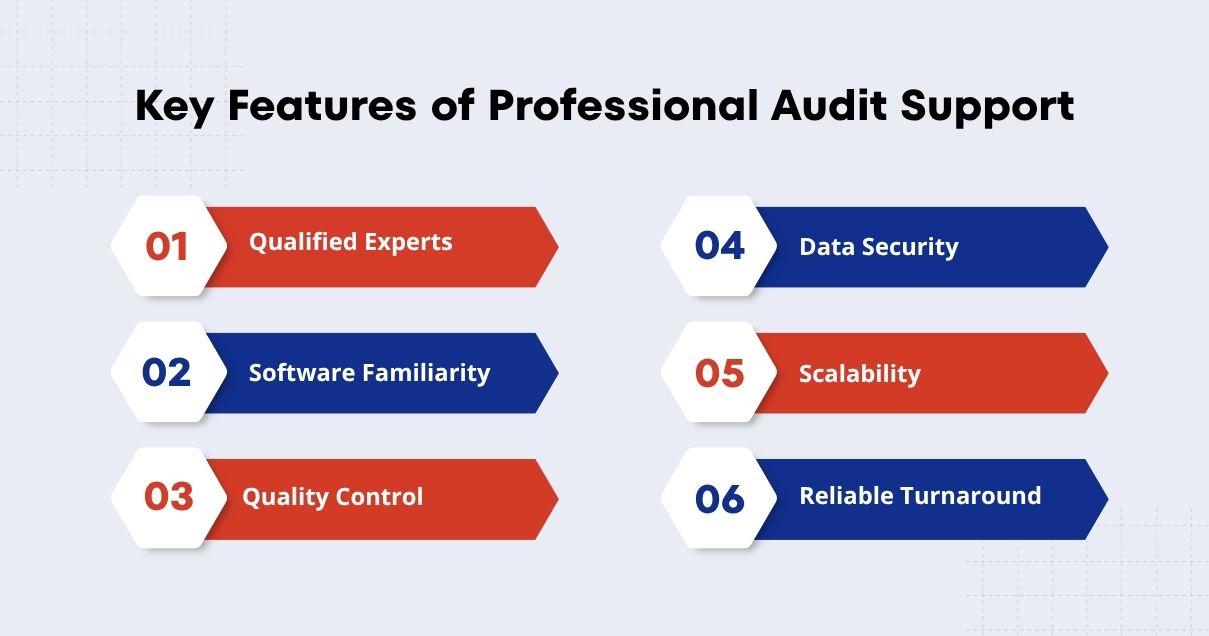
Qualified professionals doing the core work: The people preparing your files should hold accounting credentials and have real audit experience. CPAs, CAs, or equivalent qualified accountants should be doing the substantive preparation work, not data entry operators following a script. When you are evaluating a provider, ask specifically who will be on your files and what their background includes.
Real familiarity with the software you use: Whether your firm runs CaseWare Working Papers, HandiSoft, MYOB AE, Xero Practice Manager, Silverfin, or any other audit and practice management platform, the outsourced team should be able to work directly in your environment. You should not have to change your workflow, create new templates, or run a parallel system to accommodate them. If a provider asks you to do that, it is a sign they have not done this before with firms like yours.
Quality control procedure in place: All files need to have a standard internal review process prior to returning it to you. In other words, it will be reviewed by one of the senior reviewers at the remote office in terms of the requirements set out in the briefing document, file format, and appropriate standards. You can always ask any potential vendor for details about this review process, which would help determine whether or not such procedures are in place.
Data security that meets professional standards: You are dealing with client financial data. The provider you work with needs to have ISO 27001 certification or an equivalent standard in place, NDAs as a standard part of the engagement setup, secure file transfer protocols rather than unencrypted email attachments, and a documented policy on who within their organization has access to client data. This is not a nice-to-have. It is the baseline for working with any professional firm.
Scalability you can actually rely on: Audit season is real and it is intense. The right partner can increase capacity to match your peak demand without you having to manage the staffing side of that. Get specific about what capacity they can commit to during your busiest months before you start the relationship, not during it.
Communication and turnaround standards that hold: You need to know when work will come back. A 48-hour turnaround commitment is only useful if it is actually met consistently. Ask about their track record on turnaround and ask for references from existing clients in your market who can speak to the day-to-day reliability.
Bringing it all together, here is what outsourcing professional audit support services actually delivers:
Cost savings are the most obvious starting point. Outsourced professional audit support services typically run at 40 to 60 percent of the fully loaded cost of equivalent in-house capacity. That gap matters especially for firms managing tight margins or competing on price in a market where clients push back on fee increases.
Recaptured senior time is probably the most undervalued benefit in practice. When your partners and senior managers are not spending hours reviewing preparation errors or doing work that should have been done before the file reached them, that time goes somewhere more productive. Client relationships, advisory conversations, new business development, or simply a more sustainable workload during busy season.
Consistent output quality across your audit files, because every file follows the same preparation process rather than varying based on which junior prepared it and on what kind of week they were having.
Capacity flexibility that is hard to replicate with a fixed in-house team. You can scale up for a heavy quarter and scale back when the workload drops, without the cost and complexity of hiring decisions in either direction.
Access to specialist capability in areas that are niche enough that building in-house expertise is not practical. SMSF audit support is the clearest example for Australian firms. Not-for-profit financial reporting is another. Having access to a support team that works in these areas regularly and stays current with the specific requirements is worth more than the hourly cost difference.
A stronger competitive position. When you can take on more work, deliver faster, and maintain quality at a cost structure that keeps your fees competitive, you are in a genuinely better position than firms that are constrained by in-house capacity and carrying the full cost of it.
Getting strong results from an outsourced audit support arrangement is not complicated, but it does require a few deliberate habits that firms sometimes skip when they are in a hurry to get started.
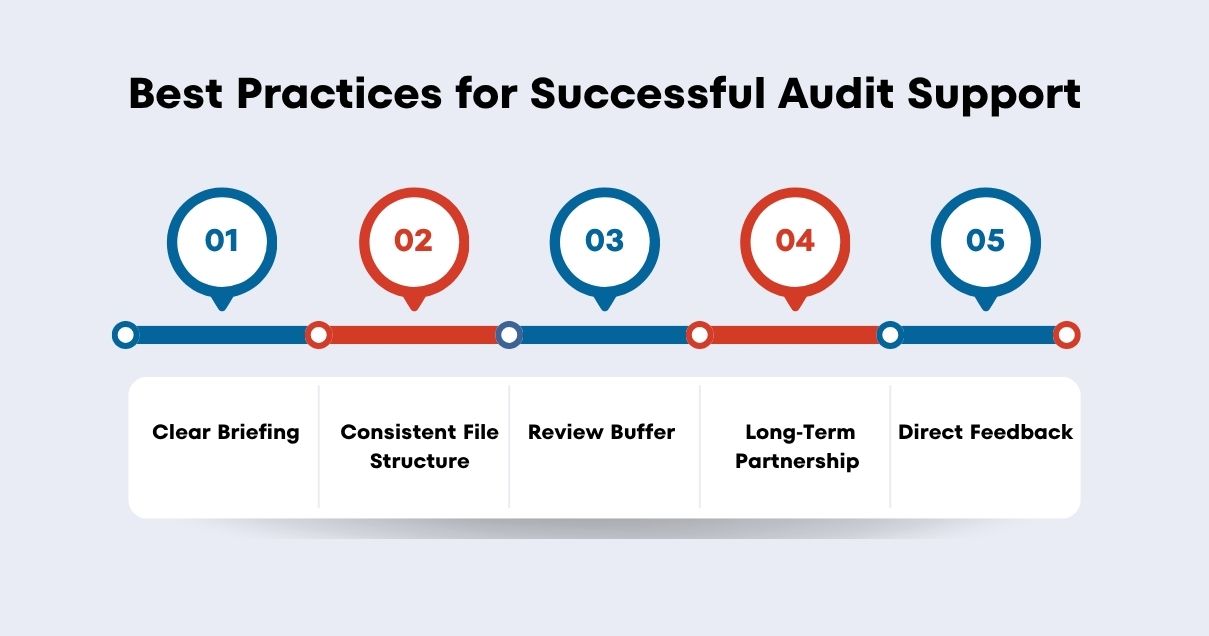
Brief clearly and specifically at the start of every engagement: The quality of what comes back is directly proportional to the quality of the brief you send. A good briefing template covers the engagement scope, the client background relevant to the audit, the file structure you want, specific requirements or quirks for that client, timelines, and who the reviewer will be on your end. The time spent on a clear brief at the start saves more time during and after the engagement.
Use a consistent file structure and template set: If your outsourced team is working within a familiar, well-organized structure from the first engagement, both turnaround time and review quality improve. If every engagement comes with a different structure, the team spends time figuring out the organization rather than preparing the content.
Build a review buffer into your engagement timeline: The most common mistake firms make when they start outsourcing is scheduling the outsourced work with zero margin between when it is due back and when the file needs to be signed off. Build in time to review what comes back, request any changes, and review the final version before it goes to sign-off. This is not a reflection on the quality of the outsourced work. It is just good engagement management.
Treat the relationship as long-term, not transactional: The value of an outsourced audit support arrangement grows over time. The more context the outsourced team builds about your practice, your preferred approaches, your client base, and your review preferences, the less briefing overhead there is on each new engagement and the better the first-draft quality becomes. Firms that cycle through providers frequently or that treat each engagement as a one-off transaction miss out on that compounding improvement.
Give direct, specific feedback: If a file comes back with something that is not right, say exactly what it is and what you expected instead. General feedback like “the quality needs to improve” does not help. Specific feedback like “the lead schedule for trade receivables did not cross-reference the aging analysis correctly, here is what I needed” gets acted on and improves the next file in a concrete way.
AI-assisted audit tools are already being integrated into workflows for document extraction, transaction matching, and population analysis. Firms using outsourced support well are gaining these efficiency benefits through their partners without having to build the technical capability in-house.
Regulatory pressure is not easing. The PCAOB, FRC, ASIC, and XRB are all moving toward higher documentation standards. More required documentation per file means the business case for audit support services strengthens each year.
The talent gap is structural. The pipeline of qualified audit professionals in most Western markets is shrinking relative to demand. Outsourced support is not a short-term workaround. It is a long-term part of how sustainable audit practices will be staffed.
Audit work is not getting lighter or simpler. Documentation requirements are more demanding, volume is growing, and the cost of quality in-house staff keeps rising. Professional audit support services give accounting firms a practical, proven way to keep pace without overloading their team or pricing themselves out of the market.
The question is not whether professional audit support services make sense for your firm. For most growing practices, the math is clear. The question is whether you make the move on your own timeline or wait until the pressure forces the decision. IMCA is here when you are ready.
The technical and documentation-based tasks that support an audit engagement: working paper preparation, financial statement analysis, lead schedules, substantive testing support, compliance documentation, and disclosure checklists, carried out by qualified accounting professionals.
Cost, capacity, and consistency. You get qualified audit support at significantly lower cost than in-house hiring, flexibility to scale during busy periods, and more consistent output through structured processes and defined review steps.
Accounting firms of all sizes that perform audit work, including mid-sized practices, boutique audit firms, and larger firms managing cost and capacity. Australian firms with high SMSF audit volumes find outsourced support especially valuable.
By shifting structured, process-driven tasks to a dedicated team, senior staff spend less time on preparation and more time on judgment-based review. Turnaround improves, review cycles decrease, and capacity increases.
Yes, with a reputable provider. Look for ISO 27001 certification or equivalent, standard NDAs, secure file transfer protocols, and documented data access policies in place from day one.
External auditors (financial statement compliance), internal auditors (internal controls and processes), government auditors (public sector entities), and forensic auditors (financial fraud investigation).
Financial statement audits, compliance audits, operational audits, and forensic audits.
Businesses do not typically engage these services directly. Accounting firms use them to manage audit workload and documentation demands. The downstream benefit to the business is a more timely, better-documented audit.
No. Firms of all sizes use audit support services. For smaller practices, outsourced support provides scalable capacity without the cost of full-time specialist staff.
Audit planning documentation, working paper preparation, lead schedules, financial statement analysis, substantive testing support, analytical procedures, disclosure checklists, compliance verification, SMSF audit file preparation, and general file management.

We use cookies and similar technologies to improve your experience, personalise content, analyse website traffic, and understand how visitors interact with our website. Some technologies may help us identify businesses visiting our website and improve our marketing and services. Some cookies are essential for website functionality.