
Bookkeeping for Real Estate Investors: 9 Essential Practices for Better Financial Control
Table Of Contents
Toggle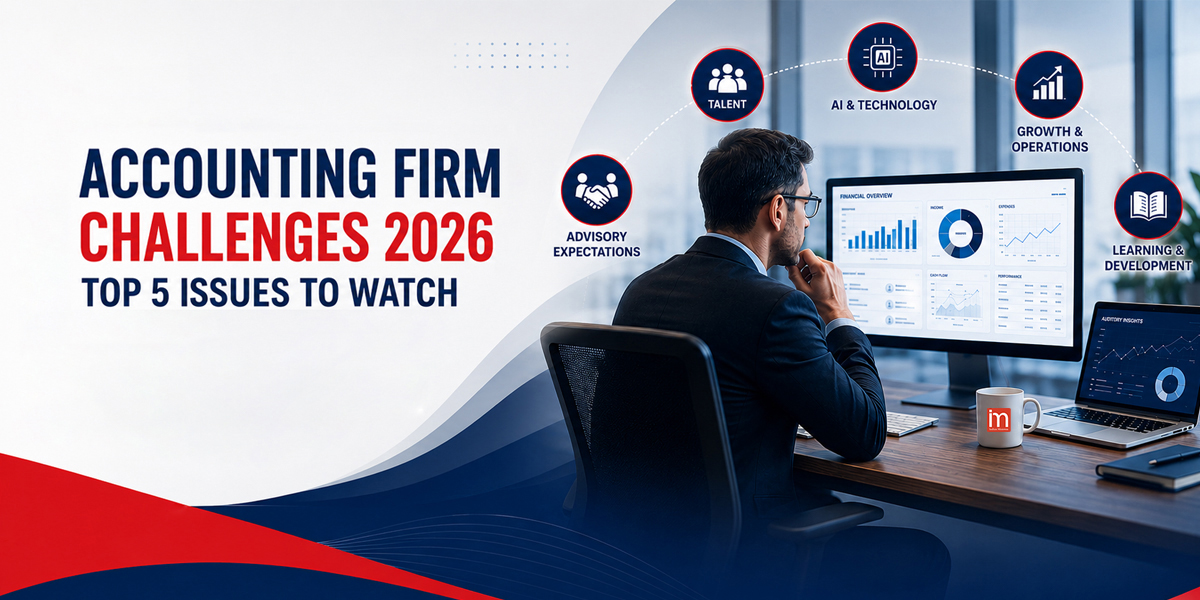
Ask any managing partner what’s kept them up at night this year, and you’ll get some version of the same answer: everything’s moving faster than the firm can absorb it.
That’s the real starting point for accounting firm challenges 2026. This isn’t a list of abstract trends — it’s what’s actually landing on partners’ desks right now.
A few numbers make that clear. AI adoption at firms jumped from 9% to 41% in a single year, according to Wolters Kluwer’s 2025 Future Ready Accountant report. Advisory work has gone from “nice to offer” to something clients simply expect.
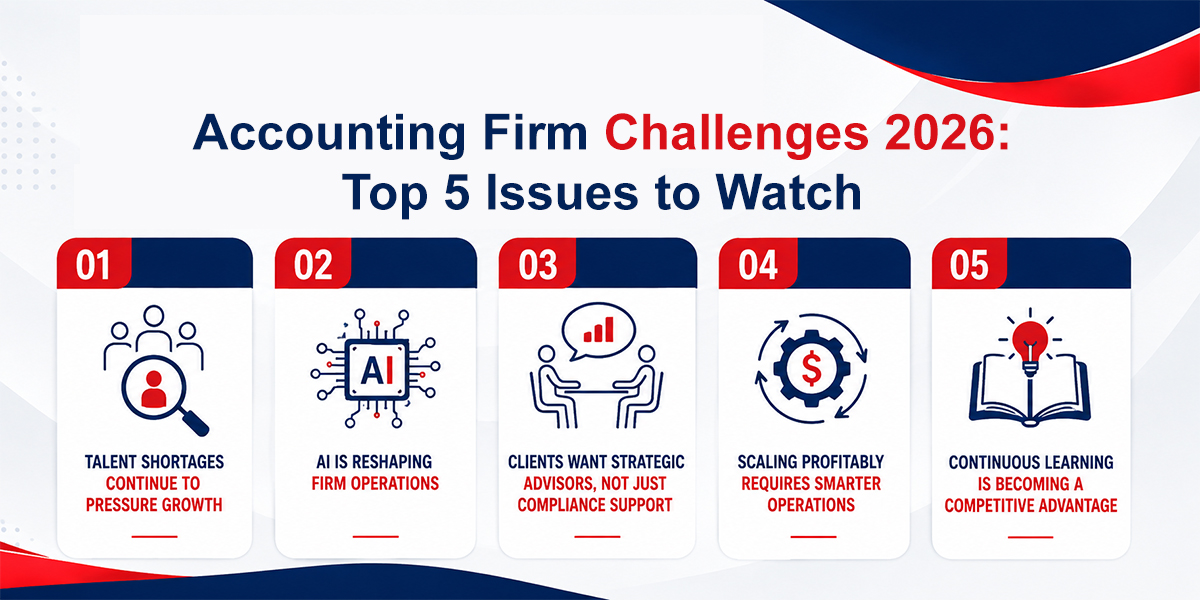
Firms that get 2026 right won’t be the ones with the flashiest tech stack. They’ll be the ones that made deliberate calls about people, process, and where to spend their limited attention. Here are the five challenges we think matter most — and what firms already ahead of the curve are doing about them.
Start with math. The U.S. Bureau of Labor Statistics projects over 120,000 accounting and auditing openings a year. The pipeline feeding those roles has been shrinking — accounting degrees awarded fell 6.6% in a single academic year, per AICPA’s 2025 Trends Report.
That’s not a hiring slump. It’s a structural shift in how many people are choosing this profession at all.
What makes it worse is who’s leaving, not just who isn’t arriving. Burnout is hollowing out the mid-level ranks — the people who actually keep a busy season running. Compensation helps, but it’s not the whole fix anymore. Flexibility and a realistic workload matter just as much for retention.
There’s a genuinely encouraging number buried in the AICPA report: three in four firms that hired in 2024 plan to hire the same or more in 2025. They’re just casting a wider net — pulling in finance, economics, and data-analytics grads and training them into the role, instead of waiting for a shrinking pool of accounting majors to apply.
What leading firms are doing: building structured upskilling programs and flexible staffing models that add capacity during busy season without burning out core teams.
Somewhere in the last eighteen months, AI in accounting firms stopped being a pilot project and became part of the daily workflow.
The numbers back that up:
Source: Wolters Kluwer releases its 2025 Future Ready Accountant report
Here’s the part that gets glossed over in a lot of coverage: nobody credible is talking about AI replacing accountants. What it’s actually doing is stripping out the mechanical, repetitive work — so people can spend their time on the parts of the job that require judgment. Reading a client’s numbers. Telling them what it means for their business.
Firms treating AI as a tool with a human still checking the output are seeing real gains in accuracy, not just speed.
Compliance used to be the product. Now it’s the entry fee.
Wolters Kluwer found that 93% of firms offer advisory services today, up from 83% a year ago. That’s not a niche positioning play anymore — it’s close to universal.
The firms pulling ahead aren’t just bolting “advisory” onto their service list. They’re having different conversations:
That takes a different skill set than tax prep does — probably why 31% of firms now list advanced skill development as a top staffing priority.
Growth that outpaces your operations doesn’t feel like growth for long. It shows up as margin pressure within a year or two.
Capacity gets tight. Staff costs climb. Firms that haven’t tightened their processes end up busier — but not more profitable.
Outsourcing has quietly become one of the more effective answers here. Roughly 10–15% of small and mid-size U.S. CPA firms used offshore support back in 2020. Industry estimates now put that figure closer to 30–35%.
The appeal isn’t just cost. It’s freeing internal teams from routine, transactional work so they can spend time on the advisory and client-facing work that pays better — and keeps clients longer.
Regulations shift. Tools change every year, sometimes every quarter. A firm that trains once and coasts falls behind quietly, then all at once.
The firms doing this well treat learning as infrastructure, not an event. That includes leadership development, not just technical CPE. Partners who invest in growing the next generation of firm leaders are the ones with a bench deep enough to keep growing past the next tax season.
None of this is easy to figure out alone at a desk. It’s a lot easier in a room with fifty other partners wrestling with the exact same questions. That’s really the case for an event like AIM 2026.
It’s built around the issues above — not abstract keynote fluff:
All told through real firm case studies, not theory.
IMCA’s involvement with The GAP on this one comes from a simple belief: firms figure this stuff out faster together than in isolation. Attendees walk away with frameworks they can use the same week, plus a network of peers going through the same transformation.
If you’d rather get ahead of where the profession’s headed than spend next year reacting to it, this is a fairly efficient way to do that.
Here’s the honest summary: firms that thrive in 2026 won’t be the ones that reacted well. They’ll be the ones that decided early — on people, on technology, on which services to build out — and did the work before it became urgent.
If you’re thinking through your firm’s next move, AIM 2026 is a solid place to start. A room full of people asking the same questions you are, and some answers worth stealing.
Talent shortages, AI adoption, rising demand for advisory services, profitable scaling, and the need for continuous learning and leadership development top the list.

We use cookies and similar technologies to improve your experience, personalise content, analyse website traffic, and understand how visitors interact with our website. Some technologies may help us identify businesses visiting our website and improve our marketing and services. Some cookies are essential for website functionality.