
Accounting Review Checklist for CPA Firms: What to Check Before Client Delivery
Table Of Contents
Toggle
A client report is due, the bookkeeping is complete, and the reconciliations appear to be in order. But before the accounts reach the client, there is one more important step: the final accounting review.
Even a well-prepared set of accounts can contain errors. A transaction could be wrong in classification, the supporting docs could be missing, a journal entry could need clarification, the balances could be out of line with the underlying records. If you don’t pick those up then you end up with wrong accounts, more client queries and a hell of a lot of rework.
An accounting review checklist for a CPA firm is a means of ensuring that the work that’s been done has been properly reviewed prior to delivery. It allows the reviewer to spot any gaps, check the key balances and ensure the financials are in a state where they can be handed over.
Here are ten must-have checks that accounting firms should be carrying out as part of their final review.
Preparing the accounts and reviewing the accounts are two very different things. Preparing is all about the recording of transactions, the completion of the reconciliations and the production of the financial statements. Reviewing is about checking that the work that has been prepared is correct, complete and properly supported.
A documented review process helps CPA firms:
There’s no process at all and the quality of the end product is very much down to individual working habits.
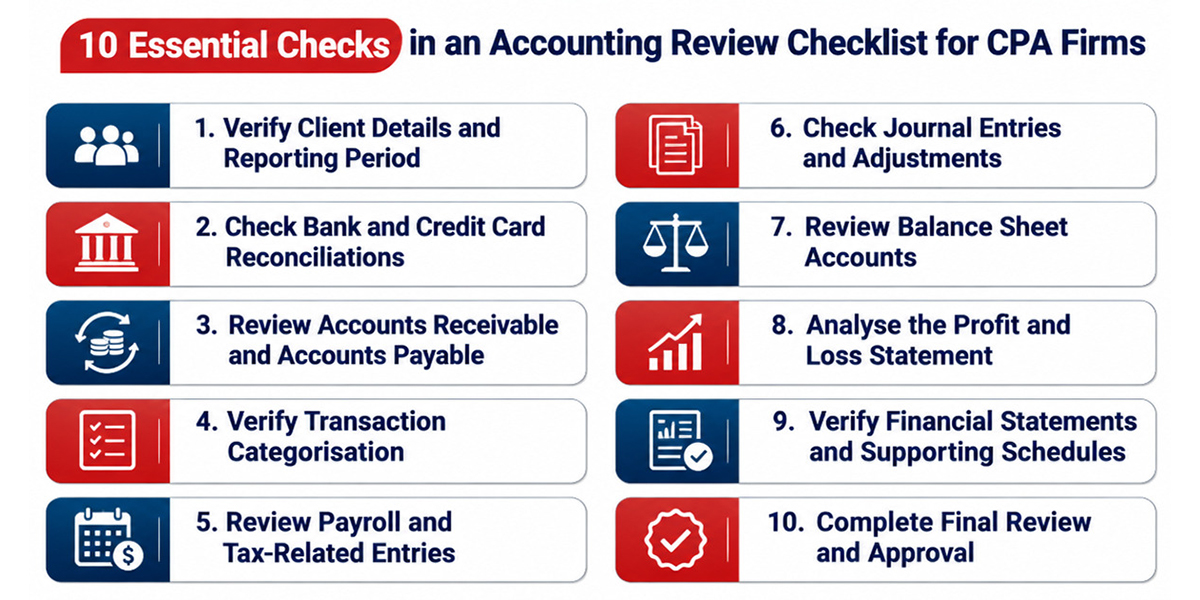
Start with the fundamentals. Make sure the accounting file is for the correct client and correct legal entity. Check the reporting period, financial year and accounting basis.
Also compare the finished work against the agreed engagement scope and any specific reporting instructions the client may have given.
A blunder at this stage can have a ripple effect right through the whole deliverable. If you’re producing the financial statements for the wrong entity or the wrong period then your numbers may be absolutely correct but completely inappropriate for the purpose for which they are being prepared.
Review all the relevant bank and credit card reconciliations, ensure the closing balances match the relevant statements and look at any unexplained differences.
Have a look at the outstanding customer invoices and the unpaid supplier bills. Look closely at the aged receivables and payables.
For instance an old customer balance may have been paid but never actually matched to the original invoice. Likewise a supplier payment may have been entered without the corresponding payable having been cleared.
Unresolved balances will distort the position so you need to look at them prior to going ahead and approving the accounts.
Ensure that the income and expenditure have been posted to the correct ledger accounts.
Look for uncategorised transactions, personal expenses recorded as business expenses, duplicate entries and odd changes in expense category.
Payroll and tax related balances should reconcile with the relevant accounting records and supporting reports.
Carefully go through the manual journal entries and the period end adjustments.
Each major entry must be properly explained and supported by the appropriate supporting information. The debits and credits must be correct and the entries must be in the correct period.
An adjustment posted to the wrong period will have an impact on the income and expenses that are reported. Any unsupported entries should be investigated prior to approval.
Don’t assume that the balance sheet balances are correct simply because they’ve been carried straight through from the prior period.
Review fixed assets, depreciation, loans and borrowings, inventory, equity, retained earnings and suspense accounts as appropriate.
Ensure that significant balances are in agreement with the supporting schedules, statements and other relevant records.
An outstanding loan balance should be compared against the lender’s statement or an appropriate repayment schedule. Old suspense account balances should be examined rather than simply carried forward into the next period.
Look at the overall financial position rather than at individual transactions.
Compare income and expenditure to the previous reporting periods and budgets where appropriate. Pay particular attention to any significant changes in revenue, gross profit, operating expenses and the other key categories.
For example if revenue has gone up significantly but the direct costs associated with it have remained flat then the reviewer should look to see whether all the relevant costs have been picked up.
An analytical review will be the way of picking up on the oddities that you wouldn’t necessarily spot if you were just looking at the transactions in isolation.
Once you’ve had a look at the underlying accounts, check the final accounts.
Confirm that:
The balance sheet, the P&L and the cash flow statement should all tell the same story.
A report shouldn’t be approved simply because the totals add up. The figures in the report have to agree with the underlying accounting records.
The last step is to confirm that the file is actually ready for client delivery.
Also Read: Bookkeeping for Real Estate Investors: 9 Essential Practices for Better Financial Control
Even firms with very experienced accounting teams can miss the boat if their review processes are rushed or inconsistent.
Some common mistakes include:
A standardised checklist, clearly defined reviewer responsibilities and proper documentation will go a long way to avoiding these problems.
When you’ve got a number of client accounts to deal with the review process has to be repeatable. If you’re relying on individual reviewers to remember each and every check that’s going to be a massive problem in terms of consistency, particularly at times of high volume.
CPA firms can improve the process by:
The checklist can be adapted to different client types, reporting requirements and engagement scopes. The aim is to get consistent quality checks without making it any more complicated than it has to be.
It’s not always the review process that’s the problem, it’s often just the sheer amount of work that’s waiting to be reviewed.
Growing client lists, seasonal deadlines and limited in-house capacity all lead to a backlog of prep work. The reviewers are going to be spending a lot of time on the basic bookkeeping rather than the more complex accounting issues.
In those situations outsourced accounting support can provide additional preparation capacity.
Indian Muneem Chartered Accountants (IMCA) work with the CA and CPA firms providing them with support in the area of bookkeeping, reconciliations, year end accounting, financial reporting and the associated accounting processes.
It can help an organisation to deal with increasing workloads, keep a degree of structure in the documentation and have work ready for internal review.
Importantly IMCA acts as an extension of the firm’s team rather than a replacement. The CPA firm still has the client relationship, the professional judgement, the review responsibilities and the ultimate accountability.
A final accounting review should be much more than a check that the transactions have been posted and the reports have been produced. It should confirm that the balances are supported, the reconciliations are complete, the financial statements are consistent and that all the outstanding issues have been dealt with.
For a CPA firm dealing with multiple client accounts a structured accounting review checklist will create a repeatable process and ensure that standards are being maintained consistently even during periods of very high reporting activity.
If internal teams are short of capacity then working with an outsourced accounting partner can go a long way to keeping the preparation work moving without the transfer of professional responsibility. Indian Muneem Chartered Accountants support CA and CPA firms with their bookkeeping, year end accounting and financial reporting needs, enabling them to manage their workloads and still have full control over the final review and client delivery.
An accounting review checklist should cover client details, reporting periods, bank reconciliations, receivables, payables, transaction classifications, payroll, journal entries, balance sheet accounts and the financial statements. It should also cover any outstanding review comments, supporting documentation and final approval.
A final review is your opportunity to spot incorrect entries, missing documentation, unsupported balances and any inconsistencies prior to the financials going to the client. It helps to reduce the number of corrections that will end up being made, improves the accuracy of the reporting and provides the accounting firm with a documented process for the approval of the work.
Accounting work is normally prepared by the bookkeepers or accountants and then reviewed by a senior accountant, a senior accounting manager or some other appropriately qualified person. The precise responsibilities will of course vary according to the firm's own internal policies, the nature of the engagement and the complexity of the client's accounts.
Yes, outsourced accounting support can be of considerable assistance in the preparation of reconciliations, the organisation of supporting documentation, the maintenance of accounting schedules and the completion of the more routine bookkeeping. If the work is carried out in accordance with the firm's own procedures and is properly documented then the internal reviewer will be in a much better position to go through the completed files.

Talk to IMCA about adding tax preparation support behind your existing workflow while your firm retains client relationships, professional review, and oversight.

We use cookies and similar technologies to improve your experience, personalise content, analyse website traffic, and understand how visitors interact with our website. Some technologies may help us identify businesses visiting our website and improve our marketing and services. Some cookies are essential for website functionality.