Year-End Accounting Checklist for CPA Firms: 10 Steps to Prepare Client Accounts

year-end accounting checklist for CPA firms

Closing the books for one client can be straightforward. Managing year-end accounts for 20, 50 or more clients is a different challenge. Accounting teams often have to deal with missing bank statements, unreconciled transactions, unanswered client queries and incomplete supporting schedules, all while working towards multiple deadlines.

Without a consistent process in place these can all delay the internal review and leave the tax prep teams sitting around waiting for the information.

A good year end accounting checklist for a CPA firm is one that provides a common process for the preparers and the reviewers. It helps to identify what’s missing, resolve any discrepancies, assign responsibilities and get the client records in order prior to moving on to the next stage of work. It also makes it much easier to track the year end close across the whole client book of the firm.

Why CPA Firms Need a Structured Year-End Accounting Checklist

A standardised checklist will of course help an accounting firm to be consistent and not have every client file go through the same process. It gives them a clear sequence of tasks and makes it far easier to spot any work that hasn’t been done prior to it reaching the reviewer.

Imagine a firm with a number of year end accounts. One client hasn’t sent through their final bank statements and another has loan balances which don’t match the general ledger at all. If such issues are uncovered in the final review the team could be in a position of having to go back and re-open work on completed files and thereby delay the others.

A structured process helps firms:

  • Keep the same procedures in place for all client accounts.
  • Identify the missing docs and the discrepancies as early as possible.
  • Reduce the number of times you follow up with a client.
  • Keep your financial statements and the supporting schedules in order.
  • Assign responsibilities between the preparers and the reviewers.
  • Track the outstanding questions against the individual client files.
  • Manage deadlines without losing sight of the stuff that still needs to be done.

The checklist should be a common framework which is then adapted to suit the individual client’s business, accounting system and reporting requirements.

Year-End Accounting Checklist for CPA Firms: 10 Essential Steps

The following CPA year end checklist covers the key things that the accounting team should be doing prior to moving the client accounts over to final review and tax prep.

1. Collect and Review All Required Client Documents

Start by making sure the accounts team have got the records they need to do the year end accounts.

Depending on the client, these may include:

  • Bank and credit card statements.
  • Sales invoices and purchase records.
  • Accounts receivable and accounts payable reports.
  • Payroll reports and liability records.
  • Loan statements and financing documents.
  • Fixed asset purchase and disposal records.
  • Inventory reports, where applicable.
  • Prior year financial statements and the associated schedules.

Keep a document tracker for each client. Split the items into received, missing and pending and have someone assigned to chase them. That way the accountants won’t be continually going back to the same files or discovering that something is missing at the point of final review.

2. Reconcile Bank and Credit Card Accounts

Compare the balances as per the general ledger with the balances as shown on the bank statements and the credit card statements.

Look for any outstanding deposits, any unpresented payments, any missing transactions, any duplicates, any bank charges and interest charges. Credit cards in particular will need to be checked as it’s quite possible that some of the expenses have occurred prior to year end but have only been recorded subsequently.

If the statement doesn’t agree with the ledger balances then investigate the difference. Don’t just go ahead and make an adjustment to get the numbers to agree. Record the reason for the difference and make any required corrections with proper supporting documentation.

3. Review Accounts Receivable and Accounts Payable

Review the outstanding customer invoices and supplier balances to ensure that the receivables and payables are all correctly recorded.

The accounting team should examine:

  • Aged receivables and overdue customer invoices.
  • Unrecorded supplier bills.
  • Duplicate invoices and credit notes.
  • Disputed customer or supplier balances.
  • Unusual negative balances.
  • Transactions recorded in the wrong accounting period.
Old balances obviously need a look at. An invoice which is outstanding for months may have in fact been paid, just not allocated. A supplier bill received after year end may in fact be for expenses which occurred in the year under review.
Seek client confirmation wherever the records available to you don’t explain a balance.

4. Verify Payroll, Taxes and Other Liabilities

Payroll and other liability accounts should be checked to make sure the amounts in the books are in agreement with the records that are actually available.

Check payroll costs, unpaid wages, payroll tax liabilities and any other employee related obligations. Check the relevant sales tax / indirect tax balances, accrued expenses and other liabilities.
The exact checks required will vary according to the client’s business structure, jurisdiction and reporting requirements. Any discrepancies between the payroll reports, the tax records and the ledger balances must be investigated prior to the file proceeding.

5. Review Fixed Assets, Loans and Depreciation Schedules

Confirm that the fixed asset and finance records are complete and properly supported.

Review the asset additions and disposals during the year (including purchase invoices and disposal docs). Compare the fixed asset register to the general ledger and ensure that depreciation has been charged in accordance with the relevant accounting policy.
For any loans or other financing arrangements, check the outstanding principal balance, the interest expense and how that interest is classified. Look at the loan statements and lease records as appropriate.
These checks serve to prevent unsupported asset balances and wrong classifications getting through into the financial statements.

6. Review Owner Transactions and Equity Accounts

Look at the contributions, the distributions, the drawings, the shareholder transactions and all the other movements in the equity.
The accounting team should be looking at transactions that may have been incorrectly classified as a business expense or posted to the wrong equity account. Personal and business transactions need to be appropriately classified in line with the client’s structure and the appropriate accounting treatment.
For instance a payment made by the owner for a business expense would be recorded differently from a personal withdrawal. Unusual balances should be flagged for investigation rather than simply reclassified.

7. Record and Review Year-End Adjusting Entries

Once the underlying records have been looked at, determine what adjustments are required to bring the accounts up to date for year end.

Common adjustments include:

  • Accrued and prepaid expenses.
  • Depreciation.
  • Interest accruals.
  • Revenue and expense cut-offs.
  • Inventory adjustments, where applicable.
  • Other supported journal entries.

Each adjustment must be properly explained and supported by appropriate documentation. The preparer must record the entry in accordance with the relevant accounting framework and any significant or unusual adjustments must be submitted for appropriate review.

8. Prepare and Reconcile Accounting Schedules

Accounting schedules are the supporting detail for the general ledger balances. They enable the reviewer to see how the figures were calculated and whether the balances reported are properly supported.

Typical schedules include:

  • Cash and bank accounts.
  • Accounts receivable and accounts payable.
  • Fixed assets and accumulated depreciation.
  • Loans and other liabilities.
  • Prepaid expenses and accrued expenses.
  • Inventory and equity accounts where applicable.

For CPA firms’ accounting schedules consistency is key. Each schedule must state the period it relates to, the supporting records and the closing balance. It must also be able to be traced back to the general ledger.

If a schedule doesn’t match the ledger then investigate and document the discrepancy prior to marking it complete.

9. Review the Trial Balance and Financial Statements

Once the approved adjustments have been recorded, prepare the adjusted trial balance and then go on to review the profit and loss statement and the balance sheet.

Look out for unexpected account balances, odd spikes in income or expenditure, negative balances and discrepancies between the financial statements and the supporting schedules.

Compare the current year to the previous year to spot any oddities. A big movement doesn’t necessarily mean there’s an error. An increase in expenditure could be the result of a company expanding or a change in the way it operates.

The objective of this review is to identify those figures which require explanation, supporting evidence or correction prior to the accounts proceeding to final review.

10. Complete the Final Review and Prepare the Client File

Before you close the accounting work, make sure that all the necessary procedures have been carried out and are properly documented.

The final checklist should cover:

  • Completion of relevant bank and balance sheet reconciliations.
  • Review of the major journal entries.
  • Agreement between the schedules and the general ledger.
  • Documentation of outstanding questions and unresolved items.
  • Appropriate preparer and reviewer sign-offs.
  • Organisation of the supporting documentation and workpapers.
  • Updated file status and next required action.

A completed accounting checklist in no way implies that the client’s tax position is final. Further tax specific analysis, additional information and professional review may still be required.

How CPA Firms Can Manage the Year-End Close Process Across Multiple Clients

Completing the checklist is only half the battle. The CPA firm also need a way to manage the work across multiple client files.

A practical approach is to create a central year-end tracker that records:

  • Client name and assigned preparer.
  • Docs received and docs still outstanding.
  • Reconciliation and schedule status.
  • Open client queries.
  • Reviewer assignment and internal deadlines.
  • Current file status and next step.

Files should also be prioritised on complexity and urgency. A client with full records and simple reconciliations could be ready for review long before a client with missing statements and unexplained balances.

Set your internal completion dates well in advance of the external deadlines and keep the tracker under regular review. That way the bottlenecks are visible and you can redistribute the work before any delay starts to impact the wider team.
Common Year-End Accounting Mistakes CPA Firms Should Avoid

Common-Year-End-Mistakes

Even experienced accounting teams can encounter problems when year-end work becomes rushed. Some common issues include:

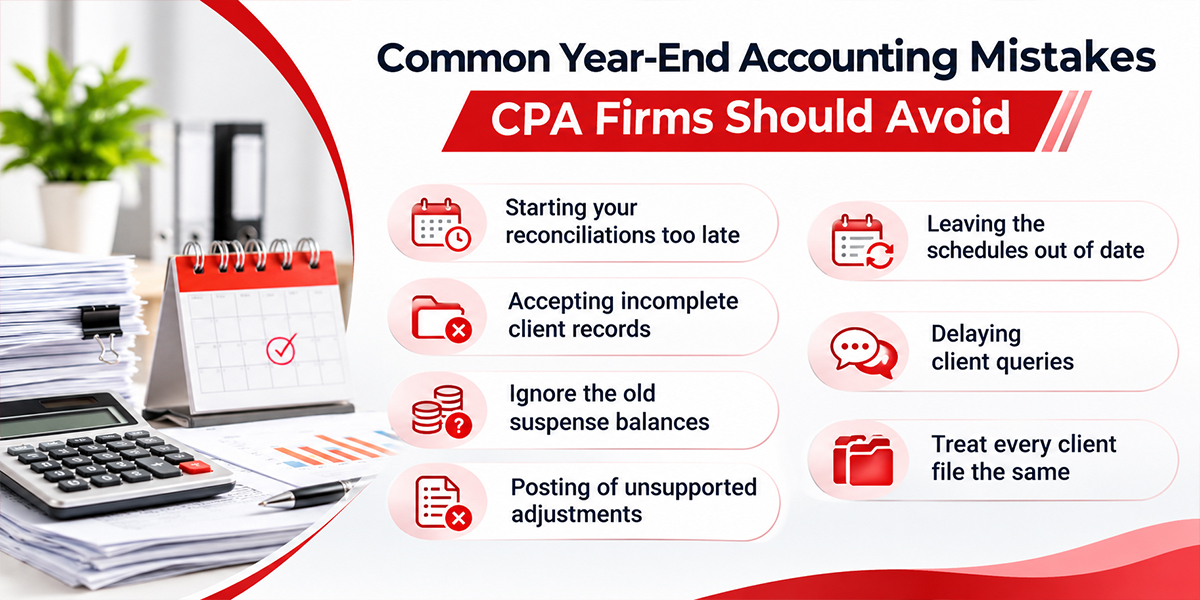
  • Starting your reconciliations too late: if you do them earlier you’ll pick up the missing records well before the final weeks of the close.
  • Accepting incomplete client records: keep a document tracker and chase down the missing information rather than making any assumptions.
  • Ignore the old suspense balances. Look at the odd entries and record how they’re sorted out.
  • Posting of unsupported adjustments: require appropriate evidence and review for significant journal entries.
  • Leaving the schedules out of date: update the supporting schedules whenever the relevant ledger balances change.
  • Delaying client queries: assign ownership and follow up dates so unanswered queries don’t hang up the final review.
  • Treat every client file the same: work on them in accordance with complexity, outstanding issues and deadlines.

These issues are far easier to deal with if the firm is monitoring progress as it happens throughout the year end rather than just having a review at the end.

When should a CPA firm consider offering Year End Accounting services?

Additional accounting support can be very useful when your in-house team are finding it difficult to keep up with the year end workload.

CPA firms may consider external support when they face:

  • A steadily growing backlog of client accounts.
  • Several files all requiring some bookkeeping clean up at the same time.
  • Limited internal accounting capacity.
  • Senior accountants spending an excessive amount of time on the routine preparation.
  • New clients coming in with incomplete financials.
  • Seasonal increases in workload which don’t warrant permanent staff.

Outsourced year end accounting can cover a range of tasks including bookkeeping, bank reconciliations, supporting schedules, journal entries and financial reporting (depending on the scope agreed).

The structure should have clearly delineated responsibilities. The CPA firm will own the client relationships, the professional judgement, the review and the final decisions.

How IMCA Supports CPA Firms With Year-End Accounting

Indian Muneem Chartered Accountants (IMCA) provide outsourced accounting and finance support to CA and CPA firms. The range of services offered includes bookkeeping, year end accounting, financial reporting and tax preparation support as well as director level review.

The team act as an extension of the CPA firm’s existing operations, assisting with the accounting workload without in any way replacing the firm’s own staff.

During year-end, this additional capacity can support:

  • Bookkeeping and general ledger maintenance.
  • Bank and account reconciliations.
  • Preparation of year end schedules and journal entries.
  • Trial balance preparation and financial reporting.
  • Accounting backlog and clean up.
  • Tax preparation support and Director level review where necessary.

This enables the CPA firm to delegate the agreed preparation work, whilst still maintaining control over client contact, professional judgement and the final review.

If you’re in the process of year end close and need some extra accounting headcount, get in touch with IMCA to discuss your needs.

Conclusion: Prepare Client Accounts for a Smoother Year-End Close

A reliable year-end process is about more than completing a list of accounting tasks. CPA firms need accurate records, reconciled balances, organised supporting schedules and a clear view of outstanding work across every client file.

Following a consistent checklist helps accounting teams identify problems earlier, manage workloads and prepare accounts for internal review and subsequent tax preparation.

When internal capacity becomes a challenge, additional accounting support can help keep client work moving without compromising the firm’s control over its processes.

Indian Muneem Chartered Accountant works alongside CPA firms to provide outsourced bookkeeping and year-end accounting support. Explore how its team can help your firm manage the next year-end close with greater confidence.

Frequently Asked Questions

A checklist should cover document collection, bank and credit card reconciliations, AR and AP, payroll liabilities, fixed assets, equity accounts, the adjusting entries, the supporting schedules, the financial statement reviews and the final file sign-offs. The specifics of what is required will of course be tailored to the individual client's business and their reporting framework.
Prep should start prior to the reporting period actually ending. Looking at the monthly reconciliations, identifying the issues that keep cropping up and getting the documents in as early as possible will go a long way to reducing the amount of work that will be outstanding at year end. Firms should set internal deadlines which will be based on the complexity of the client and the time it will take to review the work.
Standard docs would be bank and credit card statements, invoices, AR and AP reports, payroll, loan statements, fixed asset information and prior year statements. Inventory reports and other supporting documentation may be required depending on the nature of the client's business.
Accounting schedules provide the supporting detail for the general ledger balances. They are normally concerned with cash, receivables, payables, fixed assets, loans and other balance sheet accounts. They are used by the preparer to explain the balances that have been reported and enable the reviewer to trace the balances back to the underlying documentation.
Year-end accounting focuses on reconciling records, recording adjustments, preparing schedules and producing financial statements. Tax preparation uses the relevant financial information to calculate tax obligations and prepare returns. Completing the accounting close does not automatically mean tax work is complete.

Yes. Outsourced teams can assist with bookkeeping, reconciliations, schedule preparation and other agreed accounting tasks. This provides additional preparation capacity during busy periods while the CPA firm retains responsibility for client relationships, professional judgment and final review.

A file is generally ready when required reconciliations are complete, supporting schedules agree with the ledger, significant adjustments are documented and outstanding queries are clearly identified. The preparer should also complete the relevant workpaper documentation and sign-offs before submitting the file to a reviewer.

Need Accounting Support?

Talk to IMCA about adding tax preparation support behind your existing workflow while your firm retains client relationships, professional review, and oversight.

Scroll to Top