
Books Clean-Up for Tax Season: A Complete Checklist for CPA & Accounting Firms
Table Of Contents
Toggle




Tax preparation often reveals bookkeeping problems that have been sitting in a client’s records for months. A bank account may look reconciled, but a loan payment could have been posted entirely as an expense. Supplier invoices may be missing, customer payments might have been recorded twice, or personal transactions may be mixed with business spending.
For CPA and accounting firms, these issues can turn a routine tax preparation job into a series of corrections, client queries and additional reviews. The work becomes harder to schedule when several files need attention at the same time.
Books clean-up for tax season gives accounting teams an opportunity to resolve these issues before tax preparation begins. By checking account balances, tracing unusual transactions and collecting supporting documents, firms can establish a more reliable starting point for their tax teams.
A consistent cleanup process also makes it easier to identify files that are ready for review and those that still need information or further investigation.
Books clean-up for tax season involves reviewing a client’s accounting records, correcting supported errors and resolving outstanding bookkeeping issues before the file moves into tax preparation.
Routine bookkeeping records transactions as they occur. Cleanup work looks back at those records to find anything missing, duplicated, incorrectly classified or left unresolved. Year-end accounting may then include additional adjustments, supporting schedules and financial statement preparation.
A typical bookkeeping cleanup for tax season covers:
The amount of work depends on the condition of the client’s books. A business that maintains its records throughout the year may need only a few corrections. A new client with months of unreconciled transactions may require a much more detailed review.
Leaving bookkeeping problems until tax preparation is underway can create unnecessary work for both preparers and reviewers. The tax team may have to stop working on a return while someone tracks down an invoice, investigates a balance or corrects a journal entry.
A year-end books cleanup helps firms identify these issues earlier. It can also reduce repeated client follow-ups, make missing information visible and give managers a clearer picture of which files need attention first.
Consider a client whose bank balance agrees with the statement at year-end. At first glance, the account appears ready. However, the client has used a business credit card for personal purchases, recorded a loan repayment entirely as an expense and left several supplier bills unentered.
The bank reconciliation alone would not reveal every problem. The credit card transactions, loan balance and accounts payable still need investigation before the financial records can be finalised.
For firms handling many clients, this distinction matters. Early cleanup gives partners and senior accountants more time to address complex accounting questions instead of spending review hours correcting routine entries.
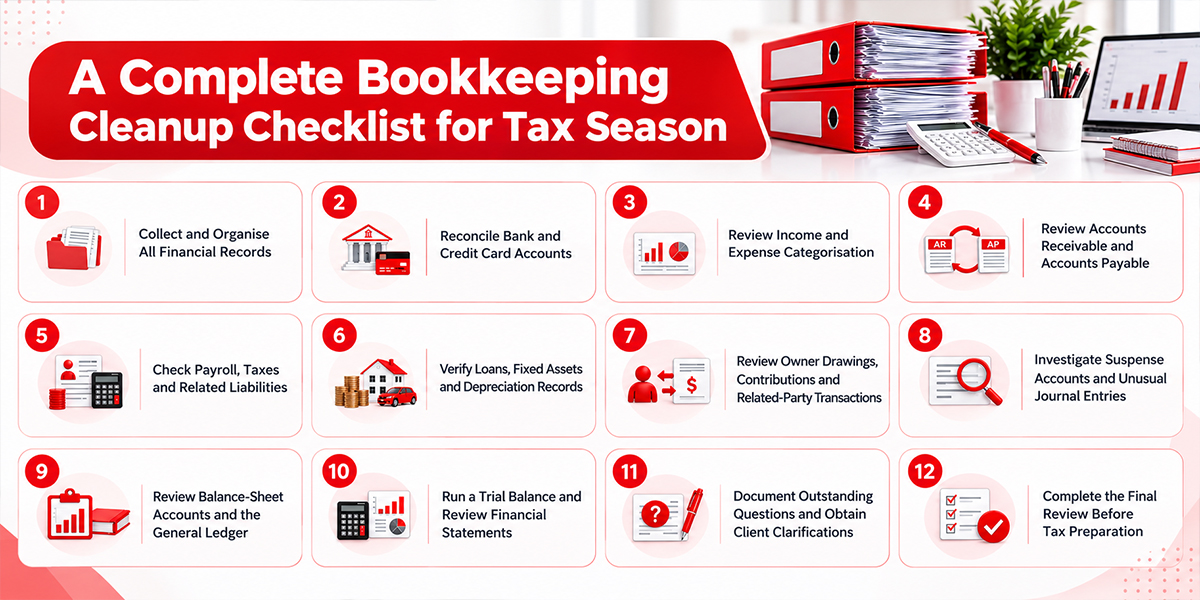
Use the following checklist as a starting point for each client file. Adapt it to the business, accounting system, reporting period and applicable tax requirements.
Start by checking whether the documents needed to support the accounts are available.
Collect relevant bank and credit card statements, sales invoices, supplier bills, receipts, loan statements, payroll reports, prior-year financial statements and fixed-asset records. Include other supporting schedules required for the particular business.
Compare the available documents with the firm’s standard requirements. If a statement or invoice is missing, record the gap and request it from the client.
Before moving on: Confirm which records have been received, which are still outstanding and who will follow up.
Compare the transactions recorded in the accounting system with the corresponding bank and credit card statements.
Look for missing deposits, duplicate payments, bank fees, interest charges, outstanding checks and transactions recorded in the wrong period. Investigate differences between the statement balance and the accounting balance rather than posting an adjustment simply to make the figures agree.
For credit cards, check that payments to the card provider have been recorded as payments against the liability, not as new expenses.
Before moving on: Document completed reconciliations and keep a record of any differences that remain unresolved.
Review the general ledger for transactions posted to unsuitable accounts. Common examples include equipment purchases recorded as ordinary expenses, loan principal classified as an expense and personal spending included in business costs.
Check whether income has been recorded consistently and whether transactions belong to the correct accounting period. Expense treatment should follow the relevant accounting policies and applicable tax rules, not assumptions based on the transaction description alone.
Before moving on: Correct supported classifications and flag items requiring additional information or professional judgment.
Check outstanding customer invoices, supplier bills, credit notes and payments that have not been matched to the relevant accounts.
Old receivables may represent unpaid invoices, disputed balances or payments that were never applied correctly. Old payables may relate to duplicate bills, missing payments or invoices that need further investigation.
Review aged receivables and payables with the supporting records. Do not automatically write off an old balance or assume it is no longer payable.
Before moving on: Identify unexplained balances, duplicate invoices, disputed amounts and unrecorded bills that require attention.
Compare payroll records with the payroll reports and related liability accounts. Review recorded payroll taxes, tax payments and other statutory balances relevant to the client’s jurisdiction.
Investigate differences between amounts recorded and amounts paid or reported. Requirements vary by jurisdiction, so the team should follow the applicable rules and the firm’s procedures.
Before moving on: Confirm that relevant balances are supported and refer unusual differences to the appropriate reviewer.
Compare outstanding loan balances with lender statements. Separate principal repayments from interest charges and investigate differences between the recorded balance and the lender’s figures.
Review purchases and disposals of fixed assets, including equipment, vehicles and other qualifying property. Check whether the fixed-asset schedule reflects the available records and whether applicable depreciation entries have been considered.
Before moving on: Update supporting schedules where appropriate and flag missing acquisition documents, disposal records or unexplained loan balances.
Check owner withdrawals, capital contributions, shareholder transactions and balances involving related parties.
The correct accounting treatment depends on the client’s legal structure and circumstances. For example, a withdrawal by a sole proprietor should not automatically be treated the same way as a payment to a shareholder of a corporation.
Review supporting records before changing the classification.
Before moving on: Make sure transactions are recorded in the appropriate accounts and that uncertain items are referred for review.
Suspense and clearing accounts can accumulate transactions that could not be classified when they were first recorded. Old journal entries may also remain in the ledger without clear explanations or supporting documents.
Review these accounts for unexplained balances, duplicate entries and adjustments that do not have an obvious purpose. Trace transactions back to source records wherever possible.
Before moving on: Resolve items with adequate support and document anything that still needs clarification. Avoid clearing balances through unsupported adjustments.
A balance-sheet review helps identify problems that may not be obvious from the profit and loss statement.
Check relevant accounts, including cash, loans, receivables, payables, inventory, prepaid expenses, accrued expenses, fixed assets and equity. Compare balances with supporting schedules and investigate unexpected movements.
Retained earnings and opening balances also deserve attention, particularly when a new client has changed accounting systems or prior-period figures have been carried forward incorrectly.
Before moving on: Confirm that material balances are supported and that the general ledger agrees with the relevant schedules.
Once the main cleanup work is complete, generate an updated trial balance, profit and loss statement and balance sheet.
Look for unexpected debit or credit balances, unusual expenses, significant changes in revenue and inconsistencies between related accounts. Comparing current results with the prior year or budget can help identify movements that need explanation.
A balanced trial balance does not automatically mean the books are correct. Transactions can be posted to the wrong accounts while total debits and credits still agree.
Before moving on: Record significant review findings and confirm that the financial reports reflect the updated ledger.
Maintain a central list of missing records, unexplained transactions, proposed adjustments and questions that need client input.
Each item should identify the issue, the information required and the person responsible for following up. Where a proposed adjustment needs approval, document its status rather than treating it as completed.
This is particularly useful when bookkeeping preparation and review are handled by different team members.
Before moving on: Ensure every outstanding matter has a clear status and that unresolved issues are visible to the reviewer.
Before handing the file to the tax team, confirm that:
The purpose of this final check is to establish whether the file is ready for the next stage. It does not automatically confirm that every tax position is correct. Tax-specific checks, technical judgement and the firm’s normal approval procedures remain necessary.
Some bookkeeping problems appear repeatedly during year-end reviews. Recognising them can help teams investigate the cause instead of correcting only the visible symptom.
When several clients need cleanup at once, assigning work purely in the order it arrives can leave complex files too close to their deadlines. CPA firms should assess each file’s deadline, record quality, outstanding documents and level of investigation required.
A practical way to organise the workload is to use three categories:
Assign straightforward work to the appropriate preparation team while identifying complex files early for additional review or investigation. Track responsibilities and outstanding queries in a shared workflow, and set internal completion dates ahead of filing deadlines.
This approach helps managers see where work is progressing and where a file may need more resources. It also makes it easier to distribute work between bookkeeping, preparation and review teams without losing sight of unresolved issues.
External bookkeeping cleanup services can be useful when internal capacity is not enough to handle the volume or condition of client records.
Common situations include:
Before engaging an external team, define the work to be completed, the accounting systems involved, access permissions, confidentiality requirements and the process for raising queries. Agree on how completed files will be handed back for review.
Outsourcing should support the firm’s existing workflow, not create a separate process that the internal team must continually manage.
Indian Muneem Chartered Accountant (IMCA) provides outsourced accounting support to CA, CPA and accounting firms. Its services include end-to-end bookkeeping, year-end accounting, tax preparation support, financial reporting and director-level review.
Depending on the agreed scope, a firm can use this support to work through bookkeeping backlogs, complete reconciliations, organise year-end schedules and prepare files for the next stage of review. Additional capacity can also help when several client jobs reach year-end together.
The working arrangement is designed to fit the firm’s existing processes. Responsibilities, handoffs and outstanding queries can be defined before work begins, helping the internal team retain visibility over each file.
IMCA’s support does not replace the firm’s client relationships or its responsibility for professional judgement, final review and tax filing decisions. Those responsibilities remain with the firm’s authorised professionals.
If your team is preparing for a busy tax season, discuss your bookkeeping and year-end accounting requirements with IMCA to explore what additional support may fit your workflow.
A reliable year-end cleanup process starts with the records, but it should not end with a list of reconciled accounts. Each significant balance needs appropriate support, unusual transactions need investigation, and outstanding questions must be visible to the people responsible for resolving them.
For CPA and accounting firms, doing this work before tax preparation begins gives the team a clearer view of what is ready and what still needs attention. A repeatable checklist also helps managers allocate work across multiple client files without losing track of review requirements.
When internal capacity becomes a constraint, additional accounting support can help move preparation work forward while the firm retains control of professional decisions and final approvals. Indian Muneem Chartered Accountant can help your team manage bookkeeping and year-end accounting workloads through an outsourced support arrangement tailored to your requirements.
It involves reviewing accounting records for missing or duplicate transactions, incorrect classifications, unreconciled balances and unsupported entries. The process also includes collecting missing documents, checking balance-sheet accounts and updating relevant schedules. The objective is to prepare a reliable set of financial records for review and tax preparation, with unresolved issues clearly documented rather than overlooked.

Talk to IMCA about adding tax preparation support behind your existing workflow while your firm retains client relationships, professional review, and oversight.

We use cookies and similar technologies to improve your experience, personalise content, analyse website traffic, and understand how visitors interact with our website. Some technologies may help us identify businesses visiting our website and improve our marketing and services. Some cookies are essential for website functionality.