
Bookkeeping for Real Estate Investors: 9 Essential Practices for Better Financial Control
Table Of Contents
Toggle
Let’s be honest. At some point, you stopped being a business owner and started being a human to-do list. Client emails, invoice follow-ups, scheduling, data entry, the stuff that genuinely keeps the lights on but also quietly eats your entire week. You didn’t start a business to spend your Thursday afternoon chasing receipts.
That’s not a productivity problem. That’s a staffing problem. And for a lot of businesses in the US, UK, Australia, and New Zealand, virtual assistant services have become the practical fix, not some abstract efficiency concept, but an actual operational decision that changes how a business runs day to day.
This guide covers everything you actually need to know in 2026. What VAs do, what they cost, where they fall short, why accounting firms in particular are leaning into this model hard, and how to avoid the mistakes that make most first-time VA hires frustrating rather than freeing.
Simple version: a virtual assistant is a skilled professional who works remotely and handles tasks your business needs done but doesn’t need a full-time, in-house person to do.
Less simple version: the category has exploded. A virtual assistant in 2015 would handle your emails and schedule your travel plans. By 2026, the VA could be responsible for your bookkeeping, customer services queue management, your CRM administration, the preparation of financial reporting, and the organization of your social media calendar as you get down to real business.
Today’s scope has expanded to include everything from basic admin support to more specific finance work, IT assistance, marketing operation, and even job-specific functions. What was once a solitary profession is now an entire industry of specialists who have experience in their particular field not just generalists with an internet connection.
One thing worth clearing up: a VA is not the same as a freelancer you hire for a one-off project. The relationship is ongoing and operational. Think less “I hired someone to build my website” and more “I have someone managing the operational layer of my busin
Before you hire anyone, it helps to know what you’re actually shopping for. The umbrella term “virtual assistant” covers a lot of ground.
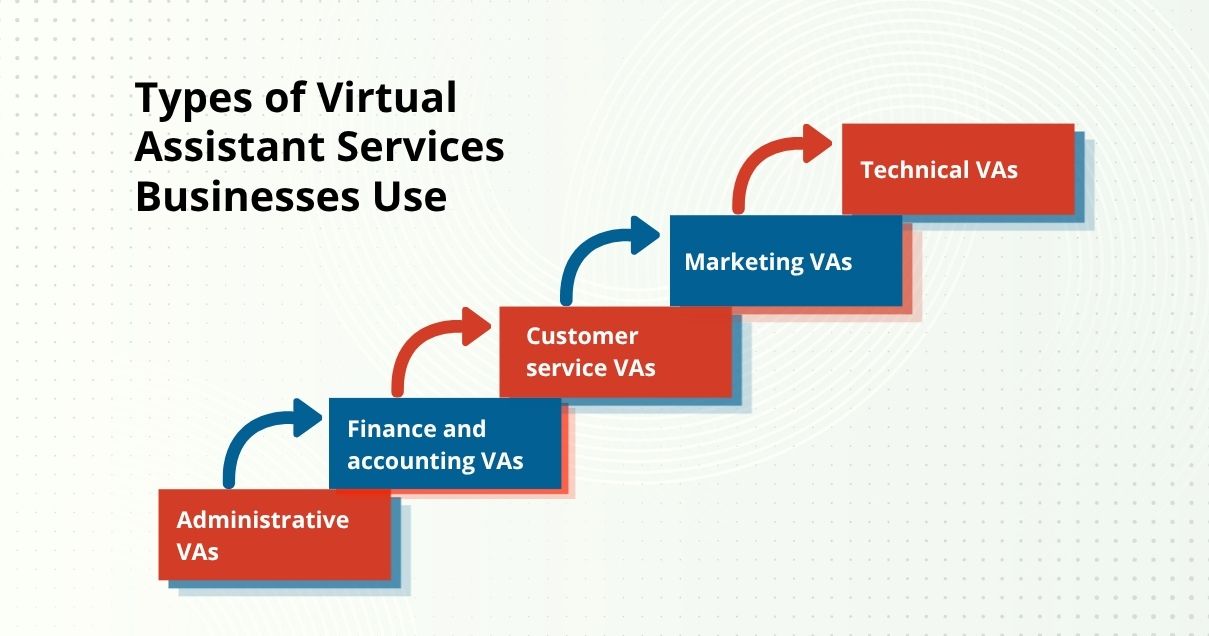
Administrative VAs are the most common entry point. Calendar management, inbox triage, travel bookings, meeting prep, task management, basic research. If your day constantly gets eaten by logistics and coordination, this is usually the first type of help that makes an immediate difference.
Finance and accounting VAs are the ones worth paying more attention to if you run a business with real financial complexity. These aren’t people who know basic math. They’re trained in bookkeeping, bank reconciliations, accounts payable tracking, payroll support, and financial data entry. They work inside your accounting software, Xero, QuickBooks, MYOB, Sage, and they handle the transactional layer of your finances so your accountant isn’t spending billable hours on work that doesn’t require their level of expertise.
Customer service VAs handle inbound client queries across email, phone, and live chat. Good ones can follow your scripts and processes closely enough that most clients genuinely can’t tell whether they’re talking to someone in your office or not. For high-volume businesses, this is a significant operational lever.
Marketing VAs handle execution, not strategy. Content scheduling, social media posting, email campaign management, basic SEO tasks, reporting. If your marketing always falls behind because you’re too busy running the business to actually do the marketing, a marketing VA handles the operational side of it.
Technical VAs deal with basic website maintenance, CRM management, software setup, integrations, and tier-one tech support. Not developers. Not engineers. But the one who can help you update your website, clean your email list, and find out why your email marketing is not working anymore.
Industry-focused VAs are the quickest growing segment in 2026. Those are VAs who are specially trained to serve in accounting offices, law offices, health clinics, and real estate firms. Industry-specific virtual assistants know the lingo, they know what it takes, and they don’t need 6 weeks of training to be ready to go.
The benefits get talked about a lot, so let’s skip the cheerleading and focus on what actually matters.
The cost difference is real and significant. A full-time, entry-level employee in the US costs somewhere between $45,000 and $65,000 annually when you factor in salary, employer taxes, benefits, equipment, and office overhead. A skilled VA providing equivalent support typically runs $12,000 to $30,000 a year depending on specialization and hours. For small and mid-sized businesses, that gap funds a lot of other things.
You get expertise without the hiring process. Finding, interviewing, onboarding, and training a good employee takes months and costs more than most people account for. A VA through a reputable service comes already trained. You still need to orient them to your business, but you’re not starting from zero.
Scalability that actually works. Busy season hits. A big client lands. You suddenly need double the support for three months. With in-house staff, scaling up means recruitment, contracts, and cost commitments that don’t disappear when the busy season ends. With virtual assistant services, you adjust the scope and move on. When things slow down, same thing in reverse.
The time math is straightforward. If you’re a business owner or senior professional spending 15 hours a week on administrative tasks, that’s 15 hours not spent on strategy, client relationships, or revenue-generating work. Delegate those 15 hours. The business grows faster. Most people who’ve done it say they wish they’d done it sooner.
This comparison comes up in almost every conversation about VAs, so let’s actually work through it rather than giving you a vague “it depends.”
Cost: Already covered above. VAs are substantially cheaper when you account for total employment cost. There’s no argument on the numbers.
Availability: In-house staff work your hours. A VA, particularly one working across time zones, can cover hours beyond your standard business day without overtime costs. For businesses with international clients or after-hours support needs, this matters.
Control and integration: This is the honest edge case for in-house. Someone physically in your office absorbs your culture, hears the conversations, and picks up on things that never get written down or communicated explicitly. That informal integration is real, and it’s harder to replicate remotely. Businesses that struggle with VAs often point to this. The fix is better communication systems and clearer documentation, not a reason to reject the model entirely.
For process-driven, repeatable work: VAs are hard to beat. Bookkeeping, data entry, scheduling, customer service scripts, report preparation, these tasks have clear inputs and outputs. Remote execution works fine.
For spontaneous collaboration and deep cultural work: In-house still has the edge. The practical answer for most businesses isn’t “VA or employee” but rather “which roles should be in-house and which should be remote support?” Most healthy businesses run both.
This is the conversation that didn’t exist much three years ago and now it’s everywhere. Worth getting specific about.
AI tools are genuinely impressive at certain things. Automated scheduling, intelligent document processing, templated email responses, basic data extraction, appointment reminders, calendar management. For high-volume, repetitive tasks with clear rules, AI works fast and doesn’t make the kind of errors tired humans do.
Human VAs are still the only option for anything requiring judgment. A human VA reads an email from a frustrated client and understands that the right response isn’t the template. They notice that the invoice has a discrepancy and flag it before sending. They hear something in a call that suggests a follow-up is needed. AI tools in 2026 can’t reliably replicate that contextual awareness, especially in client-facing situations or financial work where errors carry real consequences.
The hybrid model is where the industry has landed. Reputable VA providers now use AI to handle the high-volume mechanical work while human VAs focus on the parts that require judgment, communication, and adaptability. The result is higher output per VA hour without sacrificing quality on the work that matters.
One thing to be clear-eyed about: any provider selling you a fully AI-powered solution for complex accounting or client-facing work is overselling the technology. For financial data especially, human oversight isn’t a nice-to-have. It’s what stands between you and a compliance problem.
Here’s the operational reality of most accounting firms: highly qualified professionals spend a disproportionate amount of their time on work that doesn’t require their qualifications.
Chasing clients for documents. Following up on outstanding invoices. Data entry into accounting software. Reconciling transactions. Scheduling. Preparing draft reports for review. These tasks are essential. They’re also not what a chartered accountant or CPA went to school for, and they’re definitely not what clients are paying senior rates to have done.
The math is uncomfortable once you look at it clearly. If a senior accountant spends two hours a day on administrative and data tasks, that’s roughly 500 hours a year. At $150 per hour billing rate, that’s $75,000 in potential advisory time going toward work a trained VA could handle at a fraction of the cost.
Virtual assistant services built specifically for accounting firms address this directly. A finance-trained VA handles:
What the VA doesn’t do is sign off on the work. That stays with the accountant. The VA handles the operational layer. The accountant handles the judgment, the analysis, and the advisory relationship with the client. Both roles become more effective because they’re doing the work they’re actually built for.
The other reason accounting firms are increasingly comfortable with this model is that purpose-built services come with the right safeguards. Non-disclosure agreements as standard. Documented data security protocols. Encrypted systems. Oversight from qualified professionals. These aren’t extras, they’re baseline requirements in any serious finance VA service.
Indian Muneem Chartered Accountant approaches this differently than a generic VA agency, and the difference is relevant if you’re running a business where financial accuracy actually matters.
The virtual assistant services at Indian Muneem Chartered Accountant are designed around accounting and financial operations specifically. The VAs aren’t generalists who’ve been given a bookkeeping tutorial. They’re trained in double-entry accounting, reconciliation processes, financial reporting standards, and the documentation practices that make tax season and audits manageable rather than chaotic.
For businesses in the US, UK, Australia, and New Zealand, that means a few practical things.
Your VA already knows the software. Xero, QuickBooks, MYOB, Sage, FreshBooks. The onboarding isn’t a training exercise. It’s an orientation to your specific processes, which takes days, not months.
The scope scales with you. Ten hours a week of bookkeeping support, or a full-time VA embedded in your accounts team. Either works, and the structure adjusts as your needs change without requiring a new hiring process.
There’s professional oversight built into the model. Because the service operates from a chartered accountant background, the VA’s work sits within a quality framework. Someone qualified is checking that the output meets accounting standards. That layer of professional review is what separates this from hiring a random VA off a freelancing platform and hoping for the best.
For accounting firms specifically, the value is in capacity. Your senior team focuses on clients, advisory work, and complex filings. The operational load sits with a trained VA who handles it reliably, accurately, and within the right compliance framework.
There are hundreds of VA providers out there. Here’s what separates the good ones from the ones that waste your time.
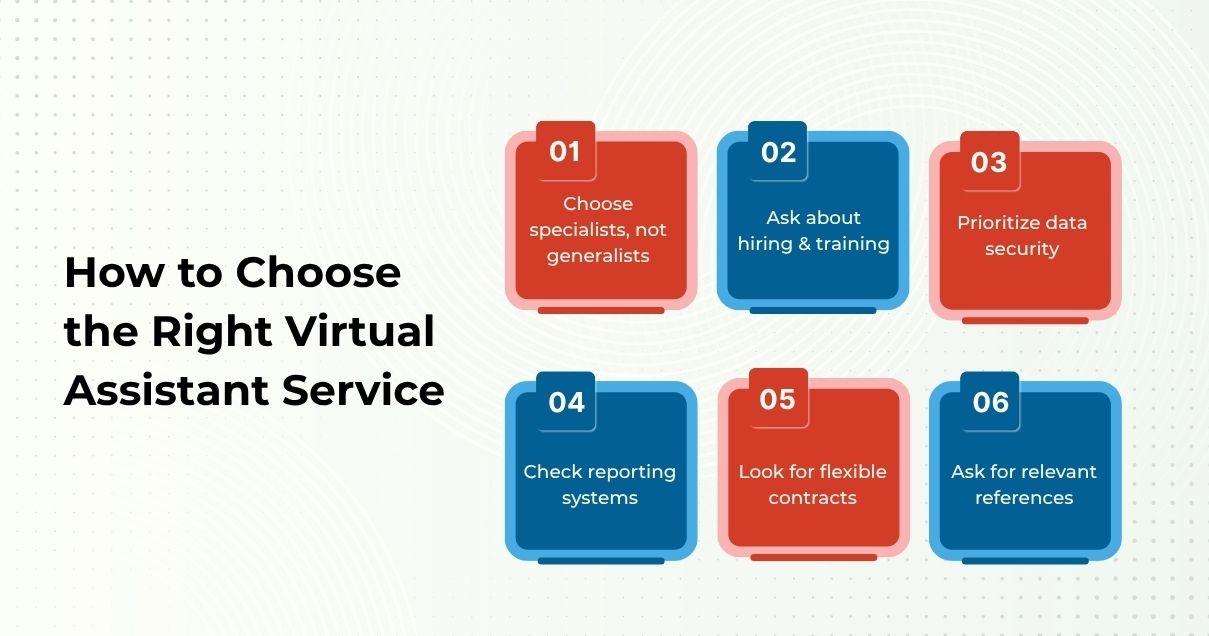
Specialization matters more than size. A provider with 5,000 generalist VAs isn’t better than a provider with 50 specialists in your field. For accounting and finance work, you want a service that’s built specifically for that domain, not one that dabbles in it as part of a broader catalogue.
Ask how they hire and train. Any serious VA service can tell you exactly how they vet their people, what training looks like, and how quality is monitored. If the answer is vague or centers entirely on the volume of available VAs, that’s not a differentiator, that’s a red flag.
Data security is non-negotiable. For anything touching financial data, client records, or business-sensitive information, ask specifically: What are the data handling protocols? Are NDAs standard? How is data stored and who has access? Are communications encrypted? If a provider doesn’t have clear, documented answers to these questions, don’t hand them your client data.
Understand the reporting structure. You should always know what your VA is working on, how time is being tracked, and what the escalation path looks like if something goes wrong. Good providers have clear systems for this. It’s not micromanagement. It’s normal operational visibility.
Look for flexibility in the contract. A VA relationship takes a few weeks to settle into its stride. Avoid providers who lock you into long contracts before you’ve had a chance to test the working relationship. A short trial period or flexible initial engagement is a reasonable ask.
References from comparable businesses. A strong track record with e-commerce startups isn’t necessarily relevant if you’re a professional services firm. Ask for references from businesses with similar size and structure to yours.
A few things have shifted enough in the past two years that they’re worth knowing about if you’re making decisions now.
Specialists are getting more specialized. The general VA market hasn’t disappeared, but the demand and the premium has shifted toward people with real depth in a specific area. Finance VAs who understand financial reporting standards, legal VAs who know court filing procedures, healthcare admin VAs who understand billing codes. The “good at everything” generalist is less valuable than the “great at your specific thing” specialist
AI tools are embedded in the workflow, not replacing it. The conversation around AI replacing VAs has settled down a bit as reality set in. What’s actually happening is that AI handles the mechanical volume work, automated scheduling, document summarization, data extraction, while human VAs focus on the contextual, judgment-dependent tasks. The combination makes VAs more productive per hour, which is good for everyone.
Outcome-based pricing is on the rise. Hourly pricing is common, yet many more organizations have shifted to providing services based on projects and outcomes, whereby you pay for the deliverable and not the hour. This pricing method is more suitable for organizations looking for clarity in their expenditure.
Security standards have gone up. As a result of some recent major third-party breaches, data security regulations within the professional VA industry have tightened. These top providers currently have policies in place that comply with the ISO 27001 standard, utilize encryption technologies, and log all activities related to their services. For this reason, many law firms and accountancy practices have become much more open to using VA providers within the last two years.
Professional services firms are adopting fast. Accounting, legal, consulting, healthcare admin. These were the last holdouts on VA adoption, largely due to confidentiality concerns. The combination of better security standards and more specialized talent pools has changed the calculation. Adoption in these sectors has grown substantially since 2024 and shows no signs of slowing.
Most VA relationships that don’t work out fail for the same few reasons. Worth knowing about before you start.
Hiring without defining the job. The most common mistake, by far. Someone feels overwhelmed so they hire a VA, but they haven’t thought through what the VA should actually do. The VA doesn’t know what to prioritize. The business owner doesn’t know how to evaluate performance. Nothing gets done well, and both parties are frustrated. Fix: spend a few hours documenting exactly what you want to hand off before you start the hiring process.
Measuring performance in week one. A new VA needs time to learn your systems, your preferences, your clients, and your business context. Expect a two to four week ramp-up period where things feel slow. If you’re judging the relationship by week one standards, you’ll almost certainly conclude it isn’t working when it just hasn’t had time to.
Under-communicating. Remote work requires more explicit communication than in-person work. Assume your VA doesn’t have the context you take for granted. Brief them properly on new tasks. Write things down. Use short video walkthroughs for complex processes. In the early weeks especially, over-communication is better than under-communication.
Assigning the wrong tasks. Not everything belongs in the VA column. Work that requires real-time judgment in client-facing situations, spontaneous collaboration with your in-office team, or physical presence is better handled in-house. Be realistic about what remote support can actually do well.
Skipping onboarding. Dropping a VA into your business with no documentation, no system access plan, and no introduction to how things work is a waste of everyone’s time. A few hours of proper setup, documented processes, even roughly, saves weeks of confusion downstream.
Choosing purely on price. The cheapest VA service is almost never the best value. For work that touches your finances, your clients, or your business-critical data, cheap usually means undertrained, unsupported, and unreliable. Pay appropriately for what you need. The savings come from the model itself, not from cutting corners on who you hire within it.
The business case for virtual assistant services in 2026 isn’t complicated. Skilled support costs less remotely than in-house. The talent pool is deep. The tools that make remote work function well are better than they’ve ever been. And the specialization available now means you’re not trading quality for cost savings.
The practical challenge is doing it right: defining the work clearly, choosing a provider that’s built for your specific needs, communicating properly in the early stages, and giving the relationship enough time to find its rhythm.
For accounting firms and finance-heavy businesses, the opportunity is sharper still. There’s a significant layer of operational work that sits underneath the strategic work in every firm, and most of it doesn’t need a chartered accountant to do it. Virtual assistant services from Indian Muneem Chartered Accountant are built specifically to handle that layer, with trained professionals, proper oversight, and the security framework that financial work actually requires.
If you want to explore what that looks like for your business, the conversation is worth having.
The virtual assistant manages various activities that your company requires but does not require a full-time person physically present. These can include a variety of things such as managing calendars and e-mail, bookkeeping, communication with customers, data entry, payroll assistance, social media, and other customer services. It will depend upon the specialization and scope of work provided by the individual concerned.
It varies by specialization and hours. General admin VAs typically run $10 to $25 per hour. Finance and accounting VAs are more specialized and usually range from $20 to $50 per hour. Monthly retainer packages are often more cost-effective than hourly billing for businesses with consistent, predictable workloads. The relevant comparison isn't just the VA rate. It's the VA rate versus the total cost of an equivalent in-house hire, which includes salary, taxes, benefits, equipment, and overhead.
Yes, with proper training and oversight. Finance-trained VAs handle bank reconciliations, accounts payable and receivable, expense tracking, payroll processing support, and financial data entry. They work within your accounting software and alongside your accountant or CFO. They handle the operational layer. Your accountant reviews and signs off. Both roles become more effective.
AI tools handle high-volume, repetitive, rule-based tasks quickly and accurately. Human VAs handle work that requires judgment, context, and adaptability. In practice, 2026's best VA setups use both: AI for mechanical volume work, humans for anything client-facing or context-dependent. For financial work, human oversight remains essential. Errors in financial data have compliance and legal consequences that AI tools aren't yet equipped to catch reliably.
With the right provider, yes. The baseline requirements for any VA handling financial or client data: signed non-disclosure agreements, encrypted communication and storage, documented data security protocols, and clear access controls. Ask these questions explicitly before signing up with any provider. If the answers are vague, that's your answer.
Because qualified accountants spend too much time on work that doesn't require their qualifications. Document collection, data entry, reconciliations, scheduling, billing follow-ups. These tasks are essential but they don't need a CA or CPA to do them. A trained finance VA handles the operational layer. The senior team focuses on advisory work, complex filings, and client relationships, which is where the real value sits.
Yes. Bookkeeping is one of the most suitable tasks for a finance-trained VA. Transaction recording, bank feeds, expense categorization, month-end preparation. A qualified accountant reviews the work for accuracy and compliance, but the day-to-day execution sits with the VA. It's an effective division of labor that most accounting firms and growing businesses benefit from.
It finds its maximum penetration in e-commerce, professional services such as accountancy, law, and consulting, real estate, healthcare management, and technology startups. In 2026, among the industries with the highest growth rate are accountancy/finance, healthcare management, and software as a service operations due to better data protection standards, along with greater penetration of specialist VAs within professional services firms.

We use cookies and similar technologies to improve your experience, personalise content, analyse website traffic, and understand how visitors interact with our website. Some technologies may help us identify businesses visiting our website and improve our marketing and services. Some cookies are essential for website functionality.