Bookkeeping for Real Estate Investors: 9 Essential Practices for Better Financial Control
Table Of Contents
Toggle
This is where AI in financial forecasting represents a genuine shift, not an incremental improvement. For New Zealand businesses navigating the current economic environment, with the OCR cycle from the Reserve Bank of NZ, softening consumer demand across key sectors, and ongoing pressure on operating margins, the ability to forecast with greater accuracy and revise with greater speed has moved from a competitive advantage to an operational necessity.
This piece is for anyone who wants a clear-eyed view of what AI-powered budgeting and forecasting actually does, where it delivers measurable value, and what it takes to implement it well. We won’t overstate the technology. But the evidence for its impact is now substantial enough that dismissing it as hype is no longer a defensible position.
Traditional budgeting processes have a fundamental architectural flaw: they are point-in-time exercises applied to continuous, dynamic systems. A plan built in October, based on data through September, is already operating with a lag before it’s even approved. By the time it’s in use, it reflects a version of the world that no longer exists.
The speed of change that contemporary businesses have to deal with is beyond the capabilities of static financial models. They cannot, without significant human intervention, take into account changes in consumer sentiment, changes in the cost of their suppliers, interest rate changes, or exchange rate changes. Someone must open the model, change the assumptions, validate the formulas, and redistribute the results. In fact, what this means is that the vast majority of businesses operate under forecasts that are weeks or months out of date.
For New Zealand businesses in particular, this lag is costly. The NZ economy is trade-exposed, highly sensitive to commodity price movements, and significantly influenced by monetary policy decisions from both the RBNZ and central banks. A manufacturing business in Auckland, an agri-business in Canterbury, or a professional services firm in Wellington faces a different set of variables than a business operating in a large, domestically-driven market, and those variables move.
The question is not whether traditional forecasting has limitations. It clearly does. The question is whether AI-powered approaches address those limitations in ways that are practical to implement and meaningful in outcome.
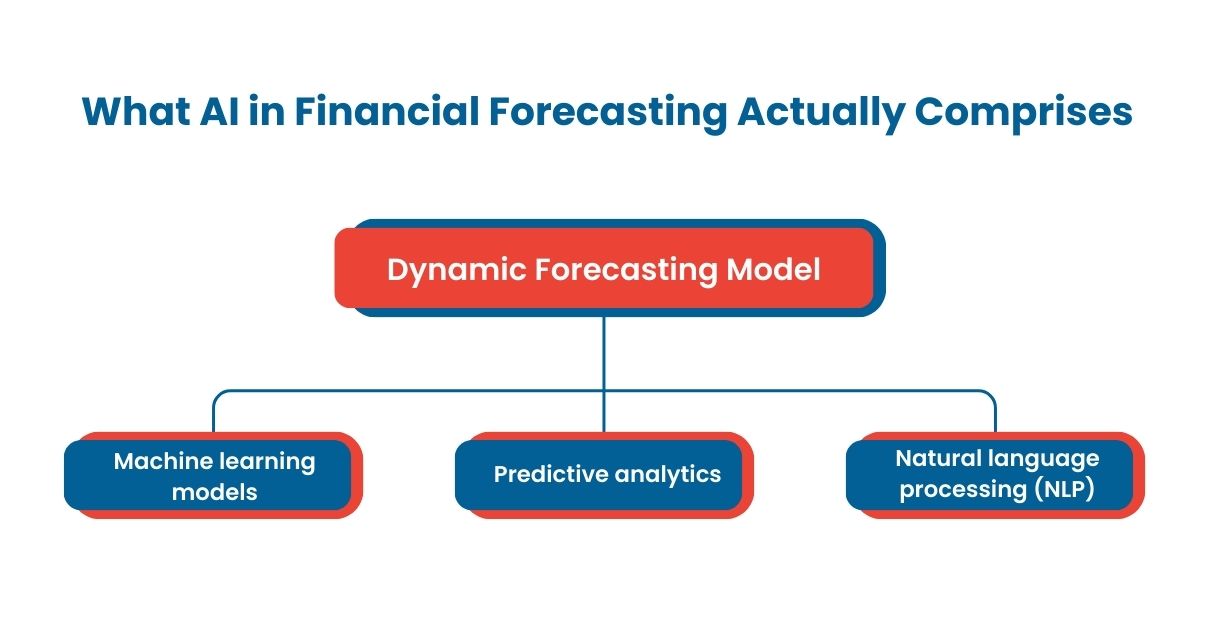
Machine learning models are trained on historical financial data: revenue patterns, cost behaviour, payment cycles, margin trends, and seasonal fluctuations. The models identify correlations and patterns across large datasets. Correlations that would be computationally impractical for a human analyst to find manually. Critically, these models update and improve as new data is introduced, rather than remaining static.
Predictive analytics uses those learned patterns, combined with external data inputs — macroeconomic indicators, sector benchmarks, commodity indices, and currency data — to generate forward-looking projections. This is what moves forecasting from reporting on the past to providing structured intelligence about likely futures.
Natural language processing (NLP) enables AI systems to process unstructured information: Reserve Bank statements, industry reports, supplier communications, earnings calls, and regulatory announcements. This qualitative context, which has historically been excluded from quantitative models because it couldn’t be systematised, can now be factored into forecasts.
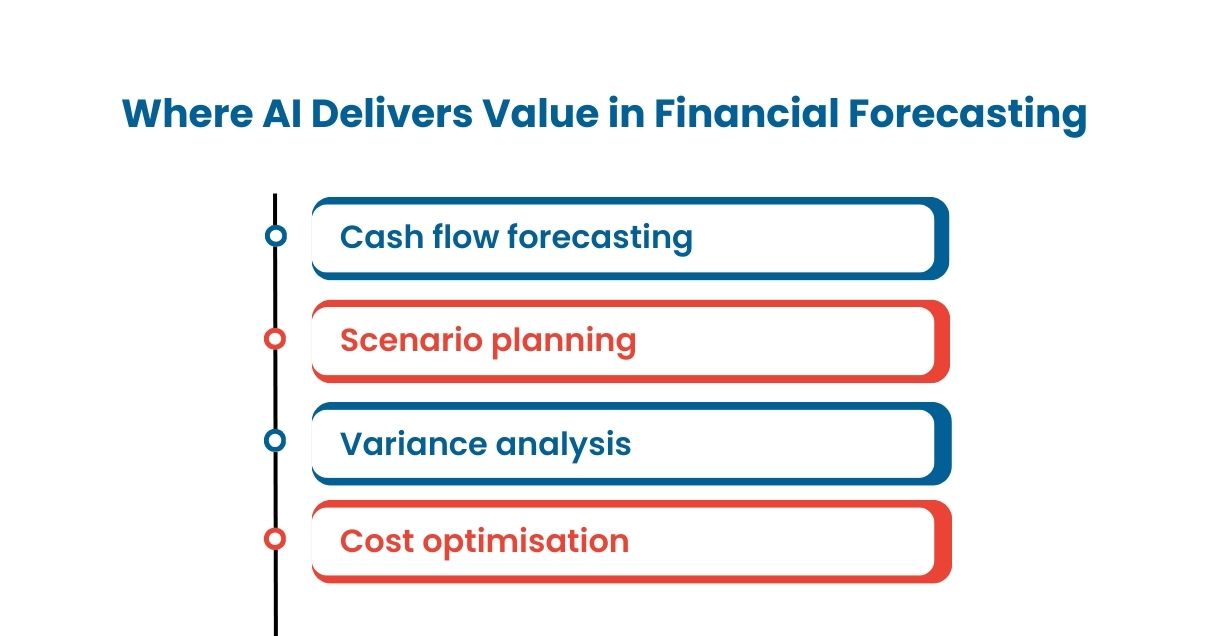
Cash flow forecasting is consistently the highest-impact application. By integrating accounts receivable aging, historical payment behaviour by customer segment, recurring cost structures, and pipeline data, AI models produce cash position projections at 30, 60, and 90-day horizons that are materially more accurate than manually-constructed forecasts. For SMEs and growth-stage businesses, where cash flow management is often the difference between viability and insolvency, this accuracy has direct operational consequences.
Scenario planning is transformed in both speed and depth. Running three manual budget scenarios, conservative, base, and optimistic, typically takes days of analyst time. AI tools can model hundreds of scenarios simultaneously, across a full range of input variables: OCR changes, NZD/USD movements, wage cost pressures, revenue growth rates, and customer retention assumptions. Decisions that previously required weeks of preparation can be made with far greater analytical support.
Variance analysis shifts from a backward-looking reporting exercise to an active diagnostic function. AI-powered real-time financial data integration means variances are identified as they develop, not at month-end close. More importantly, AI can distinguish between structural variances (those likely to persist) and transient ones, enabling finance teams to focus their attention where it has the most strategic consequence.
Cost optimisation surfaces patterns that standard budget reviews miss. Vendor contracts approaching renewal with below-market terms, operational expenditure categories with consistent overspend that has normalised over time, or shared service costs that have grown disproportionately relative to headcount, AI models identify these patterns across multiple periods and flag them for review.
The technology is not the primary determinant of outcomes. Organisations that achieve strong results from AI-powered forecasting share a set of operational characteristics that are distinct from those that don’t.
Data integrity is foundational. Machine learning models trained on inconsistently categorised transactions, incomplete historical records, or a chart of accounts that has been restructured multiple times will produce unreliable outputs, and unreliable outputs undermine trust in the tool, which ends adoption. Before selecting any AI-driven financial tool, a structured review of data quality across your accounting records is the correct starting point.
System integration determines the ceiling on value. AI forecasting tools that operate in isolation from your accounting software, ERP, and banking data feeds require manual data uploads to function. Manual uploads introduce lag and error, which defeats the core purpose of the technology. Deep, automated integration so that the model is continuously updated with current data is what separates genuinely useful forecasting from sophisticated dashboards with stale numbers. This is a non-negotiable technical requirement, not a premium feature.
Model selection must match business characteristics. Time-series forecasting algorithms perform well for businesses with stable, recurring revenue patterns and predictable cost structures. Regression-based models are more appropriate where multiple external variables like exchange rates, commodity prices, and interest rates have a material influence on financial outcomes. Many enterprise tools now use ensemble approaches that combine methodologies, but understanding which approach underpins your chosen tool is important for interpreting its outputs correctly.
Human oversight remains essential. AI forecasting tools produce outputs that require interpretation by professionals who understand the business context, the strategic priorities, and the judgment calls that no model can make. The organisations achieving the best outcomes are those that have redefined the finance function’s role from data processing to strategic analysis and have built the capability to operate at that level.
Several developments in the AI-for-finance space are worth tracking for any finance professional thinking seriously about where this goes over the next three to five years.
Generative AI is being integrated into financial planning tools, enabling plain-language interaction with financial data. Rather than building a custom report, a CFO can ask: “What drove the deterioration in gross margin across our South Island operations over the last two quarters, and which cost centres were the primary contributors?” and receive a structured, data-backed response in seconds. Conversational analytics is moving from prototype to standard capability at a faster rate than most vendors anticipated.
Continuous forecasting, the replacement of fixed annual budget cycles with rolling forecasts updated monthly or quarterly, is being adopted across a growing range of organisations in New Zealand and globally. This model is operationally viable at scale only with AI managing the underlying data processing, model updating, and variance identification. Without it, the administrative burden makes rolling forecasts impractical for most finance teams.
Automated financial reporting is compressing the production time for routine management accounts and board reporting. Consolidation tasks that required multiple days of analyst time are being reduced to hours, redirecting finance capacity toward business partnering and strategic planning.
The trajectory is from descriptive analytics (what happened) to predictive analytics (what will happen) to prescriptive analytics (what the organisation should do in response). AI in financial forecasting is the enabling infrastructure for all three.
For New Zealand businesses operating in an environment shaped by RBNZ monetary policy, international trade exposure, labour market pressures, and evolving compliance obligations, alongside the global markets of the US, UK, and Europe, the ability to forecast with greater precision and adapt with greater speed is a material strategic advantage.
AI in financial forecasting has moved beyond the pilot phase. The technology is proven, the platforms are accessible, and the implementation path is well-documented. What remains is the organisational decision to build this capability into the finance function, or to continue operating with tools that were not designed for the rate of change that modern businesses now face.
The businesses that make that decision now will have a compounding advantage over those that make it later. In financial forecasting, as in markets, timing matters.
Follow Us:

We use cookies and similar technologies to improve your experience, personalise content, analyse website traffic, and understand how visitors interact with our website. Some technologies may help us identify businesses visiting our website and improve our marketing and services. Some cookies are essential for website functionality.