
Xero vs QuickBooks: Country-Wise Comparison (2026) – Which Accounting Software Is Right for Your Business?

Table Of Contents
Toggle




Tax season is not the problem. Not being ready for it is. Most businesses in the US, UK, Australia, and New Zealand don’t fail at tax because they ignored it. They fail because they underestimated it, waited too long, or handed it to someone who wasn’t quite qualified enough.
Professional tax preparation and filing services are not a luxury for big firms. They’re how businesses at every size avoid penalties, claim what they’re actually owed, and stop losing hours to something that should be handled by someone who does it every day.
This blog covers what these services actually include, who needs them, and what to look for in a provider, without the fluff.
A lot of businesses treat tax filing like a form. Fill it in, submit it, done. That works until the numbers are wrong, a deduction is missed, or a deadline is skipped. Then it gets expensive fast.
Tax law isn’t static. Tax code updates, new reporting requirements, and changing thresholds mean last year’s approach may not be correct this year. Professionals track these changes as part of the job. Most business owners simply don’t have time to.
There’s also the opportunity cost angle. The hours a business owner spends sorting through receipts and filling out forms are hours not spent running the business. That trade-off is rarely worth it.
The term covers more than most people expect. It’s not just filling in a return.
Tax preparation means gathering financial data, identifying every applicable deduction and credit, calculating your liability accurately, and getting the return into the right format for your jurisdiction.
Tax filing is submitting that return, whether to the IRS, HMRC, the ATO, or Inland Revenue, along with any supporting documentation.
A full-service provider goes further. Comprehensive tax preparation and filing services typically include income tax returns for individuals and companies, GST and VAT return preparation, payroll tax compliance, BAS preparation for Australian entities, amended return filing, and liaison with tax authorities if something comes up.
Most businesses trip over the same things.
Disorganized records are the most common. Tax returns are only as good as the data behind them. Missing receipts, incomplete reconciliations, and uncategorized expenses all make the process slower and less accurate.
Expense classification mistakes are close behind. Capital versus revenue expenditure, deductible versus non-deductible expenses, and mixed-use asset treatment are areas where errors happen regularly and where the tax consequences can be significant.
Payroll and employer obligations add another layer. PAYE withholding, superannuation contributions in Australia, and National Insurance in the UK sit alongside the business’s own returns and have their own compliance requirements.
GST and VAT compliance is ongoing. For registered businesses, periodic filing requirements add to the workload throughout the year, and many underestimate this until they’re behind.
Claiming what you’re actually owed isn’t aggressive. It’s just knowing the rules.
Depreciation and capital allowances are consistently underused. Instant asset write-off in Australia, Section 179 deductions in the US, and Annual Investment Allowance in the UK all allow accelerated deductions that many businesses don’t fully utilize.
R&D tax credits in Australia, the US, and the UK are often missed entirely because businesses don’t realize their activities qualify, or don’t know how to document them.
Carry-forward losses from prior years can offset against future taxable income, but managing this correctly requires tracking loss positions over time and understanding when and how they’re available.
Tax authorities have gotten much better at detecting anomalies. Data matching programs cross-reference your return against information from banks, employers, investment platforms, and third-party processors. Discrepancies get flagged.
At the lower end, failure-to-lodge penalties accumulate for every period a return is overdue. In Australia they can run to thousands of dollars per late return. In the US, the IRS charges compounding penalties and interest.
The practical response to all of this is straightforward: accurate, timely filing by someone who knows what they’re doing. Professional tax preparation and filing services are as much a risk management tool as a compliance one.
Here’s what the process actually looks like from your end.
It starts with a conversation about your situation: structure, prior returns, outstanding issues, goals. From there, you get a clear document checklist covering financial statements, bank records, payroll summaries, and expense receipts. Secure document sharing handles the transfer.
Preparation involves reconciliation of accounts, identifying all applicable deductions, calculating tax payable, and preparing the return. A senior reviewer checks everything before it goes anywhere.
You then review the return before it’s filed. You should understand what’s being claimed and why. Once you’re satisfied, the return is lodged electronically and you receive confirmation along with a summary of any amounts due and when.
The engagement doesn’t end at filing. Follow-up questions, notices from tax authorities, and planning for the next year are all part of what an ongoing relationship with IMCA looks like.
Small businesses often think professional tax support is for larger operations. That’s backwards. They typically have more to gain.
Mixed-use expenses, home office deductions, and vehicle use are areas where small business owners frequently under-claim or claim incorrectly. Getting these right consistently requires knowing the rules, not approximating them.
Cash flow vulnerability is another factor. A professional who builds quarterly tax estimates into the relationship helps you plan for liabilities before they’re due, rather than scrambling to cover a bill that arrived without warning.
Small business returns also attract more scrutiny from tax authorities, particularly around sole trader deductions and trust distributions. A well-prepared, well-documented return is the best protection against that attention.
Tax obligations vary significantly across industries. A few examples of where specialist knowledge matters:
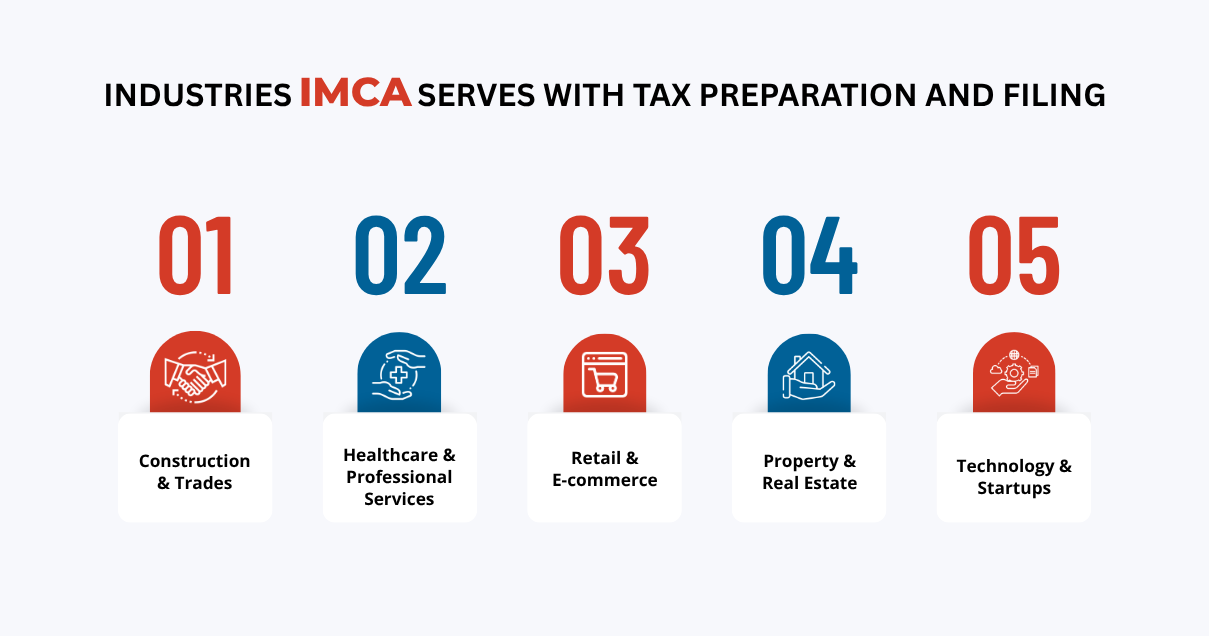
Construction & Trades: Contractual income, subcontracting income, depreciation of equipment, and vehicle costs must be managed with precision.
Healthcare & Professional Services: Business structures, income-sharing plans, and professional liability considerations continue to be a major area of emphasis.
Retail & E-commerce: Cross-border GST/VAT requirements, foreign exchange dealings, and marketplace platform reporting introduce new challenges.
Property & Real Estate: Income from rentals, investment property depreciation, and capital gains planning demand specialized expertise.
Technology & Startups: Research & Development tax credits, share scheme reporting, and international income present valuable opportunities for specialized advice.
The obvious benefit is fewer errors. Professional preparers use review processes and software that catch mistakes before they reach the tax authority. Your exposure to late filing penalties and underpayment interest drops significantly.
The less obvious benefit is what you find. A good tax preparer doesn’t just file what you give them. They look at what you’re entitled to claim. Allowable deductions, credits, and concessions that most business owners miss or under-claim are surfaced and applied correctly.
And if a tax authority does come asking questions, having a professional firm that prepared your return is a real advantage. They can manage the response without it eating up your time.
There’s no shortage of accountants. What’s harder to find is one who works across US, UK, Australian, and New Zealand tax rules with genuine depth in all of them.
Indian Muneem is built around a few things that actually matter to clients. Work is done year-round, not just at filing time, so tax planning strategies are in place before they’re needed. Pricing is transparent and quoted upfront. And clients deal with qualified chartered accountants, not junior staff or overseas processing teams.
The other thing that tends to matter: responsiveness. When a client has a question, they get a real answer from someone who knows their file.
Clients stay because the basics are done consistently. Deadlines are met. Fees are as quoted. Returns are filed correctly. When something comes from a tax authority, it’s handled.
Beyond execution, the advice is specific to the business. Generic guidance is freely available and worth roughly what you pay for it. Indian Muneem takes the time to understand your structure, your industry, and your goals so that the advice you get actually applies to your situation.
The long-term view matters too. Tax-efficient structures and sound practices are built over years, not put together in the weeks before a deadline. That’s the kind of relationship Indian Muneem is built around.
If your tax situation feels more complicated than it should, or you’re not confident you’re claiming everything you’re entitled to, a conversation with Indian Muneem is a good starting point.
The team provides tax preparation and filing services for businesses and individuals across New Zealand, the US, the UK, and Australia. Engagements start with a no-obligation consultation where you get a clear picture of what support looks like and what it costs.

We use cookies and similar technologies to improve your experience, personalise content, analyse website traffic, and understand how visitors interact with our website. Some technologies may help us identify businesses visiting our website and improve our marketing and services. Some cookies are essential for website functionality.