

Q3 Estimated Tax Deadline 2026: Your Complete September 15 Checklist
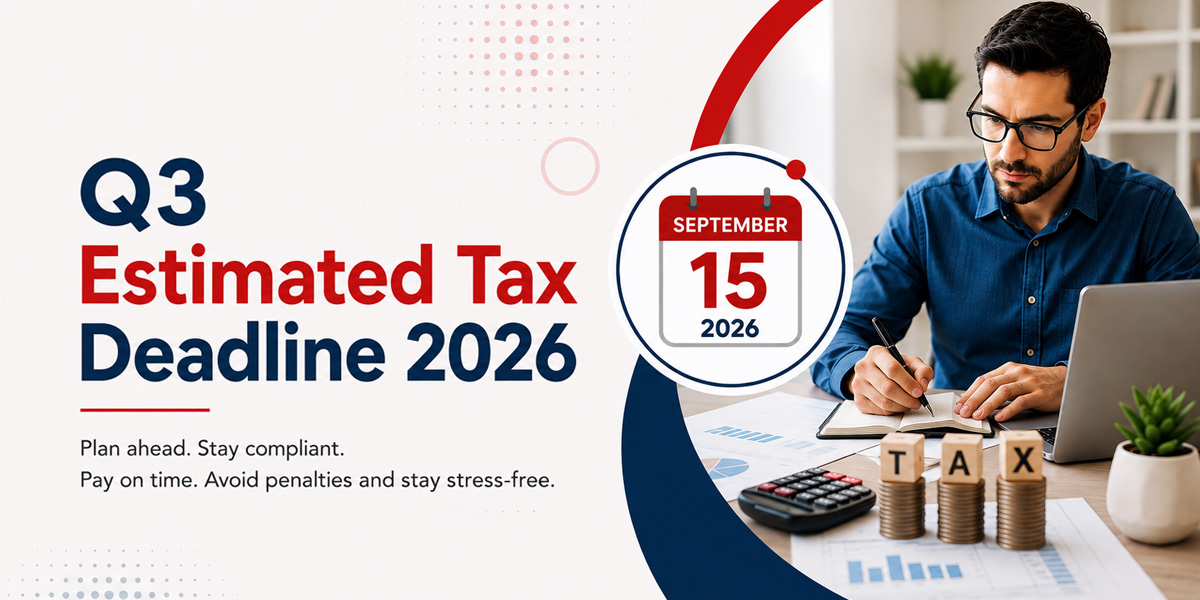
Q3 Estimated Tax Deadline 2026

If you run a business, work as a freelancer, or handle income where taxes aren’t taken out automatically, September is a big deal. The numbers you used back in April or June? They might not make sense anymore.

Maybe your revenue spiked over the summer. Maybe you sold off some stock and hit a huge capital gain, or landed a project that doubled your normal monthly rate. Or maybe things went the other direction and money was tighter than you planned. Either way, sending in a Q3 payment based on old guesses is a mistake. Your September 15 payment needs to match where your business actually stands right now.

If you’re running a CPA or accounting firm, this gets multiplied by every client on your list. Trying to run calculations on messy, outdated books right before a deadline is a nightmare. Getting financial records straight today makes the whole process smoother.

What Is Due on September 15, 2026?

For calendar-year individual taxpayers, September 15 is the due date for the third 2026 estimated tax installment.

Estimated tax is part of the federal pay-as-you-go system. Employees generally pay income tax throughout the year through payroll withholding. People who receive income without sufficient withholding may need to make estimated payments themselves.

The standard 2026 schedule for individuals is:

Payment Income Period Due Date
First January 1–March 31 April 15, 2026
Second April 1–May 31 June 15, 2026
Third June 1–August 31 September 15, 2026
Fourth September 1–December 31 January 15, 2027
One point that sometimes causes confusion is that these are not four equal three-month periods. The third installment is associated with income from June through August.

September 15 is also relevant to some extended business returns. For example, calendar-year partnerships and S corporations that obtain timely extensions generally have extended filing deadlines as of that date. Those filings are separate from an individual’s Q3 estimated payment.

Who Should Be Looking at Q3 Estimated Taxes?

The issue is not limited to full-time business owners.

Estimated payments may be relevant to freelancers, consultants, independent contractors, sole proprietors, partners, certain LLC members, S-corporation shareholders, landlords, and investors.

They can also affect someone with a regular W-2 job.

Suppose an employee has adequate withholding from salary but also receives substantial consulting income or realizes a large investment gain. Their normal paycheck withholding may no longer be sufficient to cover their overall tax liability.

Under the general IRS rules, individuals typically need to consider estimated payments if they expect to owe at least $1,000 after subtracting withholding and refundable credits and their expected payments fall below the applicable thresholds.

The important question is therefore not simply, “Am I self-employed?”

It is: Is enough tax being paid during the year based on my overall income?

Do Not Automatically Repeat Your Q2 Payment

This is one of the most practical checks to make before September 15.

If income, deductions, and withholding have remained fairly consistent, the next estimated payment may look similar to earlier installments.

But that should be the result of the calculation, not an assumption.

Start with current year-to-date information. Review what the business has actually earned, what expenses have been recorded, and whether anything significant happened during the summer.
Then look ahead.
Has revenue increased? Was there a large capital gain? Is a year-end bonus expected? Has business slowed? Did the taxpayer move from employment into self-employment?
The answers can change the estimate.
Form 1040-ES provides the federal worksheet for estimating the year’s tax. The calculation considers expected income, deductions, credits, taxes, withholding and other payments.

Consider a simple example

A consultant starts 2026 with an expected annual income of around $120,000 and makes the first two estimated payments based on that expectation.

By August, several new contracts have materially increased projected annual income.

Continuing with the original estimate simply because “that’s what we paid last quarter” may no longer make sense. The better approach is to update the full-year projection, confirm the tax already paid, and determine whether the September payment should be adjusted.
The same principle works in reverse. If income has fallen, blindly following an earlier projection may result in paying substantially more during the year than necessary.

How the Estimated Tax Safe Harbor Works

Safe harbor is one of the most useful concepts in estimated-tax planning, but it is often explained more technically than necessary.

For most individual taxpayers, the general federal framework considers whether payments during the year reach the smaller of:

  • 90% of the tax expected for the current year, or
  • 100% of the tax shown on the prior-year return, provided the prior return covered 12 months.

For certain higher-income taxpayers, the prior-year percentage increases to 110%. The current Form 1040-ES should be checked for the applicable requirements and exceptions.

Why does this matter?

Because the previous year’s tax is already known. The current year’s final tax is not.
That can make the prior-year safe harbor useful when income is difficult to predict.

There is, however, an important distinction:

Safe harbor can protect against an estimated-tax underpayment penalty. It does not necessarily mean the taxpayer has paid the full tax that will ultimately be due.

Someone having a particularly strong 2026 could satisfy the applicable safe-harbor requirement and still owe additional tax when the return is filed.

Your September 15 Checklist

A useful Q3 review starts with the accounting records, not the payment screen.
  1. Bring the books current.
    Make sure recent income and expenses have been recorded. A tax projection based on incomplete books can give a misleading result.
  2. Reconcile key accounts.
    Bank and credit card reconciliations can uncover missing, duplicated or incorrectly recorded transactions.
  3. Review year-to-date income.
    Compare actual performance with the assumptions used for earlier estimates.
  4. Look for unusual transactions.
    A capital gain, asset sale, large contract, bonus or other one-time event may materially change the tax position.
  5. Confirm what has already been paid.
    Check the Q1 and Q2 payments that actually cleared rather than relying on what was originally scheduled.
  6. Review withholding.
    Include federal income tax withheld from wages and other applicable sources.
  7. Update the full-year projection.
    Use current information to estimate income for the remainder of 2026.
  8. Check the applicable safe harbor.
    Compare the current-year estimate with the relevant prior-year threshold.
  9. Calculate the Q3 payment.
    Use Form 1040-ES and appropriate tax guidance rather than relying on a fixed percentage or simply repeating the previous installment.
  10. Submit the payment and retain confirmation.
    Keep proof of payment with the taxpayer’s records. The next estimated tax installment is generally due on January 15, 2027.

What If Income Has Been Uneven?

Not every taxpayer earns income at a steady rate.

A seasonal business might generate most of its profit during a few months. A consultant could receive a large project payment in August. An investor may realize a significant gain late in the year.

In situations where income is uneven, the Annualized Income Installment Method may be relevant. It can allow the required installments to reflect when income was actually earned rather than treating the year’s income as though it arrived evenly.

This calculation is more involved and may require Form 2210.

For taxpayers with highly variable income, this is one area where working with an appropriate tax professional can be particularly useful.

What Happens If the September 15 Payment Is Missed?

Ignoring a missed payment until tax filing season generally does not improve the situation.

The IRS can impose an underpayment penalty when sufficient tax was not paid on time through withholding and estimated payments. The calculation can depend on both the amount underpaid and the length of time it remained unpaid.
If a required payment has been missed, making it sooner may reduce the period of underpayment.
Form 2210 is used in certain situations to determine an underpayment penalty, although taxpayers do not always need to calculate the penalty themselves.

Why Bookkeeping Readiness Matters

For business owners, an estimated tax calculation depends heavily on the quality of the financial information supporting it.
If transactions are several weeks behind, bank accounts have not been reconciled or expenses are sitting in the wrong categories, the tax team may first have to determine whether the year-to-date numbers can be trusted.
For an individual taxpayer, that is inconvenient.
For a CPA firm managing dozens or hundreds of clients, it can become a workflow problem.
Instead of moving directly into tax calculations and review, staff may spend valuable time requesting missing records, cleaning up ledgers, and confirming prior payments.
This is why bookkeeping readiness should be part of the Q3 process rather than treated as a separate year-end issue.

Q3 Is Also a Capacity Test for CPA Firms

The September workload extends beyond estimated-tax calculations.
Accounting firms may also be managing extended business returns, client questions, bookkeeping cleanup, document collection, workpaper preparation, and internal review.
The technical work is only part of the challenge. The other part is getting every file ready for that work to happen.
That is where outsourced accounting support can fit into an existing CPA-firm workflow.

Indian Muneem Chartered Accountant (IMCA) supports CPA and accounting firms with agreed behind-the-scenes accounting and tax preparation activities. Depending on the engagement, that can include bookkeeping support, reconciliations, document organization, supporting schedules and tax preparation work.

The CPA firm retains its professional oversight, review process and client relationship.
For firms that already have the expertise but need more preparation capacity, the objective is straightforward: keep routine preparation work moving so qualified staff have more time available for review and client-facing decisions.

Frequently Asked Questions

For calendar-year individual taxpayers, the third 2026 estimated tax installment is due on September 15, 2026.
The third estimated-tax period for calendar-year individuals runs from June 1 through August 31, 2026.
Estimated payments commonly apply when income is not sufficiently covered by withholding. This can include self-employed individuals, partners, landlords, investors, and people with substantial side income.
For most taxpayers, the general test applies a 90% threshold of current-year tax or 100% of prior-year tax, with the prior-year percentage increasing to 110% for certain higher-income taxpayers.
Yes, but a required payment made after September 15 remains late. Paying sooner can reduce the period during which an underpayment exists.
No. Federal and state estimated-tax obligations are separate. State deadlines and calculation rules may also differ, so the relevant state tax authority should be checked.

Prepare the Numbers Before the Deadline

The Q3 estimated tax deadline is not simply about remembering September 15. It is about ensuring the payment reflects what actually happened during the year.
Before submitting Q3, bring the books current, confirm earlier payments and withholding, review significant changes in income, and update the annual tax projection.
For CPA and accounting firms, completing those steps across a large client base can create additional pressure at an already busy point in the calendar.
IMCA provides outsourced tax preparation and accounting support to help CPA and accounting firms add capacity for tax preparation while maintaining their existing review, quality control, and client management processes.
This article is provided for general informational purposes and does not constitute individual tax, legal, accounting, or financial advice. Tax requirements depend on individual circumstances and can change. Refer to current IRS and applicable state guidance or consult an appropriately qualified tax professional.

    Let’s Discuss Your Business Needs

    Tell us how we can help, and our team will get back to you shortly.

    Scroll to Top