Bookkeeping for Real Estate Investors: 9 Essential Practices for Better Financial Control
Table Of Contents
Toggle
There is a familiar scene in many accounting firms: a role is open, the workload is already there, and everyone knows the person being hired will need to be productive and quick. The problem is that finding someone with the right accounting background is only part of the challenge now.
The work itself has changed. A good accountant may be expected to move between accounting software, client conversations, financial analysis, and AI-enabled tools in the same week. Partners want people who can take ownership rather than wait for instructions. Clients want explanations, not just reports, and experienced staff is being pulled into work that used to sit lower down the career ladder.
That puts the CPA talent crisis in a different light. The shortage is not only about how many accountants are available, but it is also about whether firms can find people with the combination of skills the job now demands.
The Controllers Council’s 2026 Corporate Finance & Accounting Talent Study puts some numbers behind the pressure: its Talent Shortage Index reached 77%, while its Hiring Index reached 134%. The survey covered controllers, CFOs, and other finance executives and points to a market where companies are looking to hire while finding qualified people remains difficult.
KPMG describes a similar set of pressures, including a declining CPA pipeline, retirements, changing expectations among younger professionals, and the added complexity that technology is bringing to finance roles.
But there is an important detail that can get lost in the conversation about the shortage.
Suppose a firm manages to hire a capable accountant tomorrow; that person may still need to work with an AI-assisted workflow, understand data coming from several systems, review automated work, and explain financial results to someone who does not speak accounting.
If the firm has filled the vacancy, it has not necessarily solved the capability gap.
Technical accounting knowledge remains the starting point. The difference is what needs to sit around it.
There is another wrinkle, particularly for junior accountants.
Some of the work that experienced professionals remember as tedious was also how they learned. Reconciliations, transaction testing, checking supporting documents and tracing figures through a system gave new accountants a feel for how records were built and where things could go wrong.
AI and automation are changing that apprenticeship.
A March 2026 Journal of Accountancy article examines the problem: when entry-level tasks are automated, firms must find other ways to teach conceptual understanding, judgment, and professional skepticism.
That is more significant than it sounds.
Take a simple example. An automated system identifies an unusual expense pattern. A junior accountant may no longer spend hours finding the transactions that produced the pattern. That is useful. But someone still has to decide whether the flag is meaningful.
Was there a one-off purchase? A change in the way costs were coded? A new supplier? Or an actual control problem?
The accountant who understands the underlying accounting can investigate. The accountant who has only learned to accept the system’s answer cannot.
So firms have a training problem as well as a hiring problem.
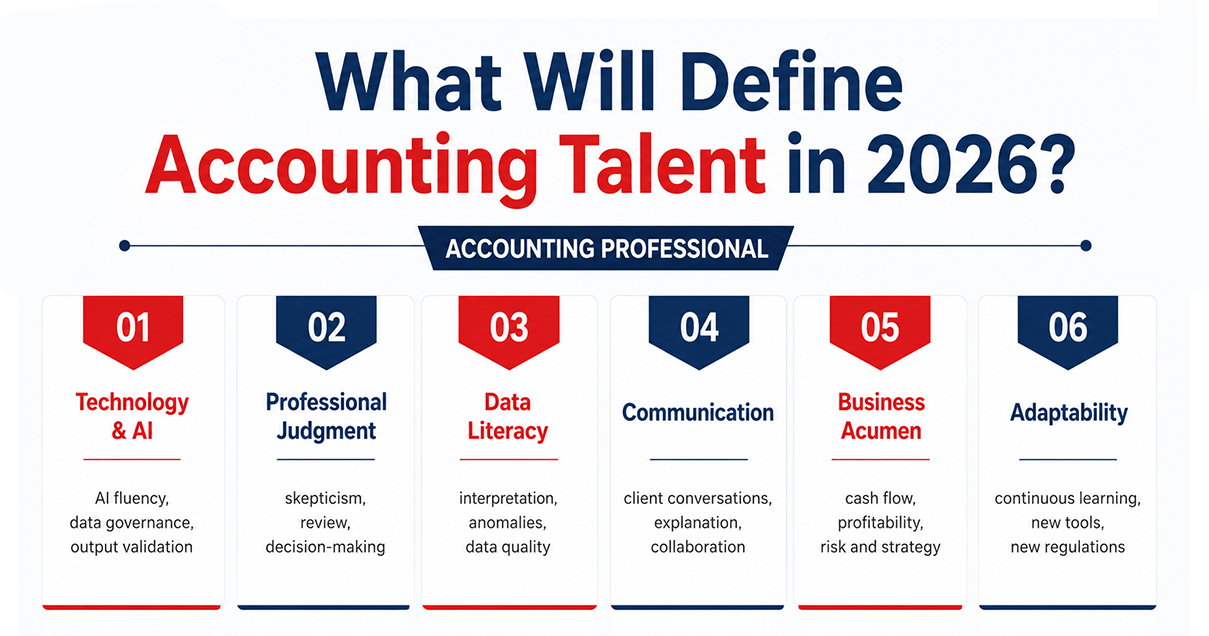
Accountants do not need to write software to work effectively with AI.
They do need to understand what happens between entering a prompt and receiving an answer. What information is being used? How reliable is the source? What are the system’s limitations? Does sensitive client data belong there? When should the output be reviewed by a person?
These questions are becoming part of ordinary professional judgment.
That is a more useful definition of AI fluency than simply knowing which buttons to press.
Accounting has always required judgment. Technology makes that judgment more visible.
Imagine an automated analysis shows that a client’s gross margin has deteriorated sharply. The software can identify the change in seconds. It cannot necessarily tell you whether the real cause was discounting, a supplier price increase, product mix, or an accounting classification issue.
Research in the May 2026 Journal of Accountancy identifies critical thinking as one of the human competencies that matter for CPAs working alongside AI.
For an accounting professional, critical thinking is not abstract problem-solving. It is the habit of being slightly uncomfortable with an answer until the evidence supports it.
If receivables are climbing, for instance, the useful question is not simply how much they have increased. It is why. Is the client selling more? Taking on slower-paying customers? Experiencing billing delays? Carrying old balances that should have been addressed earlier?
The accountant who can connect financial movements to the underlying business is doing work that a reporting system cannot do on its own.
A technically correct answer can still be a poor answer for the client.
A business owner may not care which accounting rule sits behind a conclusion. They need to know what changed, why it matters, and what they should consider doing next.
That requires accountants to ask better questions, listen properly, and explain complex issues without resorting to jargon.
The May Journal of Accountancy research also highlights empathy and interpersonal relationships alongside critical thinking, creativity, and strategic vision.
These are not decorative skills for an advisory-oriented accountant. They affect whether clients trust the advice they receive.
The most useful financial discussion often begins after the report has been delivered.
Why did profitability fall? What is happening to cash? Which customers are becoming less attractive? Is a growth plan putting too much pressure on working capital?
Accountants who understand the commercial side of the business can participate in those conversations. They do not have to become strategists overnight. They simply need to understand that financial statements describe a business; they do not exist separately from it.
There is no sensible final list of accounting technologies that someone can master and then put away.
Systems will change. AI tools will change. Regulations will change. Client expectations will change.
The implication for accountants is fairly practical: learning has to become part of the job rather than something reserved for annual training requirements. The March Journal of Accountancy research similarly points toward continuous upskilling and more experiential approaches to professional development.
This is where the talent discussion becomes an operating question.
If technology removes some of the work junior accountants used to learn from, firms need to replace the learning opportunity—not simply celebrate the time saved.
That could mean giving junior staff more responsibility for reviewing automated outputs, using simulations for unfamiliar situations, involving them earlier in client discussions or deliberately moving certain responsibilities down the hierarchy with appropriate supervision.
KPMG also points to upskilling existing employees and investing in technology as part of the response to the accounting talent shortage.
There is a useful principle here: automation should change the work people learn from, not remove the opportunity to learn.
There will still be times when training and technology cannot solve an immediate capacity problem.
A firm may have the right senior accountants but too much bookkeeping, reporting, tax preparation, or other recurring work sitting on their desks. Hiring another full-time employee may take months, and sometimes the additional workload does not justify a permanent position.
Qualified external accounting support can fill part of that gap.
Used well, outsourcing does not have to mean handing away the firm’s core expertise. An external team can take on defined accounting processes while internal CPAs retain responsibility for review, client relationships, complex decisions, and advisory work.
That distinction matters. The point is to give experienced professionals more room to use the skills that are hardest to replace.
For firms working with providers such as Indian Muneem Chartered Accountant, the model can therefore be viewed as an extension of internal capacity rather than a substitute for the internal accounting team.
The strongest response to the CPA talent crisis will probably involve several things at once: better training, sensible use of technology, stronger development of existing professionals and additional capacity where firms need it.
For accountants, the direction is equally clear. Technical knowledge still matters enormously. But the professionals who can combine it with judgment, data understanding, communication, business awareness and the ability to work intelligently with technology will have more room to grow.
All told through real firm case studies, not theory.
The profession is not running out of reasons to need accountants.
It is becoming more demanding about what it needs them to do.

We use cookies and similar technologies to improve your experience, personalise content, analyse website traffic, and understand how visitors interact with our website. Some technologies may help us identify businesses visiting our website and improve our marketing and services. Some cookies are essential for website functionality.