Bookkeeping for Real Estate Investors: 9 Essential Practices for Better Financial Control
Table Of Contents
Toggle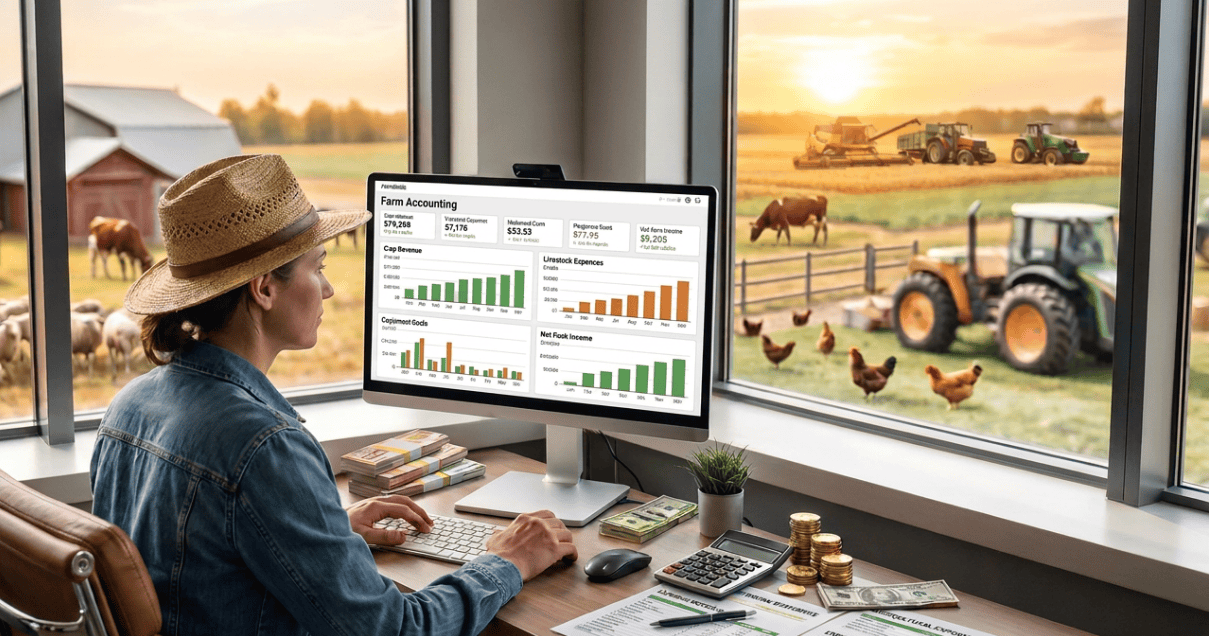
Agriculture is a multi-billion-dollar industry across the US, UK, Australia, and New Zealand. Yet farm bankruptcy rates consistently outpace most other industries. The land is productive. The labor is there. What’s usually missing is financial clarity, and that’s an accounting problem, not a farming one. The key benefits of using accounting for farming go far beyond just tracking numbers. Done right, farm accounting gives you a clear picture of what’s working, what’s draining your resources, and where your next dollar should go.
This guide breaks it all down. Whether you run a dairy operation in New Zealand, a grain farm in Australia, a sheep station in the UK, or a family farm in the US, this is for you.
A farm accountant keeps track of all the financial transactions that take place at an agrarian business. Essentially, farm accounting involves knowing how much you earned, how much you spent, and ultimately, whether you have been making money.
These transactions include revenue from sales of crops, revenue from livestock sales, leases, cost of seeds and fertilizers, fuel, wages, maintenance of farm equipment, and interest on loans. Farm accounting, however, goes beyond what most general accountants do, involving issues such as inventory value of stored grains and livestock assets, depreciation of tractors, and profitability of various agricultural enterprises.
The choice between cash basis accounting and accrual accounting matters in farming. Cash basis is simpler and works for smaller operations. But accrual accounting gives a more accurate picture as farms grow, especially with significant inventory on hand or large prepaid expenses heading into a new season.
This is where working with professionals like Indian Muneem Chartered Accountant (IMCA) makes a tangible difference. IMCA brings structured farm financial management to operations that have historically run on gut feel. For farms dealing with seasonal income swings, equipment financing, and multi-enterprise complexity, having a proper accounting framework is the difference between managing a business and just hoping things work out.
Margins have compressed. That’s true in the US, Australia, New Zealand, and the UK. Input costs have outpaced commodity prices in many sectors, and the financial buffer that used to absorb sloppy management is largely gone.
Lenders have gotten stricter too. Banks and agricultural lenders like Farm Credit, Rabobank, and rural specialist lenders want actual financial statements now, not a general sense of how things are going. Balance sheets, profit and loss statements, cash flow history. Government support programs are similar. Whether it’s a USDA payment, an agri-environment scheme in England, or drought assistance in Australia, documentation requirements have increased significantly.
Not theory. Actual outcomes farms experience when they get their financial management right.
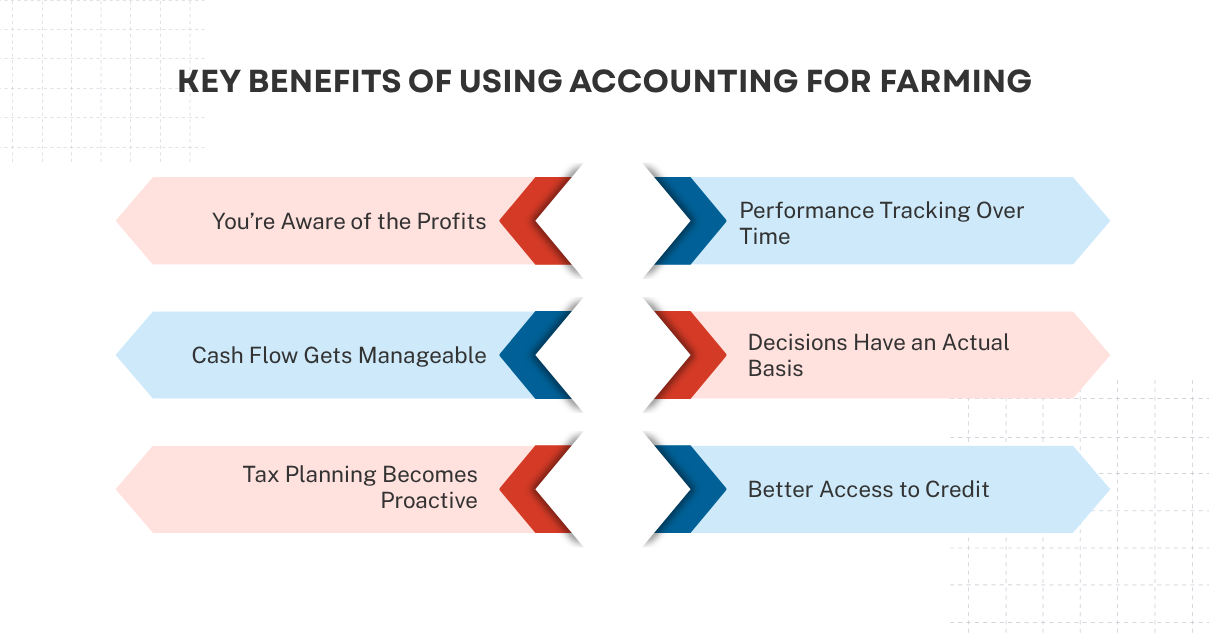
This sounds obvious. It isn’t. A farm running crops, cattle, and agritourism might feel profitable because cash is coming in. But which enterprise is driving the profit? Which one is quietly bleeding money? Without enterprise gross margin analysis, you genuinely don’t know.
Farm cash flow is lumpy by nature. Heavy spending happens ahead of planting. Income arrives at harvest. That gap can span months, and if it hasn’t been planned for, that’s where farms get into serious trouble.
Cash flow forecasting maps out the full year: when money comes in, when big expenses land, where the tight spots are. You’re not caught off guard by a cash crunch in May because you saw it coming in January and arranged your operating line accordingly. Cash flow problems kill farms that are otherwise profitable on paper. This is one of the single biggest practical wins from proper accounting.
In the US, depreciation elections like Section 179 let you write off equipment in the year of purchase. Timed right, that significantly reduces taxable income in a strong year. In Australia, Primary Production averaging smooths income across years so you don’t get hammered after a string of poor ones. In New Zealand, livestock valuation methods can be selected strategically. In the UK, specific capital allowances apply to agricultural assets.
None of these strategies are accessible if your records are a mess. A good accountant with clean data will find legal tax savings that cover their fee many times over.
Walk into a bank with three years of clean, professionally prepared financial statements and the conversation is completely different from showing up with rough figures you assembled the night before.
Farms with organized accounting get better loan terms. They’re treated as lower-risk borrowers because they demonstrate financial discipline. Farms without clean records pay higher rates, get smaller facilities, or get turned down. Bad record-keeping has a direct, measurable cost in your borrowing rates.
Should you buy the neighboring property or lease it? Add irrigation? Forward contract next season’s grain?
Partial budgeting, whole farm budgeting, and sensitivity analysis let you model decisions before making them. But only if you have accurate underlying data. Accounting provides that data. Farms making data-driven decisions consistently outperform those running on gut feel, and agricultural extension research across all four countries backs that up.
Year-one data is interesting. Year-five data is where real insight lives. Tracking your cost of production per unit across seasons shows whether efficiency is improving or quietly degrading. Comparing your return on assets against industry benchmarks from DairyNZ, Meat and Livestock Australia, the UK Farm Business Survey, or US land-grant university extensions tells you whether you’re performing well or whether there’s a gap worth investigating.
That kind of benchmarking is only possible with consistent historical records.
Separate enterprise tracking is non-negotiable. Income and costs need to be split by activity, not lumped together. Livestock and crop inventory management has to handle valuation changes and their tax implications correctly. Fixed asset tracking with depreciation keeps your balance sheet accurate and helps plan equipment replacement.
Cash flow forecasting integrated with bank feeds keeps projections current without constant manual input. Farm-specific reporting matters too: gross margin by enterprise, cost of production per unit, farm equity statements. These tell you what’s actually happening. Standard profit and loss statements alone don’t.
Commonly used platforms include Xero, QuickBooks Online, and MYOB as general bases. Agricultural-specific tools like Figured (popular in NZ and Australia), AgriMaster, and FarmFocus are purpose-built for farming and often a better fit for more complex operations.
Cash flow surprises top the list. Without forecasting, farms run short before planting, scramble for expensive overdraft, and sometimes delay inputs with real yield consequences.
Tax overpayment is chronic in farms with poor records. Missing depreciation elections, not timing income and expenses strategically, leaving deductions on the table. Over a decade, the cumulative cost is often substantial.
Hidden losses are the sneakiest problem. One strong enterprise can mask a losing one for years. The overall farm looks fine until the profitable side can no longer carry the losses. By then, fixing it is harder than it needed to be.
Poor records also directly affect your financing terms and succession outcomes. Contested valuations, late-discovered liabilities, and family disputes over farm transitions are far more common when the financial history is unclear.
Cloud accounting platforms now give real-time visibility. Bank transactions sync automatically. Invoices get captured by phone. Reports are current rather than months old by the time they’re produced.
Precision agriculture technology is connecting to financial systems in meaningful ways. GPS-guided machinery records input applications by field. Yield monitors record output by zone. That feeds directly into cost of production calculations with a level of detail that wasn’t practical a decade ago.
Farm management information systems (FMIS) are integrating operational and financial records. What happened in the paddock connects to what it cost and what it produced. The infrastructure is there. The main barrier now is adoption.
Scale and complexity come first. A small single-enterprise operation has different needs than a large mixed farm across multiple legal entities. The more complex the structure, the stronger the case for purpose-built agricultural software and a specialist accountant.
Your pain points should drive the choice. Cash flow problems? Start with forecasting tools. Tax concerns? Find an accountant with genuine agricultural experience before worrying about software. Loan applications pending? You need professionally prepared statements, which means organized records and someone qualified to prepare them.
Local knowledge is essential. Tax rules, subsidy programs, and compliance requirements differ meaningfully between the US, UK, Australia, and New Zealand. Your accountant and your software both need to be calibrated for your specific environment.
For farms looking to get their financial function properly structured, working with an accounting partner like IMCA provides a professional framework from the start rather than trying to piece it together as you go.
Farming has enough variables you can’t control. Financial management shouldn’t be one of them.
The key benefits of using accounting for farming aren’t abstract. They show up in your tax bill, your loan terms, your ability to catch a problem before it becomes a crisis, and your ability to plan beyond next season. The tools are available. The expertise is accessible. The return on the investment is well-documented.
What’s holding most farms back isn’t access. It’s getting started.
If you’re ready to get your farm finances properly sorted, IMCA can help you build the accounting foundation your operation needs.

We use cookies and similar technologies to improve your experience, personalise content, analyse website traffic, and understand how visitors interact with our website. Some technologies may help us identify businesses visiting our website and improve our marketing and services. Some cookies are essential for website functionality.