
October 15 Tax Deadline: How CPA Firms Can Manage Tax Season Workloads Without the Last-Minute Rush
Table Of Contents
Toggle



If your business sends financial statements across borders and you are still relying on a basic review process, you are leaving serious risk on the table. Director-level review is not just a compliance checkbox. It is the layer of oversight that separates businesses that grow confidently in the US market from those that get blindsided by regulatory gaps, reporting errors, or liability issues they never saw coming.
This guide is for business owners, CFOs, and finance leads in the UK, US, Australia, and New Zealand who want to understand what the best director level review services in the USA actually look like, and how to pick the right one for their business in 2026.
Director-level review refers to a structured financial and compliance oversight process carried out by a senior professional, typically a director or partner-equivalent, who examines your financial records, reporting, and internal controls with a high level of authority and accountability.
This is not the same as a standard accountant review. The person doing the review holds responsibility for signing off on findings, and they carry professional liability for the quality of that work.
In a US context, this usually means:
A CPA-licensed director reviews your financial statements or management accounts. They assess risk areas, flag inconsistencies, and provide a formal conclusion. The output carries weight with lenders, investors, regulators, and tax authorities.
Engagement letters, working paper files, risk-based review procedures, and management representation letters are all standard components of a proper director-level engagement. If your current provider is not using these, that is your first red flag.
Also Read: Why Businesses in the USA, NZ, & Europe Are Choosing Outsourced Accounting Services in 2026
The US regulatory environment is not forgiving of sloppy reporting. Whether you are a UK-based company with a subsidiary in California, an Australian firm entering the US market, or a New Zealand business with US investors, the stakes are real.
Here is what actually happens when businesses skip proper review:
Banks and lenders in the US will ask for reviewed or audited financials before they extend credit. A compilation from your bookkeeper will not cut it. Investors, especially institutional ones, will want to see that a qualified professional has signed off on your numbers. PCAOB standards and AICPA guidelines exist for a reason, and non-compliance can result in penalties, deal collapses, or rejection from listing platforms.
There is also the internal benefit. A director-level review often surfaces issues that management never noticed. Material misstatements, related party transaction disclosures, and going concern indicators are things that get caught at this level, not at the bookkeeping level.
For businesses growing into the US from Australia, the UK, or New Zealand, the cross-border financial reporting complexity alone justifies bringing in experienced director-level professionals who understand both your home standards and US requirements.
Not all review services are equal. Here is what actually differentiates a premium offering from an average one.
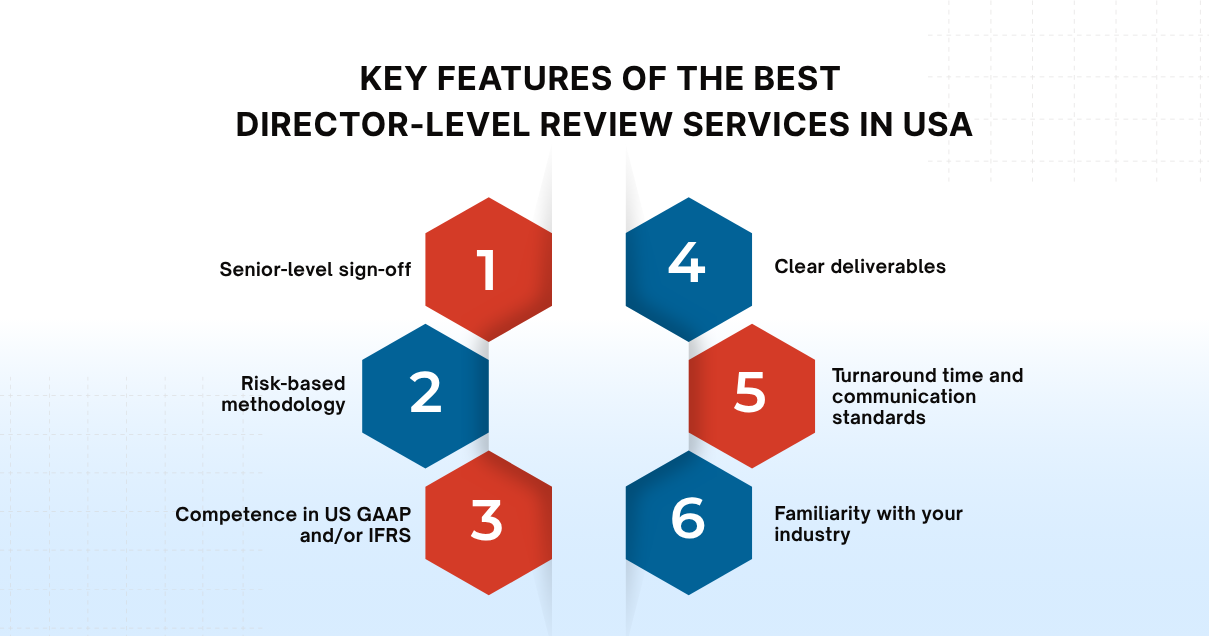
Senior-level sign-off: The review should be performed and concluded by a licensed CPA director or equivalent, not delegated to a junior staff member with a director’s name rubber-stamped at the end. Ask directly who will be performing the work.
Risk-based methodology: The best providers use a risk-based review approach, which means they focus their effort where the numbers are most likely to go wrong, rather than applying a checklist uniformly across all accounts.
Competence in US GAAP and/or IFRS: Based on the nature of your entity and reporting needs, you will require personnel that are truly proficient in both frameworks. Incorrect application of accounting standards is among the most prevalent and expensive mistakes in international transactions.
Clear deliverables: You should receive a formal review report, a management letter with findings, and a discussion of any areas requiring attention. Vague verbal feedback is not a review. It is a conversation.
Turnaround time and communication standards: US business timelines are fast. If your review provider takes three weeks to respond to basic queries, that will cause real problems when you are closing a funding round or meeting a regulatory deadline.
Familiarity with your industry: A director reviewing a SaaS company’s financials needs to understand deferred revenue recognition under ASC 606. One reviewing a real estate holding company needs to know ASC 842 lease accounting. Industry-specific knowledge is non-negotiable at this level.
When you have a senior professional reviewing your financials, your management team gets sharper. Directors tend to ask the questions that junior reviewers skip. They push back on assumptions. They identify where your internal controls are weak before an auditor or regulator does.
For fundraising, a reviewed set of financials from a reputable firm gives investors confidence. It signals that someone with professional skin in the game has looked at your numbers and is comfortable putting their name on them.
For acquisitions and exits, the buyer’s legal team will go through your financials with serious scrutiny. A clean director-level review package means fewer surprises in due diligence, which directly protects your valuation.
From a tax perspective, having a director-level review also creates a proper paper trail for transfer pricing documentation, intercompany transactions, and positions taken on R&D tax credits or other incentives. If the IRS or state tax authority ever comes knocking, your reviewed financials are a much stronger defense than unreviewed management accounts.
This is where most businesses get it wrong. They go by price, or they pick the biggest name, or they just use whoever their accountant recommends without doing any real due diligence.
Here is a smarter framework.
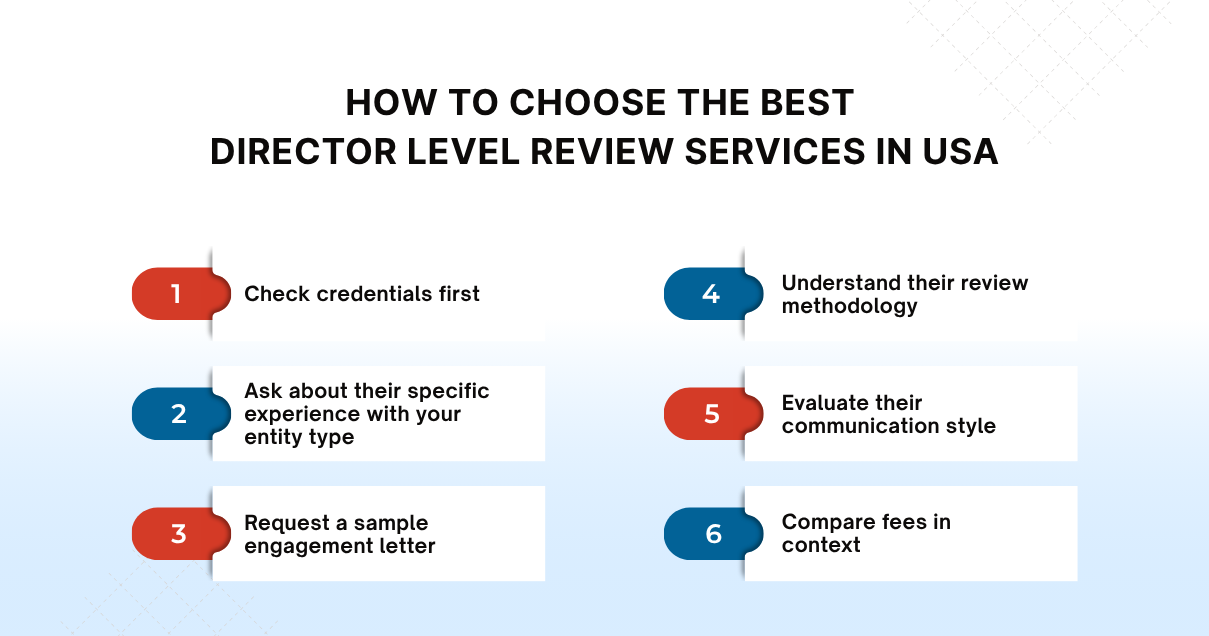
Check credentials first
The director performing your review should be a licensed CPA in the relevant US state, or at a minimum hold equivalent credentials with a clear understanding of US standards. Ask for their license number and verify it through your state’s CPA board.
Ask about their specific experience with your entity type
A firm that primarily handles sole traders or small domestic businesses is not the right fit for a foreign-owned LLC or C-Corp with cross-border transactions.
A professional firm offering the best director-level review services in USA will have a detailed engagement letter that clearly defines scope, deliverables, timelines, and fee structure. If they hesitate to provide this, walk away.
Ask them to walk you through how they approach a review engagement. They should be able to explain analytical procedures, inquiry-based testing, and how they document conclusions. If the answer is vague, the review will be vague.
You want a team that is proactive, not reactive. They should be flagging issues to you before you ask, not waiting for you to spot problems yourself.
Technology and SaaS companies deal with complex revenue recognition rules, stock-based compensation accounting, and frequent fundraising rounds where reviewed financials are table stakes.
Real estate and property investment firms face significant complexity around depreciation schedules, 1031 exchanges, and lease accounting, all of which require a senior reviewer who knows the terrain.
Healthcare businesses operate under strict compliance requirements where financial reporting errors can have regulatory consequences beyond just accounting.
Import and export businesses working between the US, UK, Australia, or New Zealand need reviewers who understand foreign currency translation, intercompany eliminations, and customs-related balance sheet items.
Lenders reject their applications because the financial statements are unreviewed, and the lender cannot accept the risk. Investors lose confidence mid-due diligence when they discover material issues that should have been caught earlier. Tax filings contain positions that are unsupported by proper documentation, creating exposure in an audit. And board members or directors carry personal liability for financial statements they have signed off on without proper professional review supporting those sign-offs.
The absence of independent professional oversight is one of the clearest markers of businesses that are not ready for the US market, regardless of how strong their product or service actually is.
Cloud-based accounting platforms like Xero, NetSuite, and QuickBooks Online have made it easier for outsourced-based firms to perform high-quality reviews of US entity financials without being physically present. This has opened up access to genuinely experienced director-level professionals for mid-market businesses that previously could not afford Big Four fees.
ESG reporting is also starting to filter into the director review conversation, particularly for businesses with US investors who are increasingly asking for non-financial metrics alongside traditional financial statements.
The businesses that will compete strongest in the US market through 2026 and beyond are the ones that treat director-level review not as a one-time compliance event, but as an ongoing governance practice built into their financial calendar.
Choosing the right director-level review partner is one of the clearest signals of how seriously a business takes its US operations. The financial landscape in the US is demanding, and the margin for error is small. Whether you are a UK firm scaling into new states, an Australian business closing a funding round, or a New Zealand company navigating US tax obligations for the first time, having a qualified director sign off on your financials is not optional at a certain level of growth. It is the foundation on which everything else is built.
The businesses that get this right early do not just stay compliant. They raise capital faster, close deals cleaner, and carry far less risk on their balance sheet. The ones that treat it as an afterthought tend to find out why it mattered when it is already too late to fix things cheaply.
So if you are evaluating your options, use the framework in this guide. Check credentials, ask the hard questions, and do not settle for a review in name only.
Indian Muneem brings genuine senior-level expertise to director-level review engagements, with a clear understanding of US compliance requirements and the cross-border complexity that businesses in the UK, Australia, and New Zealand face when operating in the US market. The team is structured to deliver reviewed financials that actually hold up, whether you are presenting to investors, lenders, or regulators.

We use cookies and similar technologies to improve your experience, personalise content, analyse website traffic, and understand how visitors interact with our website. Some technologies may help us identify businesses visiting our website and improve our marketing and services. Some cookies are essential for website functionality.