Bookkeeping for Real Estate Investors: 9 Essential Practices for Better Financial Control
Table Of Contents
Toggle
Half the businesses that reach out to us about payroll do so after something has already gone wrong. A missed filing. A wrong tax code applied for six months. An employee paid at the old rate because no one updated the system after their raise. And the frustrating part? None of it was intentional. The process just was not set up well.
So if you are here because you want to actually understand how a payroll management system works, what it should be doing for your business, and how to stop flying blind on payroll, this guide is written for you specifically.
Most definitions of a payroll management system make it sound like glorified calculator software. It is a lot more than that.
Yes, it calculates pay. But a proper system also handles tax withholding, manages employee benefits deductions, tracks leave balances, generates payslips, files reports with your tax authority, and keeps a record of every single change ever made. That last part matters more than people realise until they are sitting across from an auditor.
The way to think about it: your HR function knows who works for you and what they earn. Your accounting function needs to know what went out and when. A payroll system sits right in the middle, talking to both, and making sure the money lands where it should, with the right deductions, on the right date, every time.
For businesses in New Zealand, this means handling KiwiSaver correctly. In Australia, it is superannuation contributions and Single Touch Payroll reporting. In the UK, you have RTI submissions to HMRC. In the US, it is federal and state payroll tax filings. Each jurisdiction has its own rules, and a decent system is built around whichever ones apply to you.
Here is what usually gets overlooked: payroll is not just a finance task. It is a trust function.
When an employee gets paid wrong, they notice immediately. When it happens twice, they start looking for another job. The link between payroll accuracy and employee retention is direct, and most businesses do not take it seriously until they are losing people.
On the compliance side, the stakes are equally real. Late payroll tax filings come with penalties. Miscategorising workers or applying the wrong tax codes creates problems that compound over time. And once you are behind on payroll compliance, catching up is expensive, both in accountant fees and in fines.
There is also the cash flow angle. If your payroll numbers are inconsistent or unreliable, your financial forecasting is unreliable too. You cannot plan headcount growth or manage costs properly if the payroll figure surprises you every cycle.
None of this requires you to be a payroll expert. It does require you to have a system that handles it properly.
Manual payroll still exists. Spreadsheets, hand calculations, manually filed returns. For a sole trader paying one part-time employee, it is technically manageable. For anyone beyond that, the error rate and the time cost are not worth it.
In-house payroll software is what most growing businesses use. You subscribe to a platform, your team handles the inputs each pay cycle, and the software does the heavy lifting on calculations and compliance. This works well when someone in your team actually knows what they are doing with the system, and when the software is built for your country’s specific requirements.
Outsourced payroll means handing the whole function to a third party, typically a chartered accountant firm or a specialist payroll bureau. They manage everything from data collection to filing. This is genuinely the better option for businesses that either do not have internal payroll expertise or have more complex requirements, multiple pay rates, contractors mixed with employees, cross-border staff.
A lot of businesses land somewhere between the last two: using a cloud-based payroll management system but having their accountant review and manage it. You get the automation without losing expert oversight.
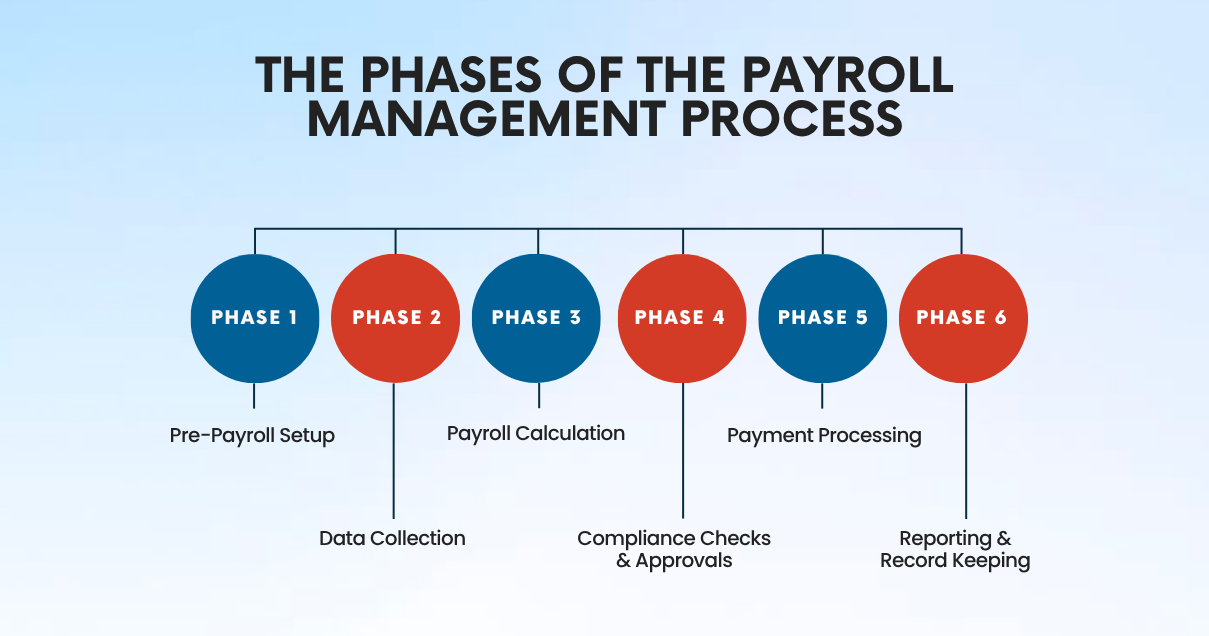
Knowing where errors happen is half the battle.
Setup is where most problems start. Pay structures, employee classifications, tax codes, deduction configurations. If these are wrong at the beginning, every payroll run after that inherits the mistake.
Data collection is the step that depends on good systems talking to each other. Hours worked, overtime, leave taken, any changes to pay or status. If your employee time tracking software is not connected to your payroll system, someone is manually entering this data, which means someone is occasionally entering it wrong.
Calculation is where the payroll management system does its core job. Gross pay gets calculated, deductions come out, you land on net pay. This should be automatic, not manual.
Review and approval is the step people skip when they are rushed, and regret later. Someone with authority needs to look at the payroll before it runs, not after.
Payment processing is the part most people think payroll is. The actual transfer of money. Direct deposits, electronic transfers, whatever your configuration is.
Reporting and record-keeping is the last step and arguably the most important for long-term compliance. Payslips to employees, journals to your accounting system, required filings to your tax authority. Everything logged with a clear audit trail.
The functions list matters because it tells you what you should be expecting from whatever system you are using:
If your current system does not handle most of these, you are covering the gaps manually somewhere, and that is where your risk sits.
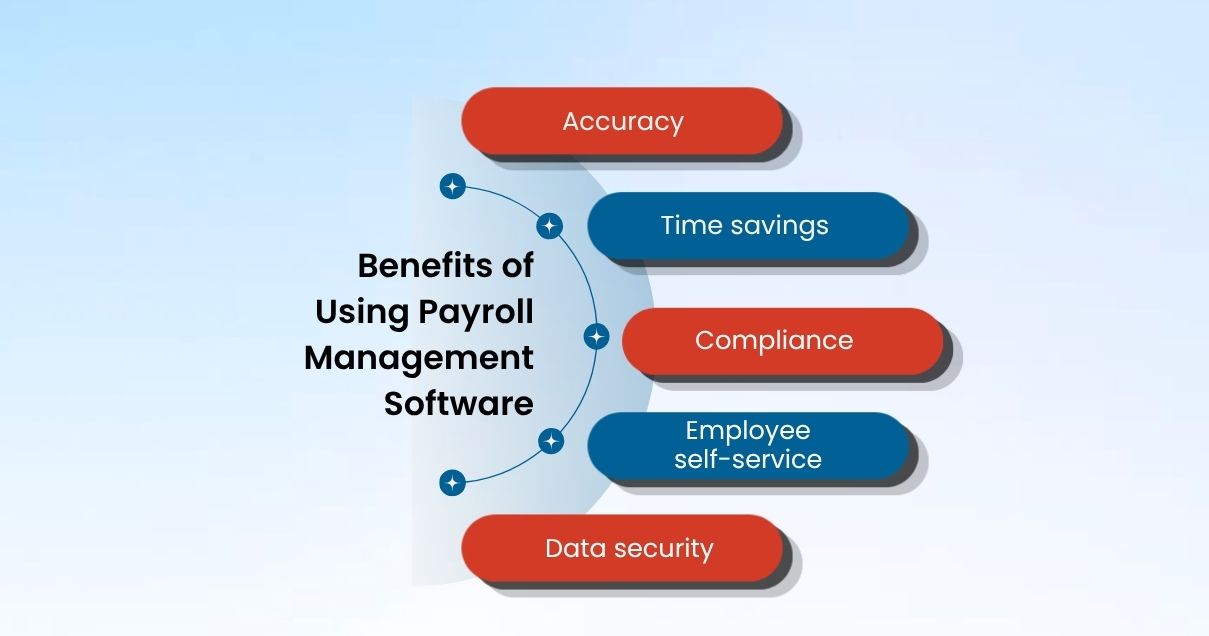
Time is the obvious one. Running payroll manually for 15 people can take the better part of a day. A configured payroll system brings that down to under an hour, sometimes much less.
Accuracy is the one that actually costs money when it is missing. Automated calculations eliminate the arithmetic errors. Tax rate updates happen automatically rather than requiring someone to catch the change and apply it manually.
Compliance stops being a guessing game. When legislative changes happen, like a new minimum wage rate or a change in reporting requirements, a good payroll system updates accordingly. You are not relying on someone in your team to catch it in the news.
And data security. Payroll data includes salaries, tax file numbers, bank account details. That information should not be living in a shared spreadsheet. A cloud-based system handles storage and security at a level no spreadsheet ever will.
This is where the advice usually gets vague. Here is what actually matters:
Does it comply with your country’s requirements? This is non-negotiable. A system built for the US may not handle STP in Australia or RTI in the UK without significant workarounds or add-ons. Check explicitly, not on the basis of marketing copy.
Will it scale? Going from 10 to 50 employees should not mean switching platforms. Check how pricing changes and whether the feature set holds up at larger volumes.
What does it integrate with? Specifically: your HR management platform, your employee time tracking tool, and your accounting software, whether that is Xero, QuickBooks, MYOB, or Sage. Disconnected systems mean manual data transfers, which means errors.
Cloud or on-premise? For most businesses, cloud-based wins. Automatic updates, access from anywhere, lower upfront cost, and the provider handles security and backups.
What support actually looks like. Payroll runs on deadlines. If something breaks at 4pm on a Friday before a Monday pay run, you need to be able to reach someone. Read the fine print on support hours and response times.
Pricing structure. Per-employee-per-month is common. That is fine at 8 employees and expensive at 80. Run the actual numbers before committing.
Working with a chartered accountant who knows payroll, rather than just picking a platform from a comparison website, often saves businesses from choosing something that looks good in a demo and causes problems in real use.
A payroll management system done properly is not a cost centre. It is what keeps your people paid correctly, your compliance clean, and your finance function running without the monthly scramble.
The businesses that treat payroll as an afterthought tend to spend far more fixing problems than they would have spent setting things up correctly from the start. Penalties, back-corrections, accountant fees to untangle historical errors, and the harder-to-quantify cost of employees who stop trusting the process.
At Indian Muneem Chartered Accountants, we help businesses across New Zealand, Australia, the UK, and the US get their payroll properly structured. Whether that means selecting the right software for your setup, managing payroll on your behalf, handling cross-border complexity, or cleaning up a mess that has been building for a while, we have done it before.
If you want payroll that actually works, get in touch with our team and let us have a proper conversation about your setup.


We use cookies and similar technologies to improve your experience, personalise content, analyse website traffic, and understand how visitors interact with our website. Some technologies may help us identify businesses visiting our website and improve our marketing and services. Some cookies are essential for website functionality.