
AI Reconciliation in Finance and Accounting

AI reconciliation in finance and accounting uses artificial intelligence to help compare financial records, match transactions and identify discrepancies that need investigation. It can reduce repetitive manual work, but accountants still need to verify results and maintain appropriate financial controls.
Consider a CPA firm closing the books for several clients at the end of the month. Most transactions have been recorded, but a few bank payments do not match the general ledger. Some descriptions are abbreviated, references are missing, and the team must investigate the differences before finalising the accounts.
AI-powered reconciliation can help identify likely matches and bring unresolved items to the accountant’s attention. Rather than checking every transaction manually, the team can focus on exceptions that require further review.
For accounting firms, the real opportunity is not simply faster transaction matching. It is a more organised reconciliation process that supports timely reporting, reliable records and better use of professional expertise.
Traditional reconciliation software generally compares transactions against predefined rules, such as matching amounts, dates or reference numbers. This works well when financial records are consistent, but it can struggle when information differs between systems.
AI-assisted reconciliation can use pattern recognition, machine learning and, in some systems, language-processing capabilities to suggest matches when records are less straightforward.
For example, a bank statement might show a payment to “ABC Office Supplies Ltd,” while the ledger lists “ABC Supplies.” If the amount, date and other available details are consistent, the system may suggest that the entries relate to the same transaction.
The accountant must still verify the match before accepting it.
The process generally involves four steps:
AI capabilities vary across accounting platforms. Some tools offer straightforward rule-based automation, while others provide machine learning-based suggestions or more advanced document analysis.
AI reconciliation can support several accounting processes. Its usefulness depends on the type of financial data, transaction volume and complexity of the work.
Bank reconciliation automation helps compare deposits, withdrawals, transfers, bank fees and payments against accounting records.
When descriptions or references differ, an AI-enabled tool may suggest possible matches. Accountants can then investigate outstanding transactions, timing differences and unexplained balances instead of searching through every entry individually.
In accounts payable, AI can help identify duplicate invoices, compare payment records and flag differences between invoices and credit notes.
For accounts receivable, it can suggest links between customer payments and outstanding invoices, including situations where a customer pays several invoices in one transfer.
These suggestions still require verification, particularly where payment allocations, credit notes or disputed balances are involved.
Businesses operating across multiple entities may record the same transaction at different times or use different currencies and account mappings.
AI-assisted tools can compare intercompany balances, highlight unmatched entries and flag unusual general ledger activity. This helps accountants prioritise discrepancies during month-end and year-end close.
Not every reconciliation issue can be resolved by comparing numbers alone. Supporting information may be contained in invoices, purchase orders, contracts, receipts, remittance advice or emails.
Machine learning in finance can help systems identify patterns in historical transactions and highlight activity that differs from expected behaviour.
Anomaly detection may flag:
However, an anomaly is not automatically an error or a sign of fraud. A legitimate one-off purchase, seasonal expense or change in business operations may also appear unusual.
The purpose of anomaly detection is to help finance teams identify where investigation may be worthwhile. Accountants must assess the evidence and determine whether further action is needed.
This is where AI risk management becomes important. Firms need clear rules for reviewing alerts, approving adjustments, documenting decisions and escalating potentially significant issues.
Choosing AI finance tools requires more than comparing feature lists. The software must work with existing financial systems and support the firm’s accounting procedures, security requirements and reporting obligations.
Use the following framework when evaluating potential solutions.
| Evaluation area | What to check |
|---|---|
| Data compatibility | Can the tool work with your bank, ledger, ERP and invoice data? |
| Matching quality | How does it handle missing references, different descriptions and partial payments? |
| Explainability | Can reviewers understand why a match or anomaly was suggested? |
| Review workflows | Does it support approvals, comments, exception queues and evidence? |
| Audit trail | Are decisions, overrides and changes recorded? |
| Security | How are financial records accessed, stored and protected? |
| Integration | Does it connect with existing accounting and reporting systems? |
| Monitoring | Can the firm measure incorrect matches, unresolved exceptions and rework? |
A vendor demonstration should reflect the problems your accounting team actually faces. Ask providers to show how their systems handle duplicate payments, missing transaction references, unusual journal entries and incomplete supporting documents.
Where possible, use representative data under appropriate confidentiality and security arrangements.
Compare the results against your existing process. A tool that identifies many anomalies is not necessarily better if it also produces excessive false alerts or provides little explanation for its recommendations.
The most suitable solution is one that helps the team investigate meaningful exceptions without weakening review and approval controls.
AI-powered reconciliation can improve efficiency, but it also creates risks if firms rely on its output without appropriate checks.
Poor-quality financial data: Missing records, inconsistent descriptions and incorrect account coding can affect the quality of suggested matches.
False matches: Two transactions may have similar amounts or dates without relating to the same business event.
Limited explainability: If reviewers cannot understand why a system suggested a match, they may struggle to justify their decisions during an audit or internal review.
Confidentiality concerns: Financial information can include sensitive client, supplier, employee and banking data. Access controls and vendor security reviews are essential.
Overreliance on automation: Accepting recommendations without checking supporting evidence can allow errors to pass through the reconciliation process.
Firms should establish clear approval responsibilities, retain appropriate audit trails, monitor system performance and define which transactions require additional review. High-value or unusual items may need stricter controls than routine transactions.
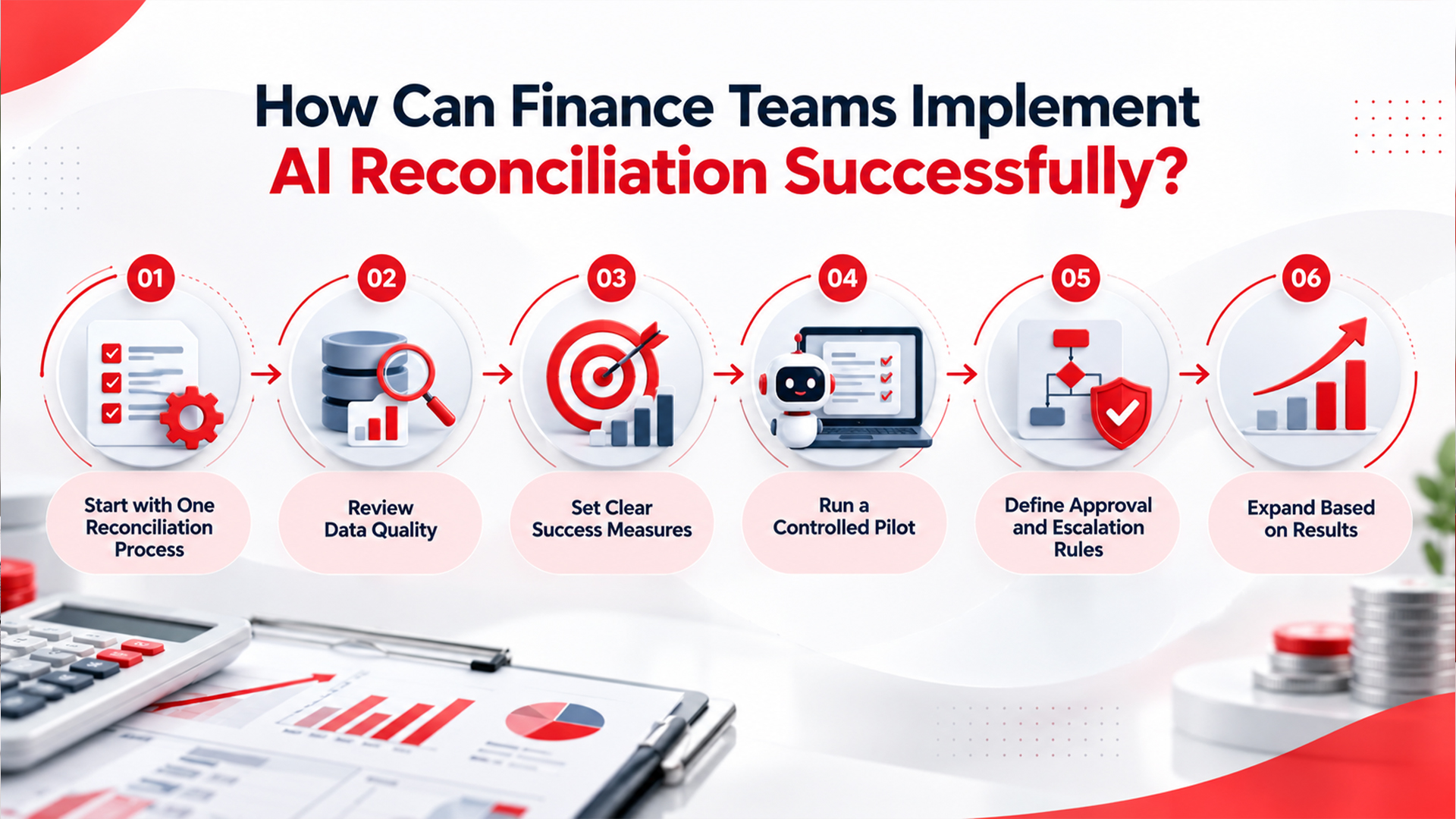
A gradual implementation helps firms evaluate whether AI solves a genuine problem before extending it across more accounts and workflows.
Choose a repetitive task with sufficient transaction volume, such as routine bank reconciliation or cash application. Avoid starting with a process that lacks documented procedures or has serious unresolved data problems.
Check whether account codes, vendor names, dates, transaction IDs and supporting records are sufficiently consistent. Correcting basic data issues can improve the usefulness of automated matching.
Track reconciliation turnaround time, the number of unmatched transactions, time spent resolving exceptions, incorrect matches and review effort.
Compare AI recommendations with the results of the existing process before allowing the system to handle more transactions automatically. Investigate differences and adjust matching rules where necessary.
Specify who can accept suggested matches, who investigates exceptions and who approves adjustments. Document how unresolved issues are escalated and how evidence is retained.
Extend the workflow to other accounts or entities only after the initial process performs reliably. Continue monitoring exceptions, staff feedback and control outcomes as the system evolves.
Reconciliation is closely connected to financial analysis because the quality of financial insights depends on the quality of the underlying records.
Once transactions have been reconciled and unusual items investigated, AI financial analysis tools may help accountants examine expense movements, identify changes in working capital and prepare explanations for budget variances.
For example, an increase in supplier payments may reflect higher purchasing activity, a change in payment timing or an issue requiring further investigation. Reconciled data gives the accountant a stronger starting point for understanding the movement.
Related technologies can also support forecasting and planning. AI budgeting tools may help model scenarios or compare assumptions, although budgeting is a separate process from reconciliation.
The important distinction is that AI can help organise information and identify patterns, but financial conclusions still need to reflect the business context and verified records.
No. AI reconciliation is best understood as a tool that supports accounting work, not a replacement for accounting expertise.
A suggested match does not automatically confirm that a transaction is correctly classified, supported by evidence or recorded in the appropriate period. Accountants must still interpret exceptions, assess material differences and make decisions within their professional responsibilities.
AI can change where the work begins. Instead of starting with thousands of transactions to inspect, reviewers may begin with suggested matches and prioritised exceptions.
That shift can create more time for analysis, reporting, client communication and advisory work, provided the firm maintains effective controls.
Even with AI reconciliation tools, accounting firms need people to prepare records, investigate discrepancies, maintain supporting schedules and complete recurring accounting tasks.
For firms managing multiple client accounts or seasonal workload increases, outsourced accounting support can provide additional operational capacity without immediately expanding the in-house team.
Indian Muneem Chartered Accountant (IMCA) supports CA and CPA firms with accounting activities such as bookkeeping, reconciliations, financial reporting and related accounting preparation, depending on the agreed scope.
An outsourced team can help firms manage recurring workloads, maintain organised records, identify outstanding queries and prepare reconciliations for review. Where AI-assisted workflows are already in use, responsibilities can be defined around the firm’s existing systems and procedures.
This arrangement allows the firm to retain its client relationships, professional judgment and review responsibilities while using additional support to keep work moving.
Explore Indian Muneem Chartered Accountant’s accounting services or learn about its remote accountant support for CPA firms.
AI reconciliation in finance and accounting can help teams match transactions more efficiently, identify unusual activity and organise the month-end close. But reliable results depend on more than the technology. Good data, appropriate controls and informed accounting review remain essential.
For CPA and CA firms, the next step is to identify where reconciliation consumes the most time, test whether automation improves that process and expand only when the results are dependable. Additional accounting support can also help firms manage recurring work without placing every task on their internal team.
Indian Muneem Chartered Accountant supports accounting firms with bookkeeping, reconciliation and related accounting services that complement their existing workflows. Visit Indian Muneem Chartered Accountant to explore how outsourced accounting support could help your firm manage its workload.

Talk to IMCA about adding tax preparation support behind your existing workflow while your firm retains client relationships, professional review, and oversight.

We use cookies and similar technologies to improve your experience, personalise content, analyse website traffic, and understand how visitors interact with our website. Some technologies may help us identify businesses visiting our website and improve our marketing and services. Some cookies are essential for website functionality.