
October 15 Tax Deadline: How CPA Firms Can Manage Tax Season Workloads Without the Last-Minute Rush
Table Of Contents
Toggle




Ask any managing partner about October 15, and you’ll get the same look. The mid-April rush gets all the press, but October is often where CPA firm capacity actually breaks down. April is about broad volume; October is about complex returns, missing pieces, and zero remaining clock.
When mid-October rolls around, firm leaders usually try to push through by asking staff to pull longer hours. But treating this final stretch as a pure effort problem misses what’s actually happening in the building.
Most of the time, your team isn’t working too slowly or managing their time poorly. You simply have a tax preparation capacity problem: more billable hours sitting on the desk than your staff could possibly clear in a standard week.
To clear the extended return pipeline without running your team into the ground, you have to fix the operational bottleneck first.
In March, work arrives at a fairly steady pace. By late September, it all lands at once, and here are a few things that pile up together:
When complex multi-state filings sit next to simple individual returns, telling everyone to push harder tends to create review errors, skipped checks, and burnout.
These two get confused all the time, and the fix differs for each.
A productivity problem means your team has the hours, but they leak away through messy handoffs, missing templates, or manual data entry. Better process helps here.
If you’re in the second situation, you need more production hands so your internal team can stay focused on judgment and review.
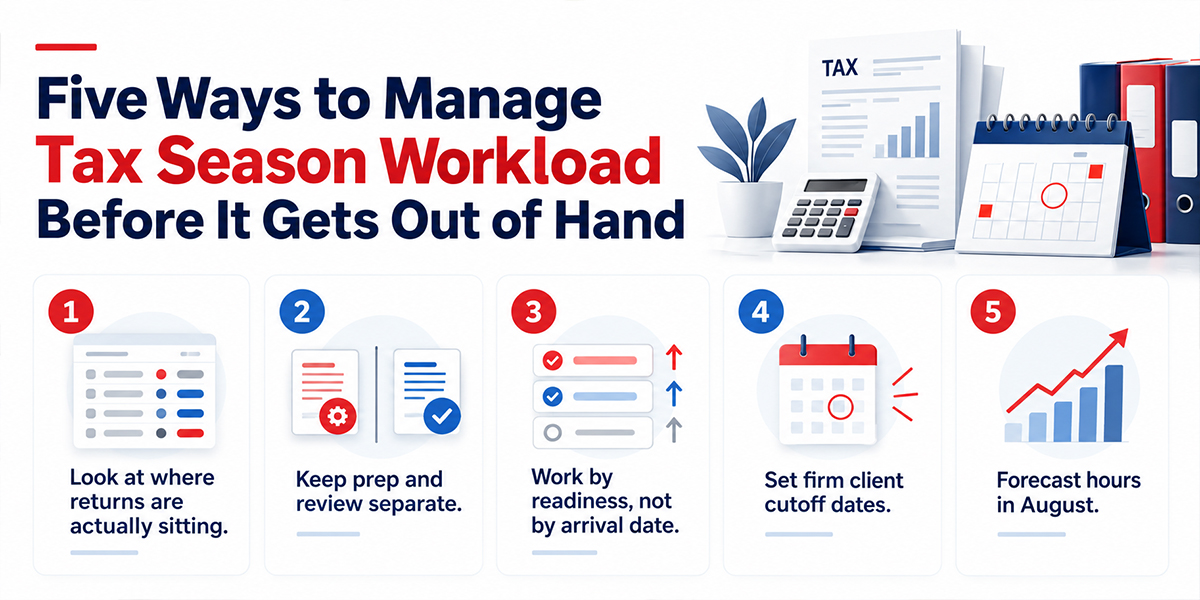
A flat list of open extensions tells you little. Sort each one into a stage: gathering data, ready for prep, in prep, waiting on the client, in review, or ready for sign-off. The jams become obvious once you do.
Say it plainly in late August or early September: documents received after a certain date can’t be guaranteed for October 15. Clients respond better to clear dates than to polite reminders.
Also Read: Bookkeeping for Real Estate Investors: 9 Essential Practices for Better Financial Control
Posting for a permanent senior tax accountant feels like the obvious move. For a seasonal spike, it comes with real drawbacks:
Permanent hires make sense for steady growth and advisory work. For a predictable seasonal bulge, flexible capacity usually fits better.
This is the case where outsourcing tax preparation for CPA firms earns its place. An outside team handles baseline production work so your staff can focus on higher-value tasks. Typical examples include:
Outsourcing doesn’t mean handing over control. Your team still owns client communication, technical decisions, final review, and authorization to file. The outside team handles standard preparation behind the scenes, giving you extra production desks without extra office overhead.
Bringing in outside help shouldn’t create another project to manage. A few basics set it up well:
Watch for these in September, ideally before the final push:
Two or three of these showing up together is usually a sign the gap is about capacity.
Firms that handle October well keep professional judgment, client relationships, and quality review in-house and bring in outside support for the raw assembly of returns. Staff stays fresher, accuracy holds up, and the last-week panic fades.
If your firm is bumping up against its limits, Indian Muneem (IMCA) provides scalable tax preparation and accounting support for CPA firms, acting as an extension of your team. You can learn more at indianmuneem.com.

Talk to IMCA about adding tax preparation support behind your existing workflow while your firm retains client relationships, professional review, and oversight.

We use cookies and similar technologies to improve your experience, personalise content, analyse website traffic, and understand how visitors interact with our website. Some technologies may help us identify businesses visiting our website and improve our marketing and services. Some cookies are essential for website functionality.