
Bookkeeping for Real Estate Investors: 9 Essential Practices for Better Financial Control

Bookkeeping for Real Estate Investors

A rental property can be performing well on paper and still leave its owner with a surprisingly unclear picture of the finances.

It usually starts innocently enough. Rent comes in, bills get paid, and receipts are saved somewhere for later. Then another property is added. There is a second mortgage, another bank account, a new property manager, and a growing list of contractors. Before long, answering a simple question—How did this particular property actually perform last quarter?—takes more work than it should.

That is where bookkeeping for real estate investors earns its value. Good books do more than keep transactions in order. They show where money is coming from, where it is going, and what is happening at each property, giving investors a clearer financial view as their portfolio grows.

Why Is Bookkeeping Important for Real Estate Investors?

Real estate often creates transactions that need context.

Some real estate transactions are easy to record. A plumber’s invoice, for example, usually has an obvious place in the books. Mortgage payments need a little more attention because they may include both principal and interest. The same goes for money received from tenants—it could be monthly rent or a security deposit. Even contractor costs need context, as routine repairs and major property improvements may need to be recorded differently.
Now multiply that across several rentals or entities.

Without a consistent real estate bookkeeping process, those details can easily disappear into broad income and expense categories. The total figures may still be available, but it becomes harder to see what happened at a particular property or explain a transaction months later.

Well-kept books preserve that detail. They also make financial reporting more useful and give accountants and tax professionals cleaner records.
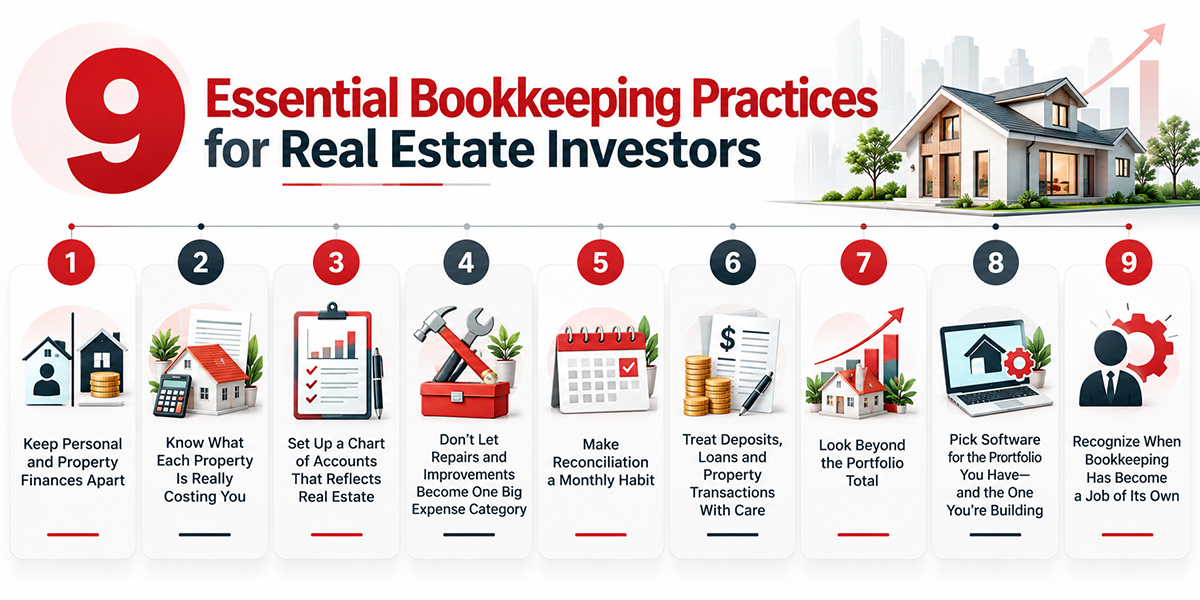
9 Essential Bookkeeping Practices for Real Estate Investors

9 Essential Bookkeeping Practices

1. Keep Personal and Property Finances Apart

Using the same account for household spending and rental-property expenses may seem harmless when there are only a handful of transactions. It becomes far less convenient when you have to sort hundreds of entries later.

Separate accounts, where appropriate, create a much cleaner trail. If several entities or properties are involved, records should also make it clear which entity or property a transaction belongs to.
Transfers need attention too. Record money introduced by an owner, withdrawn from the business, or moved between accounts for what it actually represents, rather than letting it blend into ordinary income or expenses.

This is a fairly basic part of real estate investor bookkeeping, but getting it right makes almost everything that follows easier.

2. Know What Each Property Is Really Costing You

Portfolio totals can hide a lot.
Suppose rental income is rising overall. That sounds encouraging, but one property may also have had repeated repairs, higher utilities, and rising management costs. If you record everything together, that change can be hard to spot.

Bookkeeping for rental properties works better when you can trace income and expenses back to individual properties. Rent, insurance, repairs, maintenance, utilities, and management fees are a few obvious examples.

The point is not to create an exhausting level of detail. It is to retain enough information to answer practical questions about each rental without rebuilding the numbers manually.
That property-level view becomes more valuable as the portfolio grows.

3. Set Up a Chart of Accounts That Reflects Real Estate

A generic chart of accounts can technically record property transactions, but it may not organize them in a particularly useful way.

Rental income should be easy to identify. Maintenance, insurance, property management costs, utilities, and other recurring expenses should be easy to identify. Depending on the portfolio, you may also need accounts for deposits, mortgage interest, fixed assets, and other real-estate-specific activity.

More categories are not necessarily better. An overly detailed chart of accounts can become just as frustrating as one that is too broad.

What matters is consistency. If the same type of expense appears under three different categories during the year, reports become harder to interpret. A sensible structure gives rental property bookkeeping some much-needed discipline.

4. Don't Let Repairs and Improvements Become One Big Expense Category

A broken door lock and a major property renovation are both rental costs, but they are not necessarily treated the same way for accounting or tax purposes.

The exact treatment depends on the circumstances and the rules that apply, and an appropriate accounting or tax professional should determine it.
The investor’s job is to leave a clear record.
Keep the invoice. Record what the contractor actually did. Retain the date, amount, and relevant supporting documents. If substantial work was completed, avoid burying it in a vague category that will need to be deciphered at year-end.
Six months later, “ABC Contractors – $8,750” says very little on its own.
Good documentation does.

5. Make Reconciliation a Monthly Habit

Bank feeds have made bookkeeping faster, but they have also created a common misconception: if a transaction has appeared automatically in the software, it must have been recorded correctly.

Not necessarily. Reconciliation checks that the bookkeeping records match what actually happened in the bank or credit account. It can expose duplicate entries, missing payments, incorrect amounts, and transfers recorded on one side but not the other.
Mortgage and loan accounts deserve the same attention. A mortgage payment shouldn’t automatically be treated as an ordinary expense. It may contain principal, interest, and, depending on the arrangement, amounts associated with escrow.
Monthly reconciliation keeps these issues small. Leave it for most of the year and a straightforward check can turn into a sizeable cleanup exercise.

6. Treat Deposits, Loans and Property Transactions With Care

Not every dollar entering an account is revenue. Likewise, not every dollar leaving it belongs on the profit and loss statement.
Security deposits are a good example. Depending on the arrangement and applicable requirements, you may need to track a deposit separately rather than recording it as rental income.
Property purchases, sales, and refinancing create their own bookkeeping challenges. Closing or settlement documents may include several components that need to be identified correctly, while loan transactions require careful allocation of amounts.

Owner contributions and draws should also remain clearly identifiable.

This is one area where accounting for real estate investors quickly becomes more involved than everyday income-and-expense bookkeeping. Keeping the source documents with the transaction gives the accountant or tax professional something reliable to work from later.

7. Look Beyond the Portfolio Total

A healthy overall profit figure does not tell you whether every property is pulling its weight.
Property-level profit and loss reports can show how income and operating costs are developing across individual rentals. A consolidated report then provides the broader portfolio view.

Depending on the operation, investors may also find value in balance sheets, cash flow information, accounts payable or receivable reports, and budget-versus-actual comparisons.

For larger rental portfolios, recorded rent may also need to be compared with property-management records or rent rolls so you can investigate unexplained differences.

Reports should answer questions, not simply exist because the accounting software can produce them.

8. Pick Software for the Portfolio You Have—and the One You're Building

No single piece of real estate bookkeeping software suits every investor.

Someone with two rentals may need little more than dependable transaction tracking, bank reconciliation, and clear property reporting. A larger operation may need multi-entity capabilities, document integrations, stronger reporting, and controlled access for bookkeepers or accountants.

Think about what happens if the portfolio doubles. Can the system still separate properties cleanly? Can you produce reports without manipulating spreadsheets every month? Can you find supporting documents when you need them?

Software can remove a great deal of repetitive work, but it cannot decide whether the underlying bookkeeping process makes sense. Automation works best when the underlying structure is already sound.

9. Recognize When Bookkeeping Has Become a Job of Its Own

There is no magic number of properties at which an investor suddenly needs a bookkeeper. A better sign is what happens at month-end.

Are reconciliations repeatedly pushed into next month? Are expenses being put into whichever category seems closest? Does preparing information for an accountant involve several days of cleanup? Are reports arriving after they would have been useful?

Those are operational problems, regardless of whether the portfolio contains five properties or fifty.

This is where outsourced real estate bookkeeping can make sense. Routine transaction recording, reconciliations, ledger maintenance, and record organization can be handled through professional real estate bookkeeping services, while the investor remains responsible for financial and investment decisions.

Common Real Estate Bookkeeping Mistakes to Avoid

Most bookkeeping problems don’t start with one dramatic mistake. They build quietly.
A receipt disappears. Reconciliation gets postponed. Two similar contractor payments are categorized differently. A mortgage payment is entered entirely as an expense. Several properties are grouped together because separating them can wait until “later.”
Software does not automatically solve those problems either. Automated bank feeds and categorization rules save time, but you still need to review the books.
A simple monthly routine usually works better than a heroic year-end cleanup: collect the documents, review uncategorized activity, reconcile the accounts, and review the reports while the transactions are still familiar.

When Does Professional Bookkeeping Support Make Sense?

For a small portfolio with straightforward activity, managing the books internally may work perfectly well.
The calculation changes when maintaining them starts competing with managing the properties themselves.
Growing transaction volumes, multiple entities, overdue reconciliations, and increasingly complex reporting can turn bookkeeping into a substantial recurring workload. At that point, the question is not whether an investor can keep doing it. It is whether that is the best use of their time and whether the current process is still producing reliable information.

Professional support can handle agreed day-to-day bookkeeping activities while leaving financial oversight and property decisions where they belong—with the investor or management team.

How IMCA Can Support Real Estate Bookkeeping

Indian Muneem Chartered Accountant (IMCA) provides End-to-End Bookkeeping Services for businesses that need ongoing support with their financial records.

Depending on the agreed scope, this can include transaction recording and categorization, bank and credit card reconciliations, accounts payable and receivable support, ledger maintenance, month-end bookkeeping activities, and financial record organization.
For a growing real estate business, that means routine bookkeeping does not necessarily have to grow into another full internal workload as the portfolio expands.

Need more consistent bookkeeping across your real estate portfolio? Talk to IMCA about outsourced bookkeeping support.

Frequently Asked Questions

It is the process of keeping accurate financial records for investment properties, including income, expenses, loans, deposits, and other property-related transactions. Good bookkeeping also preserves enough detail to review individual properties and the wider portfolio.
Investors should be able to identify the income and expenses associated with each property. The exact account and entity structure will depend on how the portfolio is set up, but property-level tracking makes performance much easier to review.
Useful records include bank statements, rental income records, invoices, receipts, loan documents, security-deposit information, contractor invoices, and documents relating to property purchases, sales, improvements, and refinancing.
Many systems can, but capabilities vary. Investors should check property-level reporting, reconciliation, multi-property or multi-entity functionality, integrations, and accountant or bookkeeper access before choosing a platform.
Consider outsourcing when routine bookkeeping consistently falls behind, reporting is delayed, multiple properties become hard to track, or maintaining the books takes too much time away from running the portfolio.

Better Financial Control Starts With Better Records

Real estate investors make decisions property by property, so their books should tell the same story.
Good bookkeeping for real estate investors creates that connection. Income and costs remain tied to the right properties, unusual transactions have documentation behind them, accounts are reconciled regularly, and reports become easier to trust.
As the portfolio grows, the bookkeeping process should grow with it. Sometimes that means better software or a cleaner monthly routine. Sometimes it means bringing in outside support. Either way, the objective remains the same: financial records that help you understand what is actually happening across your properties.

    Let’s Discuss Your Business Needs

    Tell us how we can help, and our team will get back to you shortly.

    Scroll to Top