


Why Businesses in the USA, NZ, & Europe Are Choosing Offshore Accounting Services in 2026

The accounting function has quietly become one of the most offshored operations across the USA, New Zealand, and Europe, and it’s not hard to see why. Finance teams are stretched. Hiring is expensive. Local CPA firms charge a premium for work that doesn’t always justify the rate. So businesses started asking: Why are we doing this in-house?
That’s where the benefits of offshore accounting services became impossible to ignore. Not as a cost-cutting gimmick, but as a real operational shift. We’re talking about companies from mid-market firms in Chicago to SMEs in Auckland and fast-growing startups in Amsterdam actively restructuring how their finance function works.
This blog is for the people who already know the basics. You’ve heard of offshoring. You might have even tried it, or considered it. So let’s skip the surface-level stuff and get into what’s actually driving the adoption and why 2026 is a different conversation than 2020 ever was.
Yes, outsourced bookkeeping and accounting work done offshore is significantly cheaper. A qualified accountant working with an offshore firm in India typically costs 60–70% less than a comparable hire in the US or UK. That’s not a rough estimate, it’s a consistent figure across the industry.
But here’s what experienced business owners actually care about: what do they get for that cost difference? The answer in 2026 is a lot more than it was five years ago.
Offshore accounting teams today operate with the same cloud tools your local team uses, like Xero, QuickBooks Online, NetSuite, and MYOB. They’re trained on GAAP compliance and IFRS standards, they understand multi-currency bookkeeping requirements, and many specialize by industry vertical. A hospitality group in New Zealand gets a team that knows F&B accounting. A SaaS company in Germany gets people who understand deferred revenue and subscription models.
So yes, cost is part of it. But what you’re really buying is a team that brings domain knowledge without the overhead of a full-time hire.
This is where most conversations about offshoring get shallow. They stop at “save money.” Let’s go further.
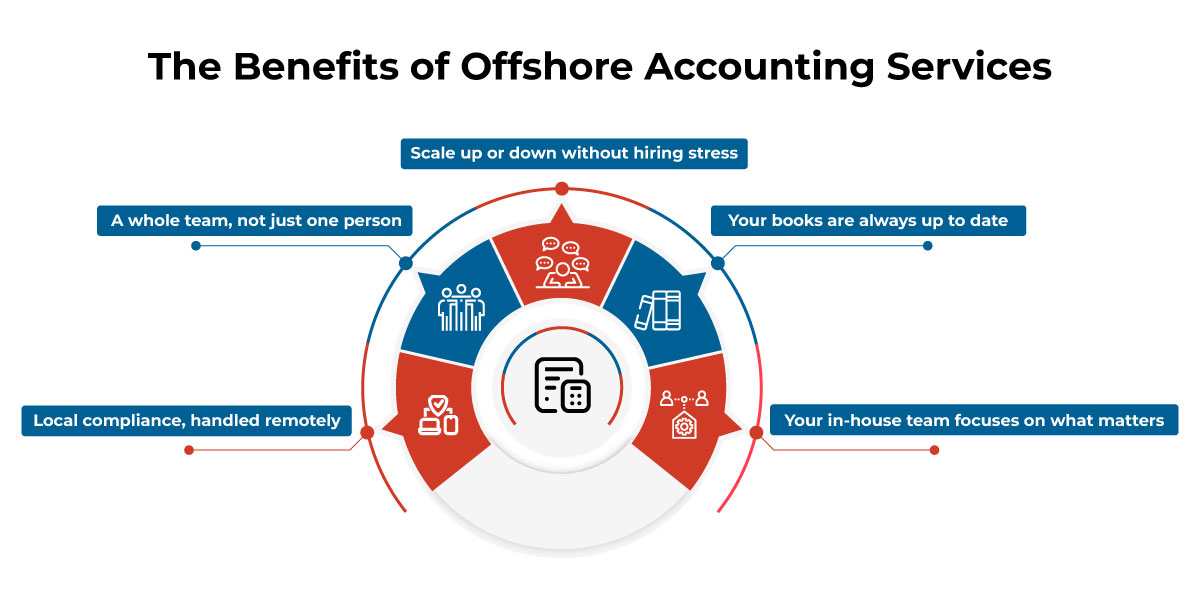
When you hire a local accountant, you get one person who has one set of skills, takes sick days, and leaves when they get a better offer. When you work with an offshore accounting firm, you get a dedicated accounting team that’s structured to handle your volume. If someone’s unavailable, the work still moves. There’s built-in redundancy that in-house hires don’t offer.
Tax season hits. You’ve had a high-growth quarter. A new entity is being added. These moments usually mean scrambling for extra hands locally or watching your internal team burn out. With offshore partners, scalable accounting solutions are baked into the model. You ramp up, they match your pace. You slow down, you’re not carrying the cost of a full team.
This one surprises people. They assume offshore means delayed. In practice, with tools like Dext, Hubdoc, and Receipt Bank feeding into a cloud ledger, your offshore team can have books reconciled and reports ready faster than a local team doing manual processing. Real-time financial reporting is no longer a privilege of companies with large finance departments.
A common worry is that offshore teams won’t understand local regulations. Reputable offshore firms deal with this directly. Indian Muneem, for example, works specifically with businesses in the USA, NZ, Australia, and Europe, so the team is trained on the tax codes, GST/VAT requirements, payroll rules, and reporting obligations that apply to your jurisdiction. Tax preparation outsourcing at this level isn’t generic; it’s jurisdiction-specific.
This explains how offshoring transactional work (reconciliations, invoice processing, accounts payable management) can help in-house staff focus on higher-value activities like budgeting, margin analysis, and business decisions. It’s a nice productivity multiplier argument, not a simple cost trade-off, and it works well with an experienced audience.
If you tried offshore accounting four or five years ago and had a bad experience, this section is for you.
The model has changed. A lot.
The early days of offshoring were messy. Communication lag, inconsistent quality, teams that rotated constantly, and no real accountability structure. That’s not the space you’re walking into in 2026.
Specialization has deepened. You can now find offshore teams who specialize in e-commerce accounting, legal firm bookkeeping, real estate accounting, or nonprofit financials. The days of sending your books to a generalist who handles everything are gone.
And critically, data security in accounting has improved significantly. ISO certified, SOC 2 compliance, encrypted data transfer, NDA-backed engagements, and role-based access controls are now standard, not optional. If a firm isn’t offering this, that’s a red flag, but most reputable offshore accounting firms are operating with enterprise-level data protocols.
It’s worth being specific about who’s benefiting most because “offshore accounting” means different things at different scales.
Small businesses and startups in the US, NZ, and Europe are using it to get a proper finance function without the cost of a full-time hire. This is probably the fastest-growing segment. A $2M ARR SaaS startup doesn’t need a CFO yet, but it does need clean books, monthly P&Ls, and someone to manage AP/AR. Offshore solves that gap perfectly.
Accounting firms themselves are offshoring. This is the part most clients don’t see. CPA firms and accounting practices in the US and UK are using offshore teams to handle the volume of work, such as data entry, bank reconciliation, accounts payable automation, while their senior staff focus on advisory and client relationships. So even when you hire a “local” firm, there’s a good chance offshore talent is in the workflow.
Mid-market businesses with complex multi-entity structures are using offshore for specific functions, such as consolidation reporting, intercompany reconciliations, or managing accounts across multiple jurisdictions. At this level, the savings are significant, and the complexity is handled by specialists.
The first two to four weeks are onboarding. So, your offshore team is figuring out your chart of accounts, workflow, and document naming conventions. They may even point out shortcomings in your current process, and if they are good, those shortcomings are features, not problems.
Not all offshore accounting firms are the same. Here’s what actually matters when you’re evaluating a partner:
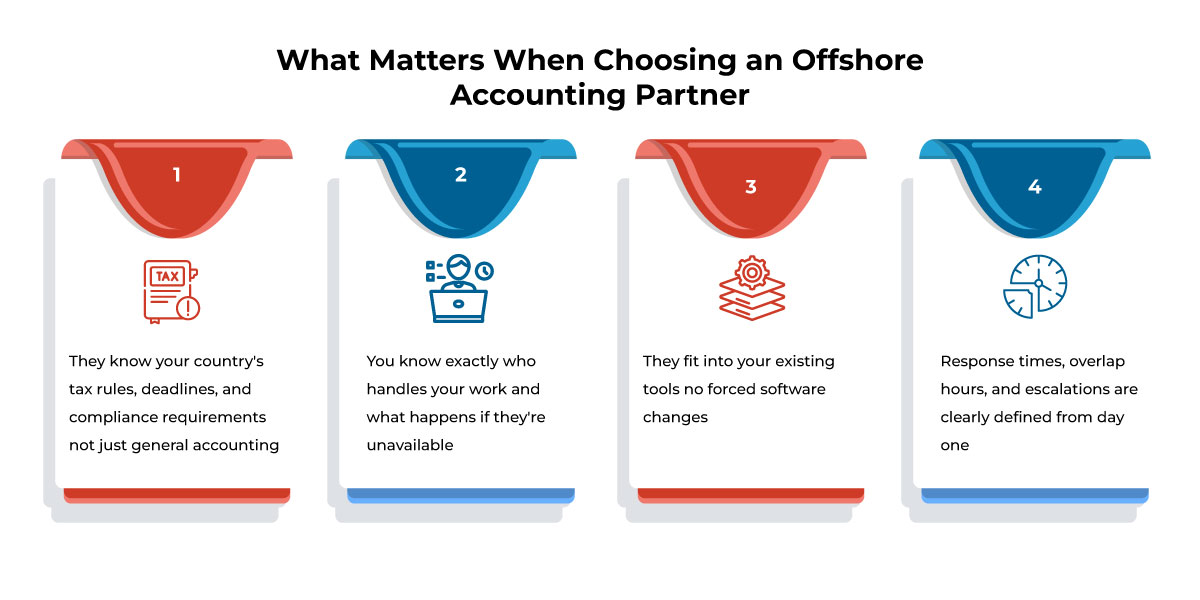
Jurisdiction knowledge: They should know your specific market — tax codes, filing deadlines, payroll rules. General accounting knowledge isn’t enough if they don’t understand GST for New Zealand businesses, or IRC compliance for US entities.
The businesses moving to offshore accounting in 2026 aren’t doing it as a last resort. They’re doing it because the model has matured, the technology supports it, and the financial case is strong. The benefits of offshore accounting services now extend well beyond cost; they include speed, scalability, specialization, and access to a quality of financial management that used to require a full in-house team.
If you’re still handling your books with a stretched internal hire or a local firm that doesn’t fully understand your business, it’s worth having a real conversation about whether this model fits you.
The numbers usually make the case. The experience seals it.
Want to explore offshore accounting for your business? Connect with the Indian Muneem Chartered Accountant team to understand how it works for your specific market and scale.
Follow Us: