
Books Clean-Up for Tax Season: A Complete Checklist for CPA & Accounting Firms
Table Of Contents
Toggle



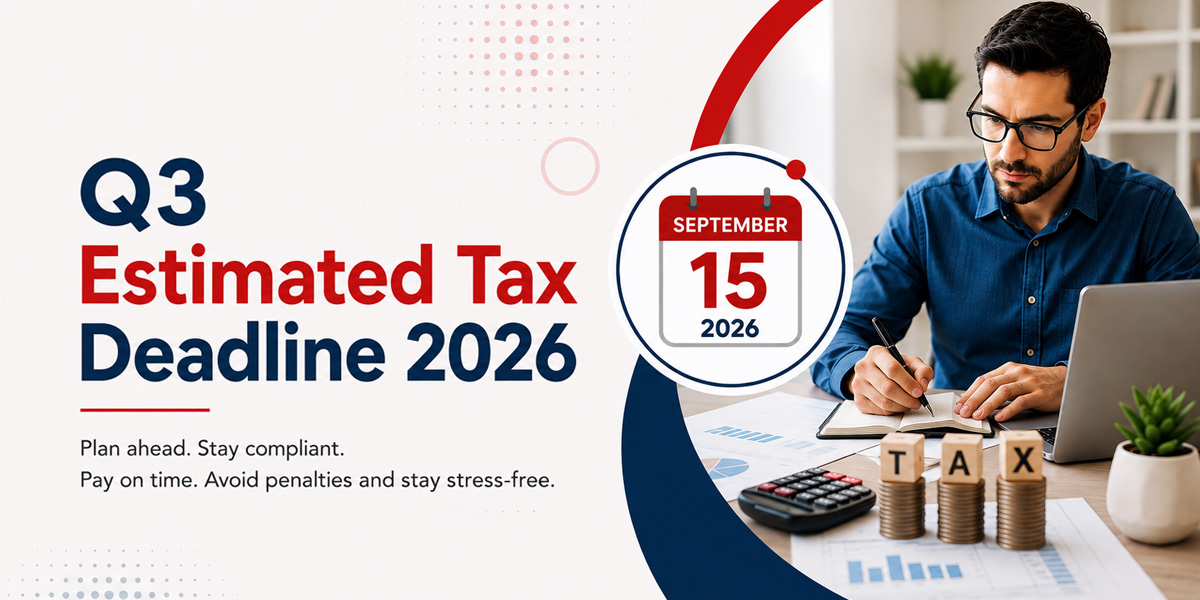
If you run a business, work as a freelancer, or handle income where taxes aren’t taken out automatically, September is a big deal. The numbers you used back in April or June? They might not make sense anymore.
Maybe your revenue spiked over the summer. Maybe you sold off some stock and hit a huge capital gain, or landed a project that doubled your normal monthly rate. Or maybe things went the other direction and money was tighter than you planned. Either way, sending in a Q3 payment based on old guesses is a mistake. Your September 15 payment needs to match where your business actually stands right now.
If you’re running a CPA or accounting firm, this gets multiplied by every client on your list. Trying to run calculations on messy, outdated books right before a deadline is a nightmare. Getting financial records straight today makes the whole process smoother.
For calendar-year individual taxpayers, September 15 is the due date for the third 2026 estimated tax installment.
Estimated tax is part of the federal pay-as-you-go system. Employees generally pay income tax throughout the year through payroll withholding. People who receive income without sufficient withholding may need to make estimated payments themselves.
The standard 2026 schedule for individuals is:
| Payment | Income Period | Due Date |
|---|---|---|
| First | January 1–March 31 | April 15, 2026 |
| Second | April 1–May 31 | June 15, 2026 |
| Third | June 1–August 31 | September 15, 2026 |
| Fourth | September 1–December 31 | January 15, 2027 |
September 15 is also relevant to some extended business returns. For example, calendar-year partnerships and S corporations that obtain timely extensions generally have extended filing deadlines as of that date. Those filings are separate from an individual’s Q3 estimated payment.
The issue is not limited to full-time business owners.
Estimated payments may be relevant to freelancers, consultants, independent contractors, sole proprietors, partners, certain LLC members, S-corporation shareholders, landlords, and investors.
They can also affect someone with a regular W-2 job.
Suppose an employee has adequate withholding from salary but also receives substantial consulting income or realizes a large investment gain. Their normal paycheck withholding may no longer be sufficient to cover their overall tax liability.
Under the general IRS rules, individuals typically need to consider estimated payments if they expect to owe at least $1,000 after subtracting withholding and refundable credits and their expected payments fall below the applicable thresholds.
The important question is therefore not simply, “Am I self-employed?”
It is: Is enough tax being paid during the year based on my overall income?
This is one of the most practical checks to make before September 15.
If income, deductions, and withholding have remained fairly consistent, the next estimated payment may look similar to earlier installments.
But that should be the result of the calculation, not an assumption.
Also Read: How to Prepare Taxes: A Step-by-Step Guide
By August, several new contracts have materially increased projected annual income.
For most individual taxpayers, the general federal framework considers whether payments during the year reach the smaller of:
For certain higher-income taxpayers, the prior-year percentage increases to 110%. The current Form 1040-ES should be checked for the applicable requirements and exceptions.
Why does this matter?
There is, however, an important distinction:
Safe harbor can protect against an estimated-tax underpayment penalty. It does not necessarily mean the taxpayer has paid the full tax that will ultimately be due.
Someone having a particularly strong 2026 could satisfy the applicable safe-harbor requirement and still owe additional tax when the return is filed.
Not every taxpayer earns income at a steady rate.
In situations where income is uneven, the Annualized Income Installment Method may be relevant. It can allow the required installments to reflect when income was actually earned rather than treating the year’s income as though it arrived evenly.
For taxpayers with highly variable income, this is one area where working with an appropriate tax professional can be particularly useful.
Ignoring a missed payment until tax filing season generally does not improve the situation.
That is where outsourced accounting support can fit into an existing CPA-firm workflow.
Indian Muneem Chartered Accountant (IMCA) supports CPA and accounting firms with agreed behind-the-scenes accounting and tax preparation activities. Depending on the engagement, that can include bookkeeping support, reconciliations, document organization, supporting schedules and tax preparation work.

We use cookies and similar technologies to improve your experience, personalise content, analyse website traffic, and understand how visitors interact with our website. Some technologies may help us identify businesses visiting our website and improve our marketing and services. Some cookies are essential for website functionality.