Bookkeeping for Real Estate Investors: 9 Essential Practices for Better Financial Control
Table Of Contents
Toggle
You can have strong sales, decent margins, and a growing client base, and still find yourself scrambling to cover payroll one month. That is not a hypothetical situation. It happens to real businesses, more often than finance professionals like to admit. And nine times out of ten, the root cause is not the product or the market. It is that nobody built a proper system around budgeting and forecasting.
This is not about throwing spreadsheets at a problem or running quarterly reviews because a consultant told you to. Done right, these two disciplines tell you where your money is going, where it is likely to go, and what to do when the two do not match. Let us get into it properly.
What makes a budget useful is not the document itself. It is what happens during the process of building it. You are forced to have conversations about priorities. Which teams get more resources? Where do you cut back? What does the business actually need to grow, versus what would be nice to have? A budget done seriously is one of the best management tools a business has access to.
Once it is finalised and approved, the budget becomes the benchmark. Every month, you compare actual performance against it and ask why the numbers are where they are.
Accountability follows from that. Targets are not handed down from finance. They are built with the people who have to hit them, which means there is shared ownership over the outcomes.
Financial forecasting is the ongoing process of projecting where the business will actually land, based on what is happening now, rather than what you hoped would happen when you built the plan.
A forecast is not a commitment. It is your best current read on the future, and it should change as new information comes in. If you close a big deal in March that was not in the pipeline in November, the forecast should reflect that. If a key customer reduces their spend, the same thing.
There are a few forecasting approaches worth understanding:
Rolling forecasts keep you looking at a fixed number of months ahead at all times. Instead of a budget that runs from January to December and gets stale by April, a rolling forecast is always 12 months out and gets refreshed monthly or quarterly. Many finance teams consider this the single biggest upgrade they can make to their planning process.
Driver-based forecasting connects your financial projections to the actual levers of the business. For a SaaS company, that means churn rate, new bookings, and average contract value. For a services firm, it might be billable utilisation and headcount. When your forecast is built this way, you can trace a revenue movement back to a specific driver rather than just shrugging at a variance.
Scenario forecasting builds multiple versions of the future side by side. Base case, upside, downside. This is not pessimism. It is how you make decisions when the future is genuinely uncertain, which it usually is.
The most undervalued benefit is lead time. A well-maintained forecast tells you about a problem weeks or months before it shows up in your bank account. That gap between seeing it coming and having to deal with it is where good decisions get made. Pull back on hiring. Accelerate a sales push. Renegotiate a supplier contract. None of those options exist if you only find out at year end.
Beyond that, forecasting improves the quality of every significant business decision. Hiring plans, capital investments, and pricing reviews, all of these are all better when they are grounded in a current, data-driven financial picture rather than an assumption set that is now six months old.
People use these words interchangeably. They should not. They are genuinely different tools.
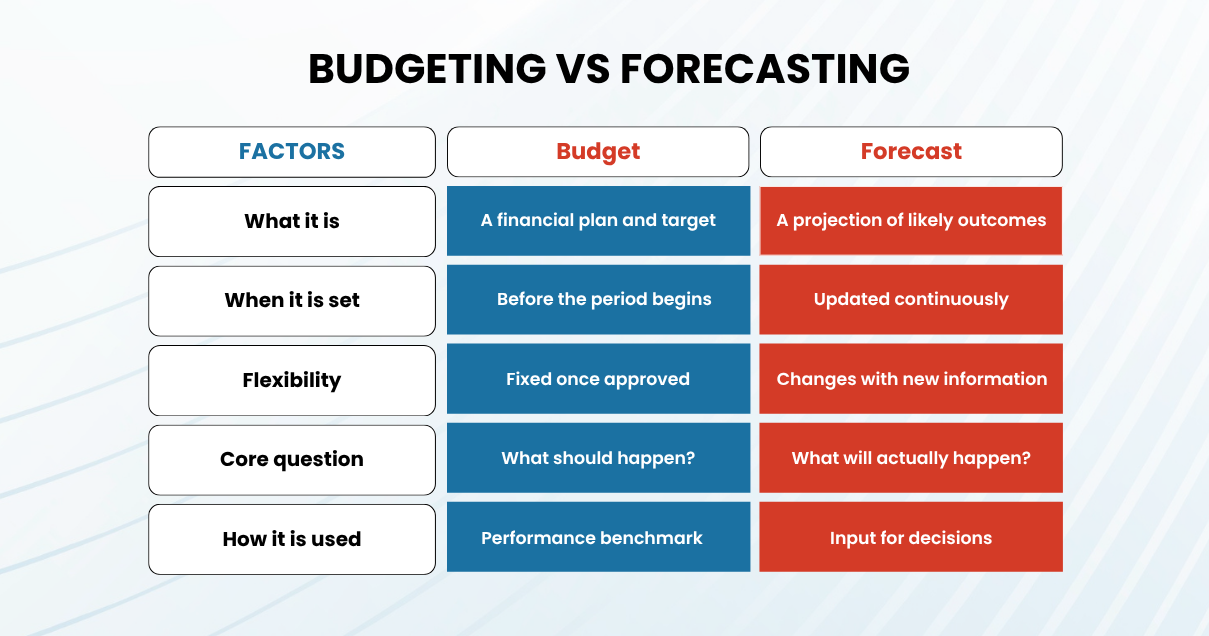
Put simply: the budget is the plan you committed to. The forecast is your honest view of where you are actually going. Both matter, and neither replaces the other.
A business working only off a budget is measuring itself against a plan that was built on last year’s assumptions. A business working only off forecasts has no fixed target to hold itself accountable to. You need both, running in parallel.
This is also how variance analysis becomes genuinely useful. When you compare actuals against the budget and then cross-reference with the forecast, you can start to understand causation, not just outcomes. Was it a pricing issue, a volume issue, or a cost overrun? The diagnosis is only possible when both budgeting and forecasting are working together.
Here is a straightforward example. You finalise a budget in November. February comes around, and a large client pauses their contract. Your budget shows you are behind. That tells you something is wrong. Your updated forecast takes that revenue loss and projects what it means for cash in the next 90 days, what needs to change in the cost base, and whether you can close the gap through the pipeline. That is the information leadership actually needs to make decisions.
Businesses that do this well usually describe it as having a financial planning and analysis (FP&A) function that ties planning, forecasting, and financial reporting into one continuous cycle rather than three separate tasks.
Demand for outsourced budgeting as well as forecasting consulting services has been growing steadily, and the reasons are not hard to see. Financial planning has become more involved. Multi-entity structures, faster reporting cycles, investor pressure for more frequent updates — internal teams that were built to manage annual plans are now being asked to do a lot more.
The global budgeting & forecasting consulting services market is currently being shaped by a few intersecting forces. The development of cloud-based FP&A tools such as Anaplan, Adaptive Insights, Vena, and Pigment has eliminated many of the technical barriers that have traditionally kept businesses stuck in spreadsheets. There is significant development in the use of AI in the forecasting process, which was not feasible two years ago. And in the US, the UK, Australia, and New Zealand, mid-market businesses are increasingly adopting continuous planning rather than the traditional annual budget process.
The outsourced services segment is the fastest-growing segment in the SME segment, as well as growth-stage businesses in the $5M to $50M revenue band. The value proposition is clear: access to CFO-quality financial intelligence without the expense of a full-time senior hire.
These problems show up across industries and business sizes. Knowing them in advance makes them easier to manage.
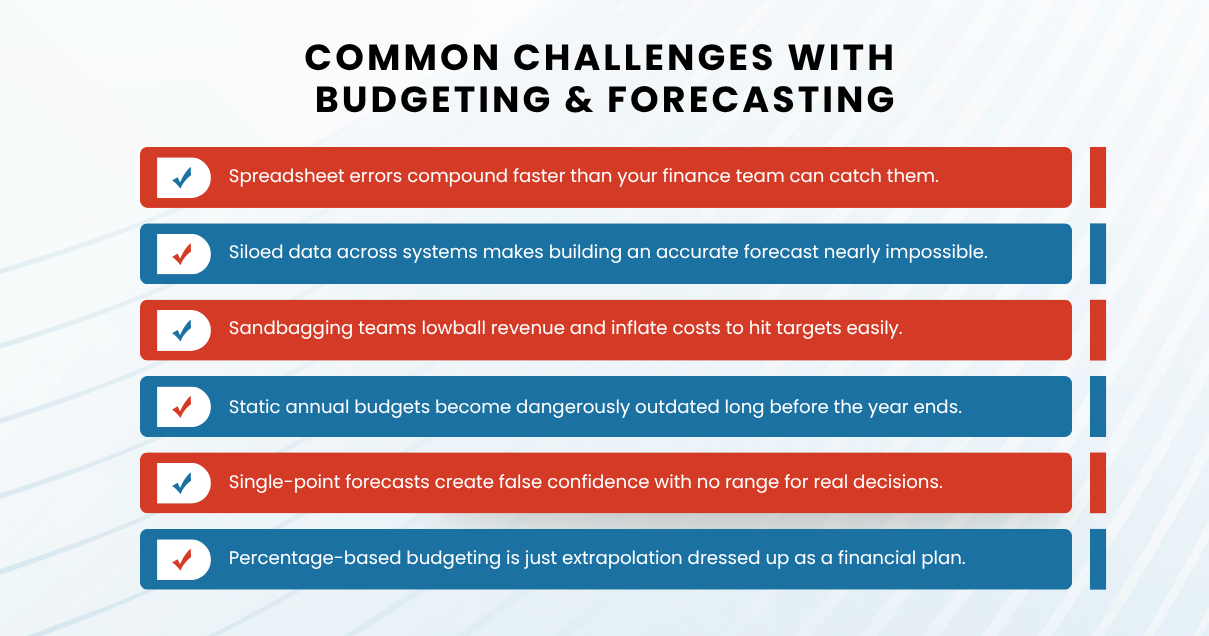
Spreadsheet dependency is probably the most widespread. Excel works until it does not. Errors compound, versions multiply, and the finance team spends more time maintaining the model than analysing the output. At a certain scale, this becomes a genuine risk.
Siloed data is what makes forecasting genuinely hard for many businesses. Sales data sits in the CRM. Operations data lives in a separate system. Finance is working off weekly exports that are already out of date. Building an accurate, up-to-date forecast in that environment is an uphill battle.
Sandbagging is a cultural problem that financial controls alone cannot fix. When department heads know their budget targets are going to be held against them, the rational move is to build in a buffer. Revenue targets come down. Cost estimates go up. The aggregate effect is a plan that nobody actually believes in.
Static annual budgets stop being useful fast in businesses where market conditions shift quickly. A plan built in November for the following calendar year can be materially wrong by March. More frequent reforecasting is not optional in most industries anymore.
Single-point forecasting is the forecasting equivalent of the static budget problem. One number for revenue, one number for costs, no range around it. That approach creates false confidence and leaves leadership with no framework for making decisions when things start moving.
Percentage-based budgeting is a lazy habit that survives because it is easy. Taking last year’s numbers and adding 10% is not planning. It is an extrapolation. Driver-based forecasting tied to real unit economics is harder to build but far more honest and far more useful when things do not go to plan.
The smarter move is to build the habit early, before the pressure arrives.
For early-stage businesses, budgeting and forecasting do not need to be complex. It needs to be honest and current. A 13-week cash flow projection updated every week tells you more about your actual situation than an annual budget reviewed twice a year. Burn rate visibility shared with the whole leadership team keeps everyone aligned on the constraints. A hiring plan built into the model matters because payroll is usually the dominant cost.
Revenue forecasts for startups should always run in multiple versions. Conservative, base, and stretch scenarios are each tied to actual pipeline conversion rates and churn data rather than top-down growth assumptions. The discipline of building the forecast this way also forces founders to be honest with themselves about which numbers are real and which are wishful.
FP&A depth matters more than breadth: You want someone who understands financial modelling, variance analysis, and driver-based planning from real-world experience, not just someone who is good at keeping the books. Compliance and forecasting are different disciplines.
Sector familiarity is worth more than it sounds: A firm that has worked with businesses in your space already understands your revenue model, your cost structure, and which metrics actually matter for your type of business. That context cuts months off the onboarding curve.
Technology capability is now a baseline requirement: If a provider is still building every deliverable in Excel, that is worth noting. The shift toward modern FP&A platforms and rolling forecast processes requires technical fluency, not just financial knowledge.
Communication quality often separates the good from the great: Numbers that cannot be explained clearly to a non-finance founder or a board are not useful numbers. The ability to translate financial insight into plain-language decisions is where a lot of providers fall short.
If your business is based in the US, UK, Australia, or New Zealand and you are at the point where you need real financial planning support, Indian Muneem Chartered Accountant works with growing businesses on exactly this. Whether you are building your first budget or moving toward a more sophisticated continuous planning setup, they can help you get there.
Contact us to talk through what your business needs.

AI cuts the time finance teams spend on data prep and model updates. More importantly, it surfaces patterns in historical data that improve the assumptions your budget is built on. Better inputs mean more reliable plans.
Demand forecasting, cash flow prediction, expense anomaly detection, and automated scenario modelling are the most common. AI also drafts variance commentary, saving finance teams hours on monthly reporting.
A static budget is set once and measured against all year. A rolling forecast updates continuously, always keeping 12 months ahead. Most modern finance teams prefer rolling forecasts because markets do not stay still.
Monthly is the standard for most businesses. Fast-moving or cash-sensitive businesses often update weekly. The goal is to always have a current enough picture to make decisions on, not a snapshot that is already three months stale.

We use cookies and similar technologies to improve your experience, personalise content, analyse website traffic, and understand how visitors interact with our website. Some technologies may help us identify businesses visiting our website and improve our marketing and services. Some cookies are essential for website functionality.