
The CPA Talent Crisis: What Skills Will Accountants Need in 2026?

Table Of Contents
Toggle




Small business owners are ruthless about cutting costs until it comes to accounting. Then somehow the same person who negotiates every vendor invoice ends up paying a local bookkeeper three times the market rate just for the comfort of a nearby office. That’s changing fast. And not because of some trendy cost-cutting fad. The move away from outsourced accounting services for small businesses is being driven by something a lot more tangible: it simply makes financial sense in 2026.
Whether you’re a 12-person e-commerce company, a marketing firm, or a logistics startup, your financials still need to be clean, your financials still need to close on time, and your tax returns still need to be accurate. None of that requires your accountant to be in the same city or even time zone as you.
So let’s get into why this model has gone from being an ‘interesting alternative’ to a real option for small businesses around the world.
Here is the true cost breakdown, one that most small businesses do not wish to face. A full-time, in-house accounting professional, whether here in the US, or abroad in the UK or Australia, is going to set you back anywhere from $55,000 to $90,000 per year, just in salary. When you factor in all of the other expenses, such as payroll taxes, benefits, space, software, etc., you’re really looking at a total cost per employee of anywhere between $110,000 to $130,000 per year.
But let’s face reality: a small business, especially one in the early to mid-stages, doesn’t really need 40 hours per week of accounting services. You need accurate bookkeeping, accurate financial reporting, timely reconciliations, accurate payroll, and someone to run off a profit/loss statement if your bank or investor asks you to. That’s a 15-20-hour-per-week job, not a 40-hour-per-week job.
This leads to a huge overpayment for services not utilized. Outsourced accounting solutions address this issue with fractional service delivery.
And with cloud-based accounting platforms like Xero, QuickBooks Online, and Zoho Books now handling real-time data syncing, document uploads, and client communication portals, the physical location of your accountant is genuinely irrelevant to the quality of work you receive.
A few things have converged to make outsourced accounting not just viable but actively attractive for small businesses right now:
Talent depth in outsourcing markets has expanded significantly. Countries such as India, the Philippines, Sri Lanka, and even Eastern Europe have built large teams of CPAs and ACCA professionals who have been trained in Western accounting standards. This is not about cheap labor and low-quality work. This is about gaining access to quality professionals at a fraction of the cost.
The use of AI in accounting workflows has also helped in making remote collaboration smoother. The outsourced teams are able to leverage the same technology as the local teams.
There’s also a post-pandemic normalization of distributed teams. The same small business owner who would’ve been skeptical about a remote accountant in 2019 is now running a fully remote internal team and using contractors in multiple countries for marketing, development, and design. Adding accounting to that mix is no longer a leap of faith — it’s just consistent with how modern small businesses already operate.
And then there’s the pure economics. Outsourced accounting services for small businesses typically run 40% to 70% cheaper than comparable local services — and that number matters enormously when you’re managing working capital tightly.
Not everything needs to go outsourced. But certain functions are practically designed for it:
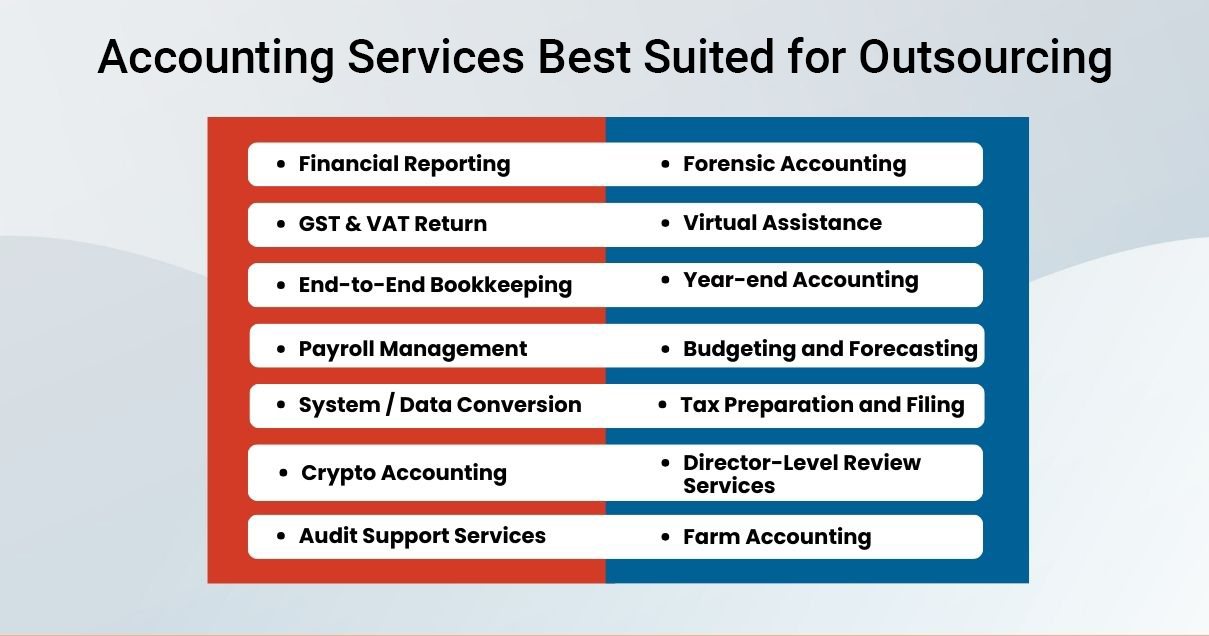
End-to-end bookkeeping is the clearest win. Transaction categorization, invoice matching, bank reconciliation, and accounts payable and receivable management are all task-based, platform-dependent, and don’t require any face-to-face interaction. An experienced outsourced bookkeeper can handle these in a structured workflow that’s actually more reliable than many in-house setups.
Payroll processing is another strong candidate. With platforms like Gusto, ADP, or Rippling integrated into the workflow, payroll management becomes a process that a well-briefed outsourced team can run with minimal oversight once the initial setup is clean.
Financial reporting is increasingly being handled outsourced, too. Monthly management accounts, your P&L, balance sheet, and cash flow statement can be prepared remotely and reviewed by the business owner with a brief call. Many outsourced providers now offer dedicated reporting dashboards so you have visibility without needing to micromanage.
Tax preparation is worth mentioning separately. While it’s still important to have a local tax advisor familiar with your area who can do the final review and filing for you, much of the background work in preparing your taxes, classification of your deductions, and the actual preparation of the working papers for your return can be done outsourced, thus saving you money on the billable hours of your local tax advisor.
Reputable outsourced accounting firms operate under strict data security protocols. Non-disclosure agreements are standard. ISO 27001 certification and SOC 2 compliance are increasingly common requirements that small business clients can and should ask for. Data is shared through encrypted portals, not email attachments, and access is role-controlled, so individual team members only see what they need to.
The reality is that many small businesses are safer working with an established outsourced provider than with a solo local bookkeeper who stores files on a personal laptop with no backup.
That said, due diligence matters. You should be asking about client data handling policies, what happens to your data if you terminate the contract, whether they have professional liability insurance, and whether their staff signs individual confidentiality agreements. These are normal, professional questions; any credible provider will answer them without hesitation.
The outsourced accounting space has good providers and bad ones, just like any industry. Here’s what actually separates them:
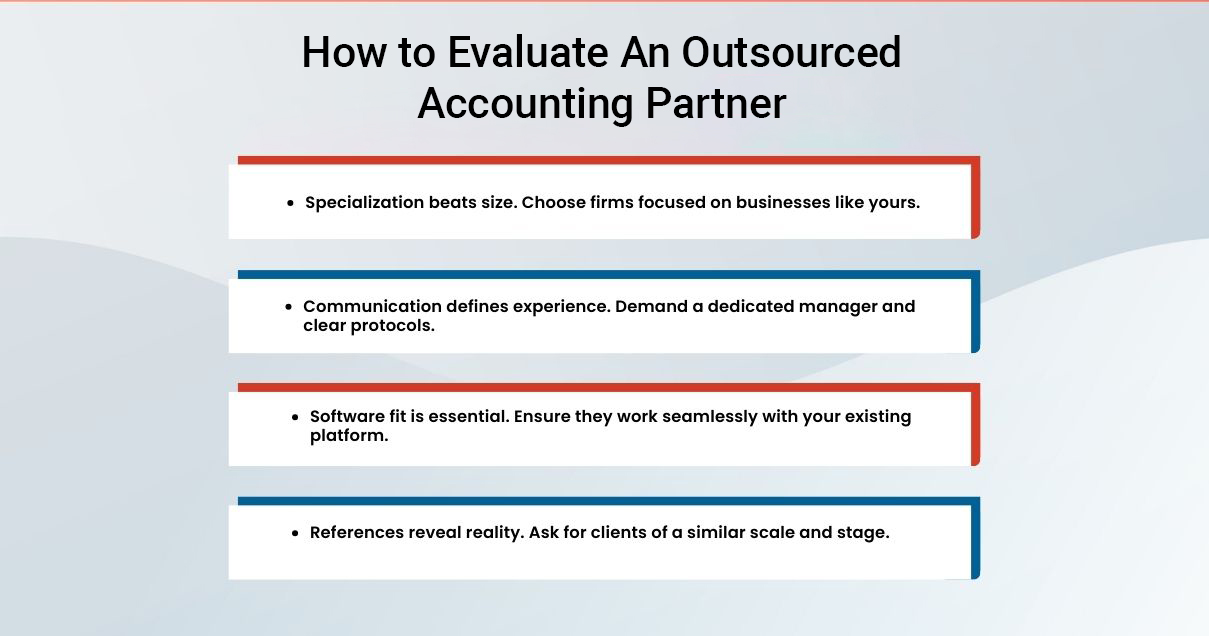
Communication structure is the real differentiator: Find out who your day-to-day point of contact is, how turnaround times are set, and what their escalation process looks like when something urgent comes up. A firm that assigns you a dedicated account manager and a clear communication protocol will deliver a fundamentally different experience than one where you’re emailing a generic inbox.
Software compatibility is non-negotiable: Make sure they work fluently in whatever accounting software your business already uses. Switching platforms to accommodate your provider is a cost and a disruption that’s rarely worth it.
Ask for references: Specifically from businesses at a similar scale and stage to yours. A provider who handles enterprise clients may not have the right model or attention span for a 10-person company. References from comparable clients will tell you much more than any sales pitch.
One thing worth noting is that the companies that are hesitant to use outsourced accounting tend to do so due to a general unease rather than a particular objection. When pressed to clarify their objection, it is often not related to quality or security, but rather to a general feeling that a local relationship is more important to accountability.
But accountability in accounting isn’t about proximity. It comes from clear deliverables, documented processes, regular reporting, and a provider who has structured their business around client retention. A well-run outsourced accounting service is often more accountable by design than a local bookkeeper who sends a monthly summary and is otherwise unreachable.
If your current accounting setup costs more than it should, delivers less visibility than you need, or simply hasn’t scaled with your business, then yes, exploring outsourced accounting services for small businesses is worth your time in 2026.
The businesses getting the most value from this aren’t the ones that chose outsourcing because it was cheap. They’re the ones who chose it because it was the smartest use of their financial resources and then built a proper working relationship around that decision.
And that’s exactly what we do at Indian Muneem Chartered Accountant. We work with small businesses to deliver reliable, cost-effective accounting, without the local price tag.
Follow Us:

We use cookies and similar technologies to improve your experience, personalise content, analyse website traffic, and understand how visitors interact with our website. Some technologies may help us identify businesses visiting our website and improve our marketing and services. Some cookies are essential for website functionality.