
Outsourcing Tax Preparation: A Practical Guide for Growing CPA Firms
Table Of Contents
Toggle
A CPA firm can add tax clients faster than it can add experienced tax staff. As return volumes grow, preparation work takes up more of the team’s time, review queues get longer, and senior professionals find themselves spending tax season on production work when their attention is also needed for review, technical matters, and clients.
Outsourcing tax preparation gives firms another way to handle part of that workload. Rather than moving the entire tax function outside the firm, a CPA practice can delegate defined preparation activities while retaining control of its clients, professional review, judgment, and final decisions.
The important question is therefore not simply whether to outsource. It is what to outsource, how the work will fit into the firm’s existing process, and where responsibility should remain.
Tax preparation outsourcing means assigning agreed preparation activities to an external accounting or tax support team. The scope depends on the firm. Some CPA practices may outsource a selected group of returns, while others may use an external team for particular stages of preparation.
Outsourcing preparation does not necessarily mean outsourcing the client relationship, final professional review, tax advice, complex technical decisions, or engagement responsibility. The CPA firm can keep those areas.
The outsourced team should function as additional preparation support within a workflow that the firm continues to control.
Growth does not always produce an even workload. Tax work tends to become concentrated around filing periods, which can create pressure even when a firm is appropriately staffed during the rest of the year. At the same time, experienced tax professionals may spend substantial time preparing returns rather than reviewing completed work, resolving technical questions, or working directly with clients.
The exact scope should always be agreed between the CPA firm and the provider. Depending on the engagement, outsourced tax preparation services may support activities such as:
The key is to define where preparation support ends and CPA-firm review begins. Material tax judgments, unusual positions, or issues requiring client knowledge should have a clear escalation route back to the appropriate person within the firm.
This boundary deserves particular attention. The outsourced team can extend the firm’s preparation capability, but it should not replace the professional judgment or client relationships that belong with the CPA firm.
The firm should retain responsibility for final professional review, complex tax positions, material technical issues, client-specific tax advice, sensitive client conversations, and approval or sign-off where applicable.
Client ownership should also remain clear. A firm can outsource preparation work without changing who manages the relationship with the taxpayer.
A well-defined arrangement therefore separates preparation capacity from professional responsibility. The external team handles the agreed production work; the CPA firm maintains the review, judgment, and client-facing responsibilities it has chosen to retain.
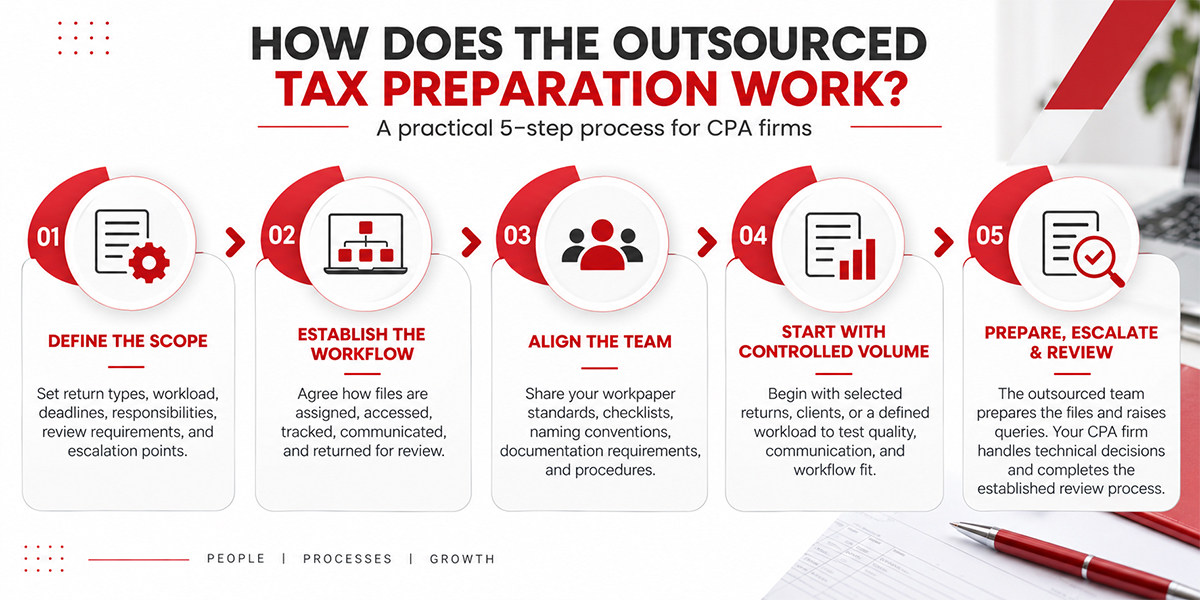
Identify the work being outsourced, expected volume, deadlines, responsibilities, review expectations, and matters that need to be escalated. This prevents uncertainty once files begin moving between teams.
Agree how work will be assigned, how information will be accessed, where questions will go, how progress will be tracked, and how completed preparation will return to the CPA firm. Where possible, the outsourced process should fit the firm’s existing systems and procedures rather than create a completely separate workflow.
The outsourced team completes the agreed preparation work and raises questions where information is missing or professional input is required. Completed files then return to the CPA firm for its established review process. Corrections, technical decisions, and final review remain within the agreed responsibility structure.
Feedback from the first group of files can then improve instructions and reduce recurring questions before the scope expands.
Security should be part of provider evaluation before sharing any taxpayer information. A CPA firm should understand how information will be accessed and transferred, where it will be stored, who can access it, whether local downloads are permitted, what authentication and access controls are used, and how data is retained or deleted.
The firm should also consider incident procedures and contractual responsibilities.
For U.S. tax return preparers, IRC §7216 and related regulations are particularly relevant. Section 7216 restricts certain disclosures and uses of tax return information by tax return preparers, subject to regulatory exceptions and consent requirements.
Offshore tax preparation requires additional care. IRS rules and guidance address disclosures of tax return information to preparers outside the United States, including consent and Social Security number-related requirements.
Firms should not assume that a general client consent resolves every requirement. Before outsourcing taxpayer information, the CPA firm should determine how applicable federal requirements, professional obligations, contractual terms, and its own security policies apply to the proposed arrangement.
Useful questions include:
The lowest hourly rate isn’t necessarily the best option. Workflow compatibility, preparation experience, communication, security, and review discipline all affect how useful the relationship will be during tax season.
CPA firms considering tax outsourcing services often have similar concerns about control, quality, communication, and client information.
Will we lose control of the work?
Not if responsibilities are properly defined. A clear scope, review points, progress reporting, and CPA-firm ownership of the final review can keep the firm in control of the engagement.
Will an external team understand our processes?
That depends heavily on onboarding. Procedures, checklists, workpaper standards, examples, and feedback help outsourced preparers understand how the firm expects work to be completed.
What about quality?
The provider should have its own preparation and QC procedures, but outsourced preparation should still move through the CPA firm’s agreed professional review process.
How will communication work?
There should be clear routes for routine questions, missing information, technical issues, and urgent escalations. The process matters more than the particular communication platform being used.
Indian Muneem Chartered Accountant (IMCA) provides outsourced accounting and tax support for CPA and accounting firms. For tax preparation, the model is intended to work behind the CPA firm’s existing client relationship and review process. IMCA can handle agreed preparation support while the CPA firm retains control of its clients, professional review, judgment, and engagement decisions.
Outsourcing tax preparation should not simply mean sending returns elsewhere when tax season gets busy. For a growing CPA firm, the more useful approach is to decide which preparation activities can move outside, how those files will pass through the existing workflow, who will review the work, how questions will be escalated, and how taxpayer information will be handled.
When those responsibilities are clearly defined, an outsourced team can provide additional preparation support while the CPA firm retains the professional judgment and client relationships at the center of the engagement.

Talk to IMCA about adding tax preparation support behind your existing workflow while your firm retains client relationships, professional review, and oversight.

We use cookies and similar technologies to improve your experience, personalise content, analyse website traffic, and understand how visitors interact with our website. Some technologies may help us identify businesses visiting our website and improve our marketing and services. Some cookies are essential for website functionality.